
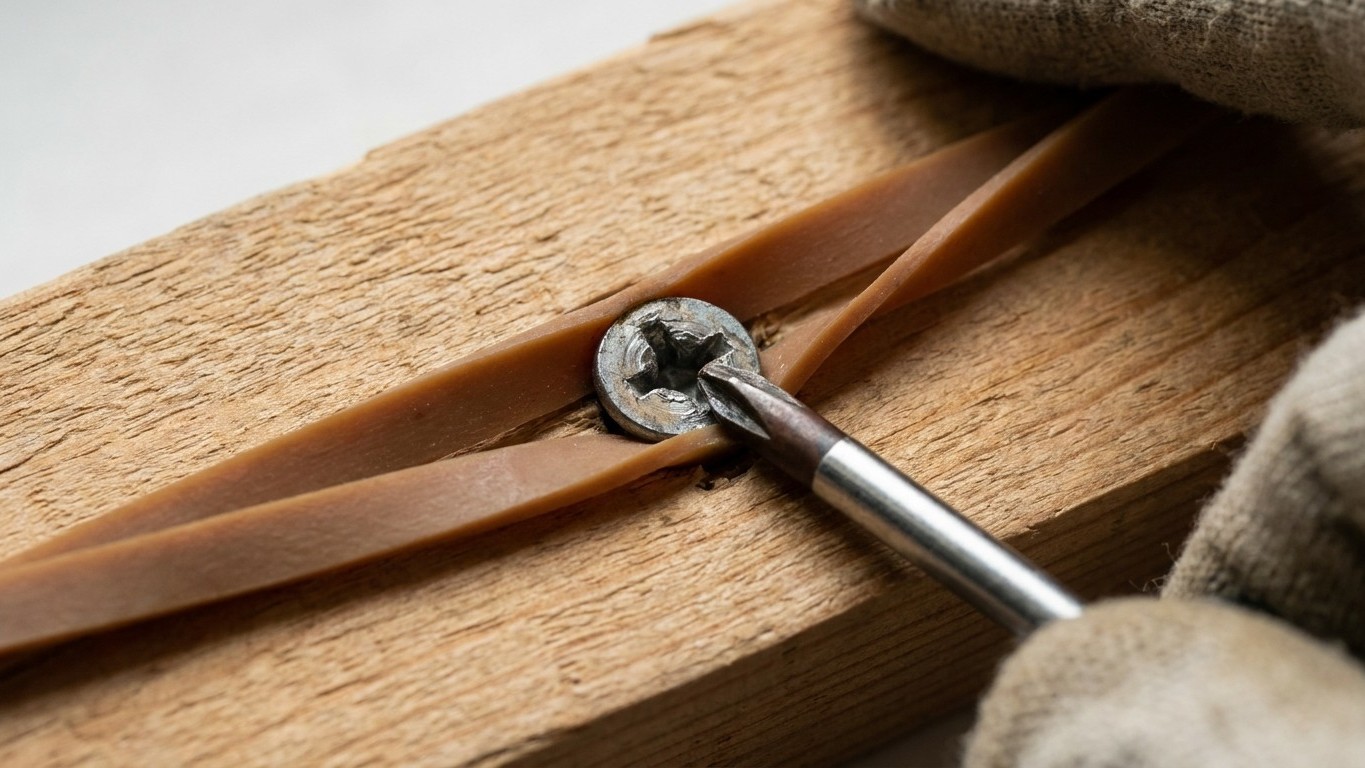
That gummy, useless little crater where a Phillips or Pozidriv recess used to be doesn’t have to mean defeat. Reach into the kitchen drawer, pull out an ordinary rubber band, and you’ve got a genuine fix for a stripped screw head that’s been passed down in workshops long before anyone filmed it for the internet.
The trick itself couldn’t be simpler. Lay a wide rubber band flat over the ruined screw head, then push your screwdriver tip down through it, right into what’s left of the recess, before turning slowly and firmly. Place the rubber band over the screw head, using the driver to push the rubber band into the stripped screw head, then apply firm pressure and turn the screwdriver slowly. No drilling, no special extractor kit, no trip to the hardware shop. Just something that’s probably Sitting in Your stationery drawer right now.
Key takeaways
- A decades-old workshop secret works better than expensive screw extractors, and costs almost nothing
- The physics behind it reveals why rubber succeeds where steel fails—and it has everything to do with friction
- There are clear limits to this hack, and knowing when to stop saves you from wasted effort
Why a bit of stretchy rubber succeeds where steel fails
It sounds almost too daft to work, and I’ll admit my own first reaction was disbelief. But there’s proper physics behind it, not just kitchen folklore. To understand why the trick works, it helps to look at why screws strip in the first place: often it’s a result of using a driver bit that’s slightly too small for the screw head, or applying high torque with cheap, soft metal screws found in budget furniture kits. Once the driver slips, it shears off the internal ridges of the screw head, leaving a smooth, cone-shaped depression that offers zero purchase for the tool. That’s your problem in a nutshell: a driver with nothing left to bite into.
This is where the rubber earns its keep. The rubber band trick introduces a malleable, high-friction medium; when you place a wide rubber band between the driver and the screw head, the pressure forces the rubber into the remaining crevices of the stripped head, which increases the coefficient of friction significantly. Think of it less like a tool and more like a temporary gasket, squeezing itself into every dent and gouge that the original cross-head pattern left behind. A rubber band behaves like a compliant gasket: under pressure it fills the gaps, increasing surface area and friction, with the elastomer deforming into the damaged slots and gripping high and low points that a rigid bit skips over.
There’s a second, less obvious benefit too. Rubber doesn’t just grip, it forgives. Rubber’s high coefficient of friction against steel resists slip, while its shear gives a forgiving cushion that evens out micro-misalignment between driver and head, resulting in less cam-out and more torque transfer at lower speed. In plain terms, that wobble that made the screwdriver skate off the head in the first place gets absorbed by the rubber instead of turning into another skid. I’ve always thought of it a bit like putting on rubber-soled boots on an icy path, rather than smooth leather ones; same effort, far more grip.
Getting the technique right
Not every band in the drawer will do the job. Width and thickness matter more than most people expect, because a thin, narrow band simply shreds under pressure before it’s had a chance to mould into the recess. Select a rubber band that’s wide enough to cover the screw head and thick enough to give it some substance. A chunky postal elastic band, the sort that comes wrapped round bundles of letters, tends to work far better than the thin ones that snap off a bag of spring onions.
Once you’ve got the right band, patience does more work than muscle. Place the rubber band over the screw head, use the driver to push the rubber band into the stripped screw head, apply firm pressure and turn the screwdriver slowly, and if using a power tool, keep the pressure and speed steady. Racing the drill only shreds the rubber before it’s had a chance to bite. If you’re using a manual screwdriver, downward pressure is doing at least half the work here, so press down as if you’re trying to push the screw further in even while turning it out.
Should the first attempt not quite shift it, doubling up the rubber can help with deeper damage. One household tradesman’s tip I came across suggests trying adding two layers of rubber for deeper grooves, which gives the elastomer more material to compress into those worn-out flutes. And if you genuinely haven’t got a rubber band to hand, you’re not stuck. If the screw head isn’t too badly stripped but you don’t have a rubber band, try duct tape as a substitute. Steel wool, oddly enough, works on the same gap-filling principle and is worth remembering for smaller screws.
Knowing when to stop and reach for something else
Honesty Matters More Than false hope here. This trick is marvellous for the everyday flat-pack disaster, the loose cupboard hinge, or the drawer knob that’s given you grief for a fortnight. It is not a miracle cure for every seized fastener in the house. The hack shines with lightly to moderately stripped screws, shallow recesses, and soft metals, but is less effective on deep damage, oily or painted heads, or where torque demand is high, think seized outdoor fixings or automotive assemblies. If you’re battling a rusted hinge bolt that’s been exposed to a decade of British weather, don’t expect a rubber band to perform miracles.
Cleanliness also counts for more than people realise. Grease, dust or old paint sitting in the recess will simply cancel out the extra friction you’re trying to create, so a quick wipe before you start pays off. And there’s one fastener type worth flagging separately: avoid the trick on security screws with spinning collars, since the rubber can’t anchor there. For Everything else within reason, though, this is the kind of small, free bit of household wisdom that saves a trip to the shops and a fair bit of muttering under your breath. Keep a spare band or two tucked in your toolbox rather than leaving it to chance in the kitchen drawer, and you’ll always have this particular rescue ready when a screw decides to fight back.
Sources : usmicroscrew.com | familyhandyman.com