
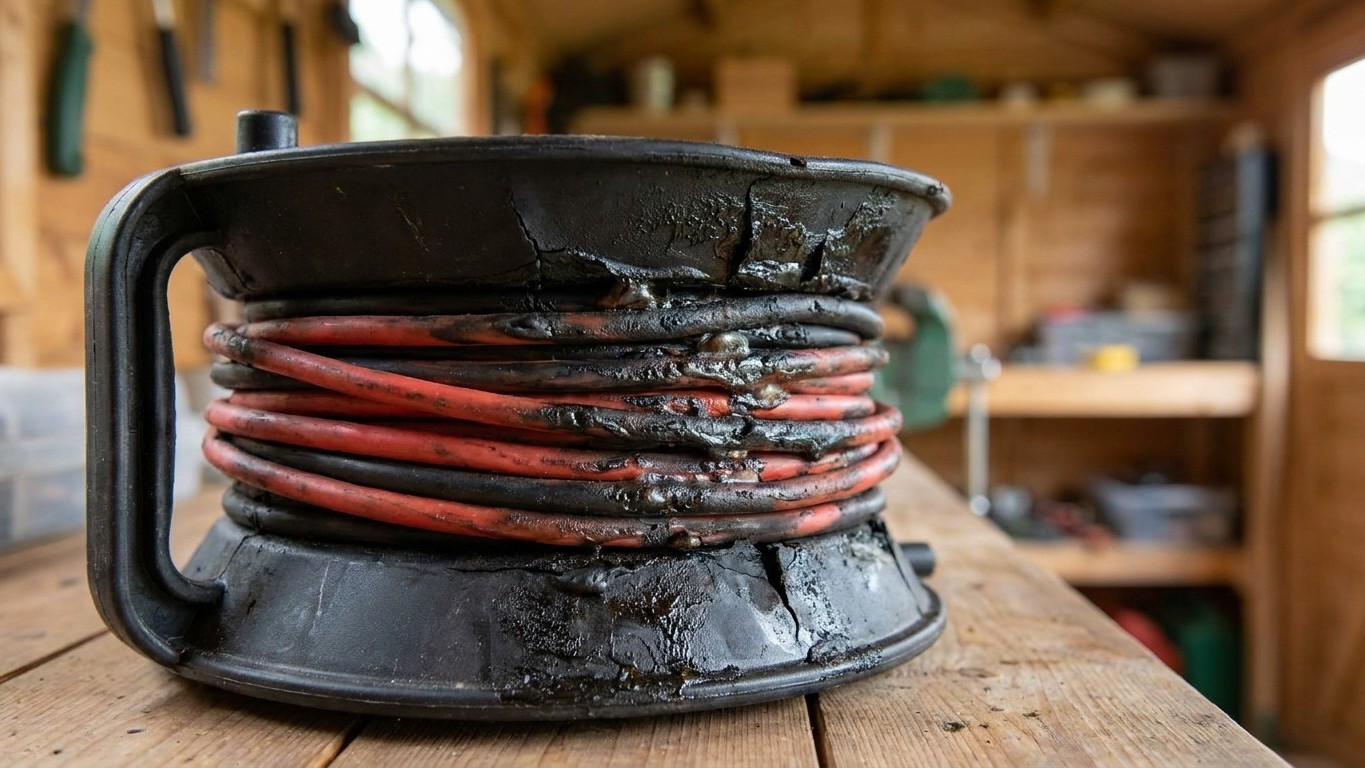
That acrid, slightly sweet smell of hot plastic is PVC insulation starting to give up the fight. Leave a pressure washer running through a cable that’s still wound around its reel and you’re building a miniature heater, one that has no way to lose the warmth it’s generating. Within minutes the outer layers of cable can reach temperatures high enough to soften and fuse together, and the drum itself can blister or warp from the heat trapped inside the coil.
What’s actually happening is simpler than most people assume. Every cable warms up slightly when current passes through it, that’s just physics. Normally this heat drifts off into the air around it. When power flows through an electrical cable, some heat is always generated, but this heat generally dissipates into the air. If the reel is left coiled during use, the heat generated in the cable may not dissipate and can start to build up. Wound tightly around a drum, each loop sits pressed against its neighbour, trapping the warmth with nowhere to go. Layer after layer, the temperature climbs until the plastic sheath starts to soften.
Key takeaways
- A pressure washer drawing full current through a coiled cable can generate dangerous heat in minutes, not hours
- Melted cable insulation creates hidden electrical hazards that make your equipment lethal to touch
- The same reel rated for 3000W unwound might only handle 1000W when coiled—a threefold safety difference most people ignore
Why a coiled cable turns into its own worst enemy
A fire and rescue investigation into a cable reel fire in Dorset laid out exactly how this escalates. If the reel is left coiled during use, the heat generated in the cable may not dissipate and can start to build up. This in turn can melt the outer insulation of the cable and the insulation on the cores. The really nasty part is what happens next. When this happens, as well as the risk of fire, the earth cores and neutral cores become electrically live, and this creates a very serious risk of electrocution for anyone using an appliance fed through the reel. So it isn’t just your drum at risk. Touch a live casing on a “dead” appliance plugged into that same lead and you’re in real trouble.
Electricians talk about “derating” a cable reel, which sounds technical but boils down to a rule of thumb worth remembering: derating the cable when wound on a cable to around 50-55% of its max rating is done because 8A run through a 16A cable wound up won’t get any hotter than 16A when laid out. In plain terms, a reel rated for 16 amps stretched out flat might only be safe for half that current while still coiled. Pressure washers, being thirsty appliances, routinely push well past that safer margin if the cable is left bundled up.
One angle grinder owner learned this the hard way after leaving ten metres of cable wound on the reel. Being lazy, they left about 10 metres on the reel, thinking it’s only a small current, should be fine, within 15 minutes I saw smoke coming from the extension reel. The result was a cable so badly melted that after unplugging, they tried to unreel but the cable had melted, welding the coils together. A pressure washer, drawing considerably more current than a small grinder, will get there faster.
Pressure washers push cables harder than most garden tools
Domestic pressure washers sit among the hungriest kit in the shed. A standard UK plug and socket combination is limited to 13A x 240V = 3,120W, which is the absolute maximum your lead can support. Many pressure washers, especially the more powerful models, draw a substantial chunk of that limit on their own, leaving very little headroom if the cable is also fighting to shed heat from being coiled.
Cable reels sold with a thermal cut-out often carry two separate ratings depending on whether they’re wound or not, and the gap between them is stark. One typical 25 metre reel with 1.5mm² cable is rated at just 1000W / 230V when fully wound, 3000W / 230V when fully unwound. That’s a threefold difference simply down to whether you bothered to pull the cable off the drum. Plug a 1800W or 2000W pressure washer into a reel like that while it’s still coiled and you’ve already exceeded the safe limit before the trigger’s even pulled.
Cable thickness matters too. Thinner cable has more electrical resistance, which generates more heat for the same current. The high current draw, combined with high resistance from thin 1mm or 1.25mm wire, causes the extension cable and plug to get very warm or hot. Manufacturers generally recommend keeping runs of thinner cable fairly short for anything power-hungry, and flexible 1.25mm² cables should not generally exceed 12 metres in length when used for high-power tools.
Making your cable reel safe again
None of this means abandoning the reel altogether, it’s still the tidiest way to store a long cable. It just needs treating with a bit more respect than most of us give it. A few habits make all the difference:
- Unwind the entire cable before switching anything on, even if you only need a few metres of reach.
- Check the cable’s rating against your pressure washer’s power draw, printed on the machine’s rating plate.
- Fit a Residual Current Device (RCD) between the socket and the lead. It constantly monitors the electrical current and cuts the power in under 40 milliseconds if it detects a fault, such as you accidentally cutting the cable.
- Inspect the cable regularly for cracking, discolouration or a slightly tacky feel to the plastic, all signs of heat damage already done.
Position matters as well. Cable left baking in direct summer sun starts the day already warmer than it should be, giving it far less headroom before it overheats under load. Cables left in direct sunlight or wound up on a reel can overheat, so always fully unwind cable reels before use and ensure they are suitable for the equipment you’re using. Keep the reel in shade if you can, and let it lie flat rather than looped in tight bundles even once unwound, since bundled loops still trap some warmth compared with cable laid out straight.
If your reel has already suffered the fate mine did, with cable that’s gone stiff, slightly bubbled or fused together at any point, don’t try to nurse it along for one more job. Once the insulation has been compromised by heat, it doesn’t recover, and the earth core issue mentioned by fire investigators means a reel that looks fine on the outside can still be dangerously live on the inside. A replacement reel costs a great deal less than the excess on a house insurance claim, and considerably less than a trip to A&E.
Sources : dwfire.org.uk | directhoses.net