
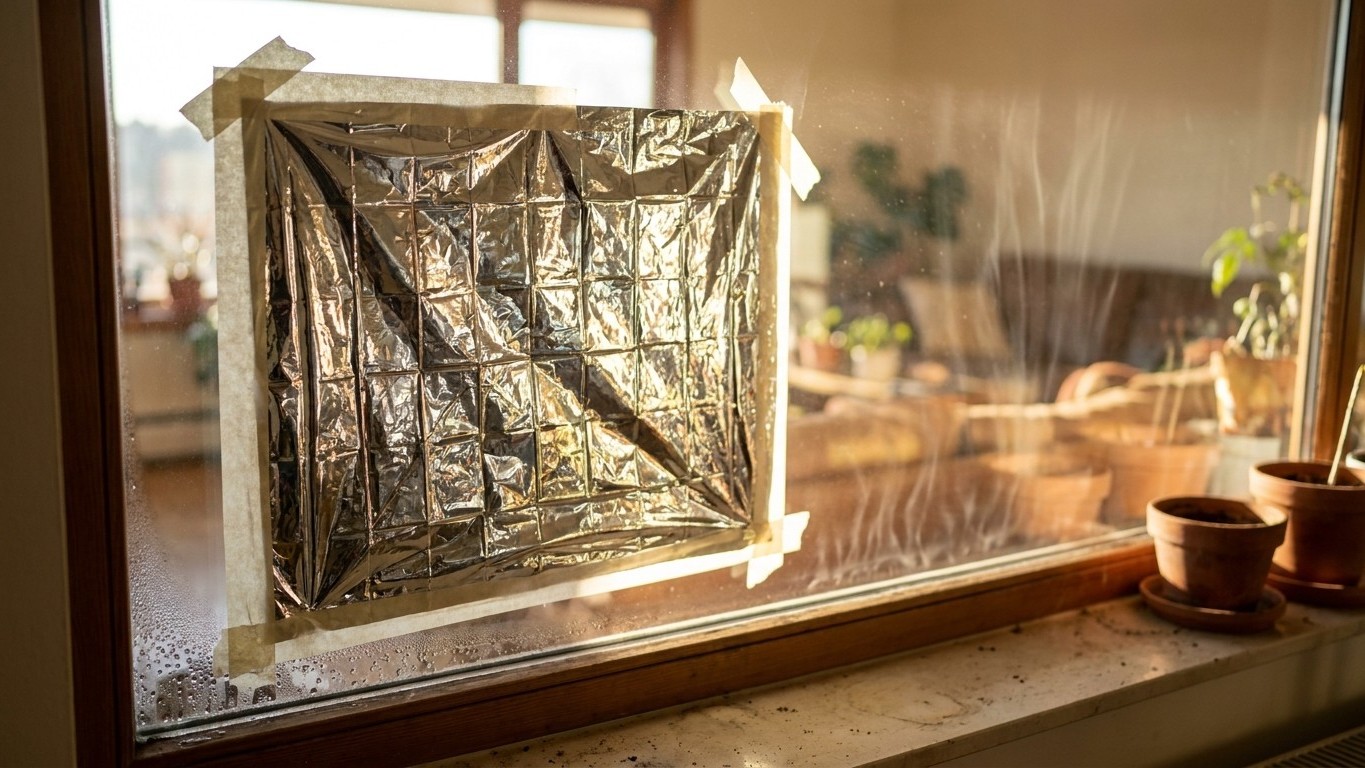
Reflective foil sheets like that shiny orange-and-silver survival blanket really can trap heat brilliantly, which is exactly the trouble. Tape one across a sunny window with the metallic side facing into the room, expecting a cosy afternoon, and you may find yourself opening every window in the house by half past three, wondering why your “insulation” has turned the lounge into a proper hothouse.
This is precisely what caught me out, and it’s a mix-up I hear about often enough from readers that it’s worth untangling properly. The blanket does exactly what it’s designed to do. The problem is that most people, myself included on that particular afternoon, use it the wrong way round for the season.
Key takeaways
- A single orientation mistake can transform a heat-saving tool into a room-warming trap in hours
- The silver side’s reflectivity changes everything—but only if you know which way to point it
- One reader’s uncomfortable discovery reveals the hidden mechanism that manufacturers intentionally engineer into these blankets
Why the shiny side matters more than you’d think
A survival blanket isn’t just a shiny bit of plastic. It’s a thin metallised film, usually with one face far more reflective than the other. Testing by outdoor gear reviewers has shown that the silver side is much lower emissivity than the coloured side, and the difference isn’t small: measured emissivity of the coloured side comes in around 0.64, against just 0.13 for the silver. In plain English, the silver face is the one that bounces infrared heat straight back where it came from, while the coloured face absorbs a good deal more of it.
That’s why manufacturers give you two completely different instructions depending on what you’re trying to achieve. To keep a body warm, the guidance is clear: with the red side facing out, the survival blanket captures the sun’s infrared rays to warm up the rescue victim, while the silver side reflects 90% of their body heat back inward. But flip your goal round, and the advice flips with it. To prevent overheating, you put the coloured side against the body to let heat escape and the silver-coloured side facing out to reflect the sun’s infrared rays away before they ever get absorbed. Same blanket, opposite orientation, entirely different outcome.
On a window, the glass plays the role of your skin. Face the silver inward and you’re telling the whole system to hold onto whatever heat gets in. Face it outward and you’re telling it to bounce that heat straight back outside before it settles.
Why my afternoon turned into a sauna
Household prepping sites do recommend using emergency blankets on windows precisely because they work both ways depending on the season. You can put blankets on the inside of your windows in the summer to help blackout the windows and keep heat out, and in winter, taping the blanket over the window sill helps trap air and adds a layer of insulation that keeps heat in, plus the blanket can reflect heat back into the home. Notice the distinction buried in there: for summer, the point is keeping heat out; for winter, it’s reflecting heat back in. Two very different jobs.
My mistake was straightforward. I’d set the blanket up as though preparing for a frosty February, silver facing the room, on a west-facing window in the middle of a warm July spell. Through the morning, nothing seemed amiss. But by mid-afternoon, as the sun swung round and hit that glass directly, the coloured outer face soaked up every bit of radiant heat pouring through, and the silver layer behind it dutifully bounced that heat straight back into the room instead of letting any of it escape. The air trapped in the gap between glass and foil had nowhere to go. It just kept climbing.
There’s a second sting in this particular tail, too. Reflective installations create a sealed pocket of air against the glass, and if that pocket gets warm and humid with nowhere to ventilate, you’re setting the stage for condensation. Building specialists note that an unfortunate side effect of a well-sealed home is condensation forming on the inside of window glass, which can also lead to mould growth, and the basic mechanism is simple: when warm, moist air meets cold window glass, water droplets form on the surface. Even manufacturers of these blankets acknowledge the airflow issue for body use, advising to remember to let some air through for ventilation. Tape a foil sheet flush against a window with no gap for air movement, and you’ve built a miniature greenhouse with a damp problem waiting in the wings once temperatures swing back down at night.
Getting the orientation right, season by season
The fix costs nothing but five minutes of thought before you reach for the tape. In the cold months, when the goal is to stop your radiator’s hard work escaping through the glass, face the silver side into the room. This mirrors the classic hypothermia-blanket setup, where the silver side facing inwards is used to retain heat during a long stay in a cold environment, and reflecting 90% of the warmth back when the silver side faces in is genuinely useful against a draughty single-glazed pane. Leave a small air gap of a couple of centimetres between the foil and the glass rather than sticking it flat, since that trapped layer of still air behaves a little like an extra pane of glazing.
Come summer, on any window that gets a proper baking from direct sun, turn the whole thing round: place the silver side outward to reflect the sun’s rays and let heat escape rather than build up. This is the same principle behind those fold-out silver windscreen shades you see propped in car windows on hot days, and it works for the very same reason. Crack the window open an inch behind the foil if you can, so any heat that does creep through has somewhere to go rather than stewing behind your carefully taped sheet.
A cheap roll of these blankets runs to a few pounds and covers several windows, so there’s no harm in testing your set-up on one room before committing the whole house. Check it again after a few hours of proper sun, not just at breakfast when the light is still low and gentle. That’s the real lesson from my sweltering afternoon: it’s not the blanket that lets you down, it’s judging the result too early, before the sun has had its say.
Sources : adventuremedicalkits.com | hunker.com