
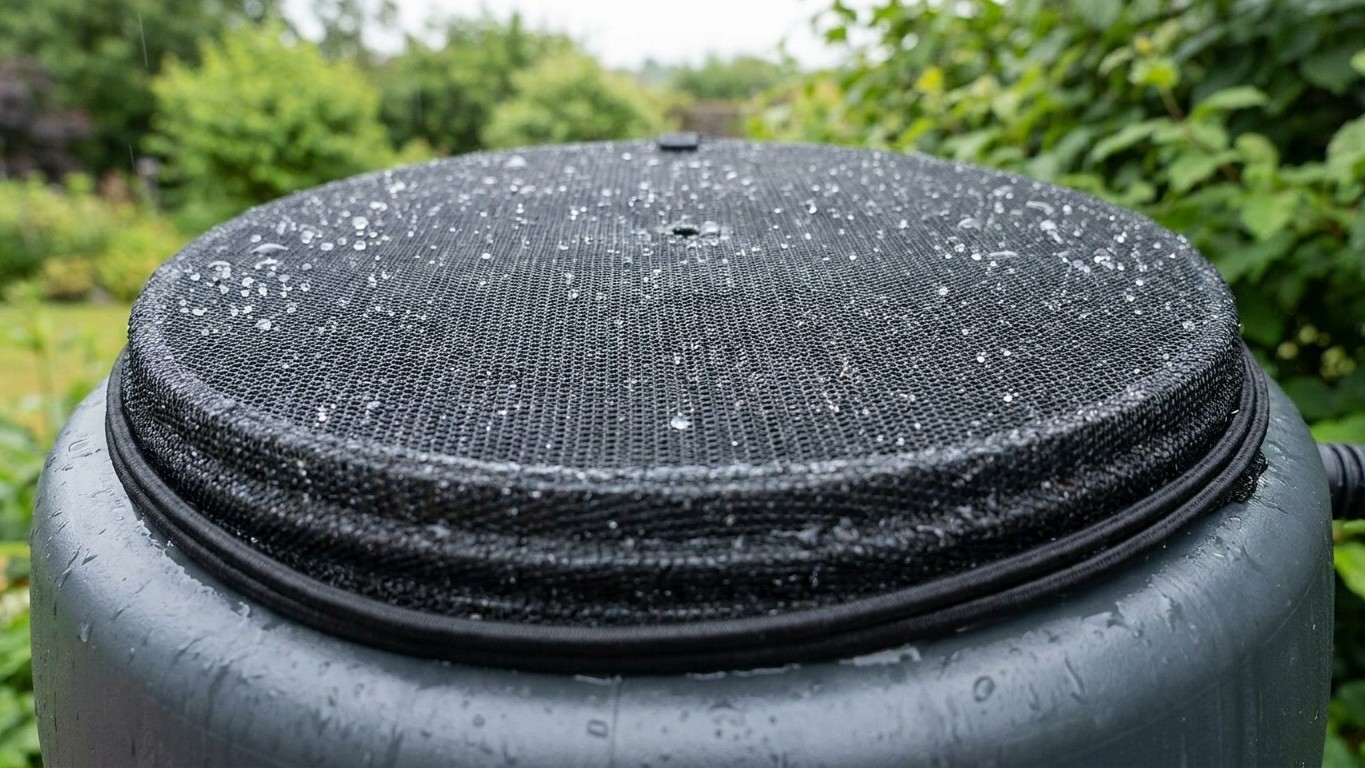
A square of fine mesh clipped over the inlet does more than stop leaves clogging the tap. Mosquitoes need still, open water to lay their eggs, and once you deny them access to the surface, the whole breeding cycle simply cannot start. That little wriggling drama that used to play out in the murky green water every June and July just stops.
The reasoning is simpler than it sounds. A female mosquito lands on the water, dips her abdomen, and releases a raft of eggs that float until they hatch into larvae, those familiar “wrigglers” that hang below the surface and breathe through a tube at their tail end. Cover the water so she cannot land, and there is nothing to lay. No standard fly screen will do this properly, mind: large-mesh screens and perforated tops will not keep mosquitoes out because the openings are way too big to prevent mosquito breeding. A 1 mm weave is fine enough to bar an adult mosquito from squeezing through, yet open enough to let rainwater pass straight in off the downpipe or roof gutter.
Key takeaways
- One tiny barrier stops an entire breeding cycle—but only if the mesh is the right size
- Leaves were never really the problem; it’s about denying mosquitoes the still water they need to lay eggs
- British health officials have been quietly recommending this for years, but nobody talks about it
Why leaves were never really the point
Most gardeners fit mesh purely to stop debris fouling the water, and that job matters too. Decaying leaves feed algae and give mosquito larvae something to graze on, since the resulting hatching larvae are solely aquatic and feed on floating algae and detritus. Strip out the leaf litter and you starve any larvae that do get in, but you also keep the water clearer and less smelly, which was probably your original goal anyway.
British health guidance has been saying much the same thing for years, though usually about the butt’s lid rather than a mesh screen. Public health advice on garden mosquito control notes plainly that mosquitoes often breed in water butts, and a well fitted lid will help to stop mosquitoes breeding in these containers. The trouble, as any allotment holder will tell you, is that most butts simply don’t fit that snugly, and mosquitoes often find their way in even with fairly well fitted lids. A loose-fitting lid still leaves gaps around the inlet pipe, the overflow, or the tap housing, and that is exactly where a determined female mosquito will squeeze through. A taut piece of mesh fixed directly over the inlet, held with a cable tie or a stretchy bungee cord, closes that particular gap far more reliably than a wobbly plastic lid ever could.
What size mesh actually works
There is a bit of science behind the 1 mm figure, and it is worth knowing so you don’t buy something too coarse by mistake. Guidance aimed at rain barrel owners recommends screening intakes with standard window screen with 18 to 20 holes per inch, tight enough to block adult mosquitoes from reaching the water to lay eggs while still allowing rainwater to flow through. That works out to gaps of roughly 1 mm or a touch under, which lines up nicely with what you have found in practice. Some official mosquito-control advice pitches slightly finer, suggesting screens made of fine mesh with holes smaller than 1.2mm to keep mosquitoes out, so anything in that ballpark should do the trick.
Where people sometimes come unstuck is fitting a single flimsy layer that sags in the middle after a downpour, creating a dip where water pools on top rather than draining through. American vector control officers who deal with this daily recommend going a step further and using a double layer of fine mesh window screen over any intake, with an air gap so that water must pass through the screen of the intake opening rather than a hose or downpipe feeding straight through it. You don’t need to go that far for an ordinary garden butt, but do keep the mesh taut and check it after storms, since a torn corner undoes the whole job.
The rest of the garden still needs watching
Sorting the water butt is genuinely the biggest single win, since it is usually the largest body of standing water on a plot, but mosquitoes are opportunists and will happily use far smaller puddles instead. Health officials point out that as little as a cupful of standing water is enough for hundreds of eggs to hatch, so it’s worth doing a quick weekly circuit of the garden. Tip out birdbaths and refill with fresh water regularly, turn wheelbarrows and buckets upside down when not in use, and clear any leaf debris that collects in gutters or flat roofs, since these all provide exactly the still water mosquitoes are looking for.
If you already had a mosquito problem before fitting the mesh, don’t expect it to vanish overnight; anything already laid as an egg or hatched as a larva will still complete its life cycle in the water already sitting in the butt. A traditional trick still recommended by gardening writers, if you want to deal with an existing infestation while the mesh handles future arrivals, is to float a thin skin of vegetable oil on the surface, since it stops any surviving larvae breathing and kills them off within a day or two without harming the water for plants. Combine that one-off treatment with your new mesh screen and you’ve covered both the immediate problem and the ongoing prevention, which is really the whole trick to it.
Sources : essentialhomeandgarden.com | sgvmosquito.org