
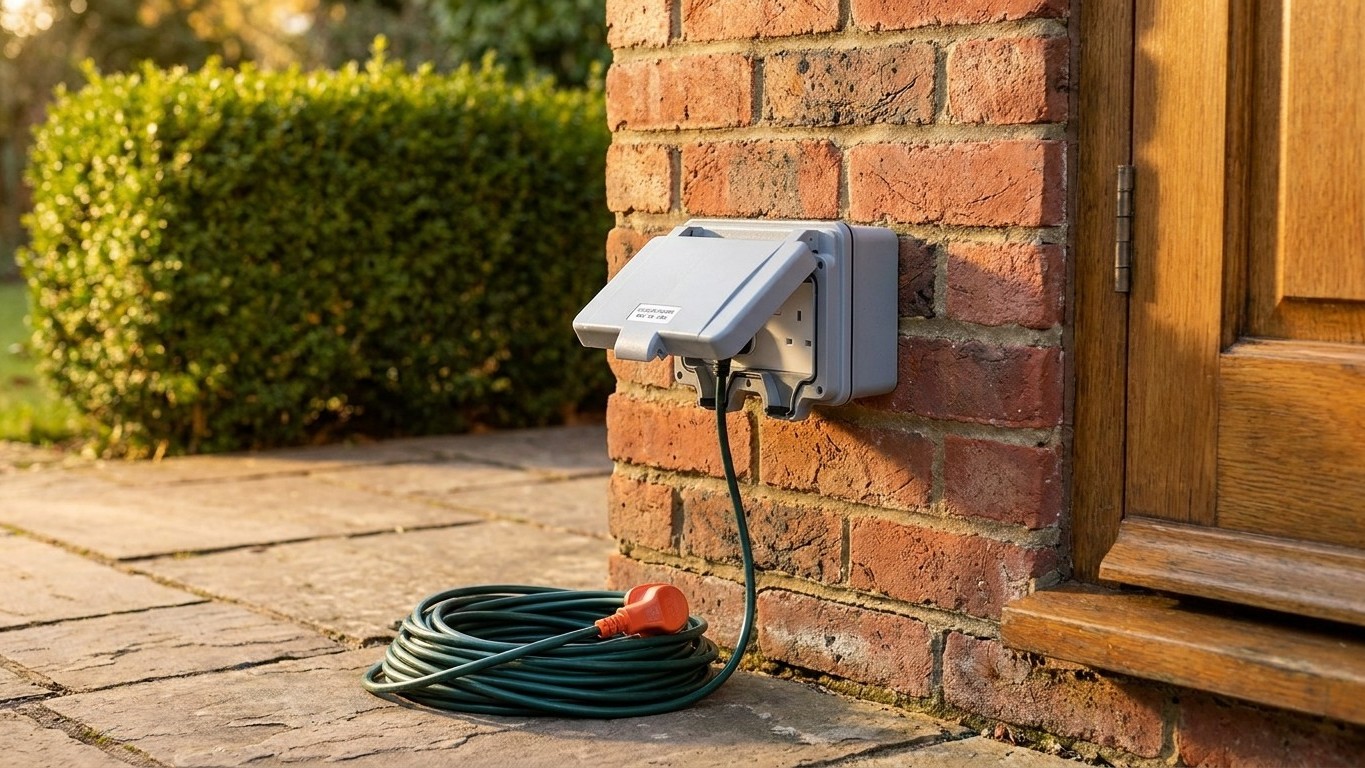
That little weatherproof socket by my back door cost me an afternoon, a trip to the hardware shop, and about £15 in parts. Two years on, it very nearly cost me the sale of my house, because the certificate that was supposed to sit in my paperwork folder simply didn’t exist. I hadn’t broken any laws through malice, just through not knowing that plugging in some fairy lights outdoors is treated very differently to plugging in a toaster indoors.
The socket itself worked perfectly. Rain came and went, the RCD tripped exactly when it should during one soggy November, and I plugged in solar-adjacent string lights and a hedge trimmer without a single spark of drama. What I hadn’t grasped was that the moment you run a new cable outside to feed that socket, you’ve stepped into a different regulatory world entirely, one that has nothing to do with whether the wiring actually works and everything to do with whether it was ever officially signed off.
Key takeaways
- A perfectly working garden socket became a legal problem because no one officially signed it off
- Outdoor electrical work follows completely different rules than indoor—even though the wiring itself was safe
- Missing the right certificate can stall a property sale and create panic during conveyancing
Why outdoor sockets play by stricter rules
Indoors, swapping a socket or adding one to an existing ring circuit in most rooms is something you can legally do yourself, wire it neatly, screw it in, done. Outdoors is a different story. In England, an extra socket added in a kitchen or garden via a spur is no longer notifiable, but a new circuit to supply it always is. That distinction is the whole crux of my near-disaster: I hadn’t tapped into an existing circuit, I’d run a fresh cable from the consumer unit out through the wall, which tips the job straight into notifiable territory.
A new outdoor mains circuit is notifiable work under Part P of the Building Regulations, and in Wales, all outdoor electrical work is notifiable, full stop, no exceptions for spurs or existing circuits. There’s sound reasoning behind the fuss. Outdoor installations are exposed to harsher conditions than indoor wiring, and the consequences of a fault, particularly electric shock, can be more severe when people are in contact with the ground. Standing on wet grass while fumbling with a plug is precisely the scenario the regulations were written to guard against.
There are technical standards too, and I’m rather glad my socket happened to meet them by luck rather than judgement. Outdoor socket outlets must be housed in an enclosure rated at least IP66, protected against powerful water jets and dust ingress, and the socket must also be RCD protected with a 30mA device. Mine ticked those boxes because the box I bought at the shop happened to be sold as garden-rated, but I couldn’t have told you the IP rating meant anything at the time. I just wanted something that wouldn’t rust shut by spring.
What the surveyor actually flagged
The surveyor wasn’t fussed about whether the lights worked. He asked, quite reasonably, for the Electrical Installation Certificate covering the new outdoor circuit, the document an electrician or building control issues once notifiable work has been tested and signed off. I had no such certificate, because I’d never notified anyone that the work had happened at all. My buyer’s solicitor then flagged it as a compliance gap, the sort of thing that can quietly stall a chain while everyone works out what to do next.
Missing an Electrical Installation Certificate doesn’t stop you selling your home outright, but it will likely cause delays in the conveyancing process, and delays are exactly what nobody wants when a chain is waiting on you. Part P itself has been around since it was introduced on 1 January 2005 in England and Wales, so this isn’t some obscure new rule catching people out, it’s simply one that DIY enthusiasts like me rarely stumble across until a sale forces the issue.
Sorting it out without losing the sale
Once I knew what the gap actually was, fixing it turned out to be far less dramatic than the panic suggested. There are essentially three routes people in my situation take, and my solicitor talked me through each.
- Ask a registered electrician to inspect the work and issue certification retrospectively, though if the work was not certified at the time, the electrician who did it should ideally certify it, and although work should technically have been certified within 30 days, retrospective certification is still generally acceptable in practice, provided that original electrician can be traced. Since I’d done the work myself, this route wasn’t open to me directly.
- Book a Part P registered electrician to carry out an Electrical Installation Condition Report, since an EICR is a narrower kind of survey reviewing the state of an electrical installation, and the local authority may accept it for compliance purposes in place of a full certificate. This was the option I ended up taking, mostly because it also gave me peace of mind about the rest of the house’s wiring.
- Take out indemnity insurance, since an indemnity policy works rather like an insurance policy and protects the buyer from any costs that may arise due to the missing certificate, though it doesn’t check or warranty the safety of the electrics itself.
In the end I paid for an EICR, which came to a modest sum, and my solicitor confirmed to the buyer’s side that the electrics had been properly assessed. The whole business added perhaps two weeks to completion, nothing compared to the months the sale could have lost had we let it drift unresolved. Indemnity policies, for what it’s worth, tend to be genuinely cheap, often just a couple of hundred pounds arranged through your solicitor and electrician, which is a small price for smoothing over paperwork you can’t retrospectively conjure up any other way.
If you’re planning any outdoor electrical job this autumn, the one thing worth doing before you even pick up a screwdriver is ringing a local electrician registered with a competent person scheme and simply asking whether your particular job counts as a new circuit. That five-minute phone call is the difference between a folder full of proper paperwork and a very awkward conversation with a surveyor two years down the line, garden lights glowing away merrily the whole time, blissfully unaware of the fuss they’ve caused.
Sources : pmms.org.uk | trade2base.com