
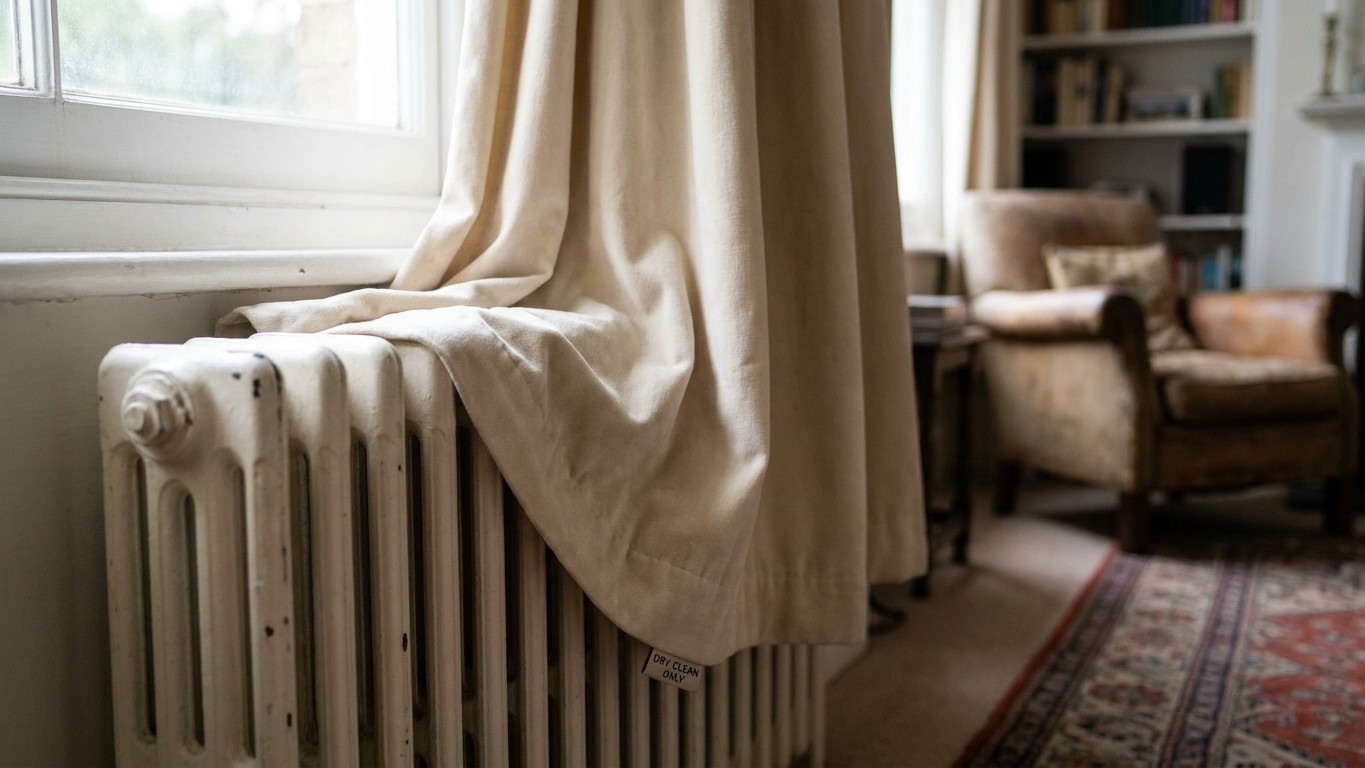
Radiators tucked behind heavy curtains are one of the most overlooked reasons a single room refuses to warm up while the rest of the house feels perfectly toasty. The boiler is doing its job; the hot water is reaching the pipes just fine. What’s happening is that the curtain has turned your radiator into a private sauna for itself, and none of that warmth is making it out into the room where you’re sitting with cold feet.
Key takeaways
- Your radiator could be reaching 40°C behind the curtain while your room stays cold
- Half the heat your radiator produces goes backward into the wall, not into your room
- The solution costs almost nothing and doesn’t require new curtains or a heating engineer
How a curtain quietly hijacks your heating
Radiators don’t really “heat” a room the way a fire does. The radiator draws in cool air from the floor, heats this air using the hot water circulating inside it, and this newly warmed air rises towards the ceiling, pushing cooler air down to be heated in a continuous cycle. That cycle only works if the warm air has somewhere to go. Hang a long curtain in front of the radiator and, in effect, you’ve created a barrier right where the air needs to escape.
Instead of spreading through the room, the hot air gets trapped, funnelled up towards the window, the coldest part of the wall, and lost to the outside. You end up with a peculiar little pocket behind the fabric that can climb surprisingly high, while your sofa, your reading chair and the rest of the room stay stubbornly chilly. One radiator manufacturer’s testing found the air gap between an old cast iron radiator and the curtain can reach around 40°C even though the room itself never gets close to that. If you’ve ever pressed your hand against a radiator that’s blazing hot while the room feels no warmer than a shed, this is very likely why.
It isn’t just the curtains at fault, either. Radiators are almost always fixed under windows, which happens to be the single leakiest part of most British walls. The Energy Saving Trust estimates that around eighteen percent of heat loss in the average home happens through windows, so you’ve got a radiator working hardest right next to the spot where warmth escapes fastest, then a curtain sealing that heat into a dead zone rather than letting it drift into the room. Add a slightly draughty window frame and you’ve got the perfect recipe for one cold room in an otherwise warm house.
The wall is in on it too
Curtains aren’t the only culprit standing between your radiator and a warm room. A good portion of the heat a radiator produces goes backwards, straight into the wall, before it ever reaches you. Radiators can pump around half of their output into the wall they’re hanging on, which seems a waste when your heating system is working that hard just to warm bricks. On an older, uninsulated external wall, much of that warmth then carries straight on through to the outside air, which is exactly the kind of wall you’ll typically find behind a curtained window in a period house.
This isn’t just anecdotal. Research measuring plain aluminium foil placed behind a radiator recorded reductions in overall room energy consumption of up to 6%, with heat loss through the wall behind the radiator falling to less than 30% of the original value. In a typical small bedroom or sitting room, that translated to a modest but real saving over a UK winter. Reflector foil works by bouncing radiant heat back towards you rather than letting the wall soak it up like a sponge, and it costs only a few pounds for a roll from most hardware shops. It’s not magic, and it won’t transform a freezing room into a hothouse, but combined with sorting out the curtains, it closes off a second route by which that one room is losing its warmth.
Fixing it without buying new curtains
The good news is that none of this requires new curtains, a new radiator, or a call to a heating engineer. The fixes are almost embarrassingly simple, and most cost nothing at all.
- Open your curtains, or tuck them behind the radiator onto the windowsill, whenever the heating is actually running, then close them again once it switches off for the evening.
- If your curtains puddle onto the floor or drape right over the radiator casing, have them shortened, or fit a curtain track that finishes just above the sill rather than a full-length pole.
- Slide a slim reflector panel or heavy-duty foil between the radiator and the wall, leaving a small air gap rather than pressing it flat.
- Fit draught strips around the window frame itself, since small gaps around window frames let cold air in and warm air escape, creating uneven temperatures that make rooms feel colder than they should.
There’s a slightly counterintuitive timing point worth knowing here, too. During the day, while the heating is on, curtains over a radiator are working against you. But once your heating has switched off for the night, closing those same curtains becomes genuinely useful, because at night heat escapes through windows by radiation, and curtains absorb and slow this process, reducing the amount of warmth lost while you sleep. So the trick isn’t to banish curtains altogether, it’s to open them while the radiator’s working and shut them once it’s resting, letting each do its proper job rather than fighting each other.
Older cast iron radiators suffer from this curtain trap noticeably more than modern flat panel ones, simply because they rely more heavily on radiant heat rather than convection, and a thick curtain blocks radiant heat almost completely while only partially interrupting airflow. If you’ve got a Victorian terrace with the original cast iron radiators still fitted under the front bay window, that’s usually the exact room where visitors complain of a chill, whatever the thermostat says.
Sources : livingetc.com | bzradiator.com