
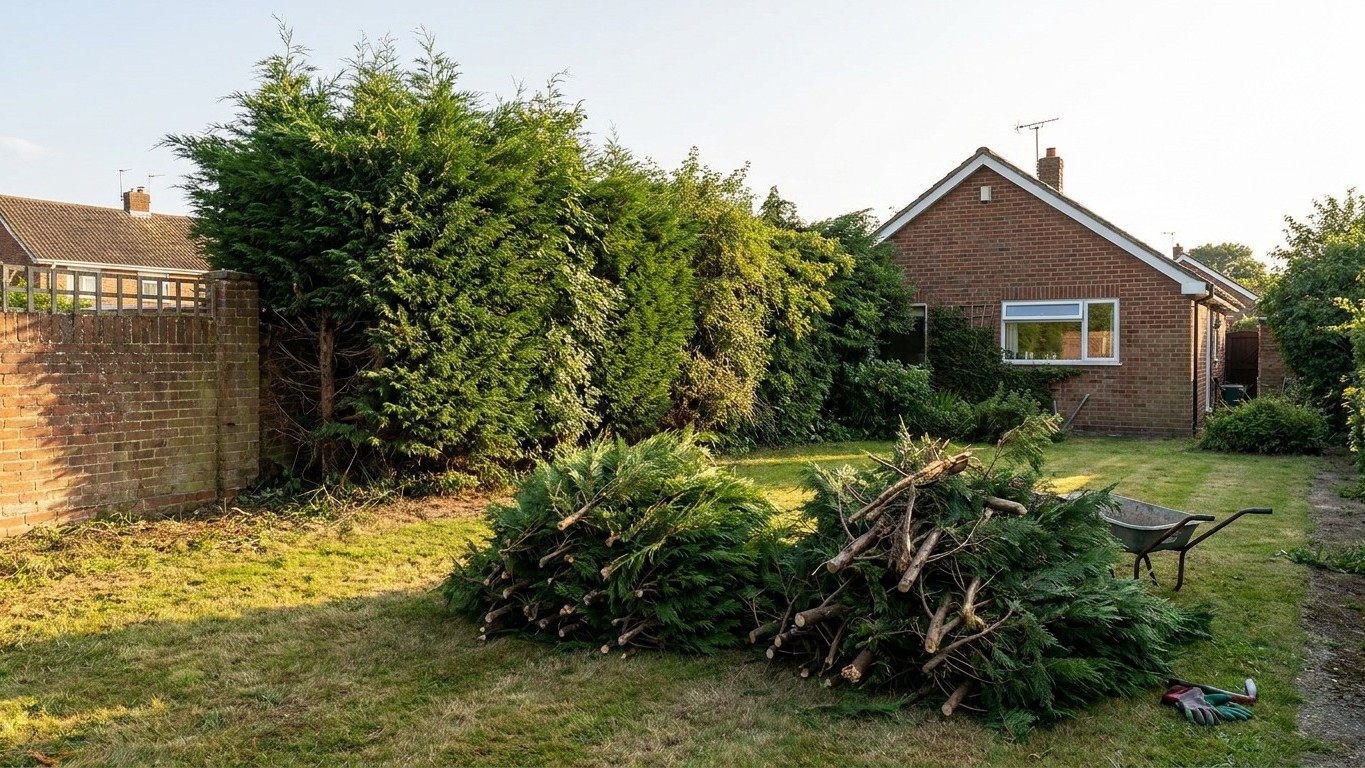
You were within your rights to reach for the loppers. Any homeowner in England or Wales can cut back a neighbour’s overhanging branches to the fence line without asking permission first, and that includes a leylandii hedge that’s marching into your kitchen window. What almost nobody realises, until a council lorry drives past their carefully bagged trimmings, is that the branches you just cut are still not yours. You can cut back branches that overhang your property, but only up to the exact boundary line, under a right called “abatement” that lets you remove the nuisance without needing permission from the tree owner. Once the branches have been cut, they legally remain the property of the tree owner. That peculiar bit of common law is exactly why your green bin came back untouched.
Key takeaways
- You can trim overhanging branches without permission, but only to your property boundary
- The cut branches legally remain your neighbor’s property—a detail that catches most people out
- Your green bin was refused because councils won’t accept large woody branches, creating an awkward situation
Your right to cut, and where it stops
Leylandii disputes are so common in Britain that they’ve practically earned their own chapter in neighbourly folklore, and for good reason. Over a million householders each year suffer damage to their property or experience an accident caused by a neighbour’s trees and hedges. The law that lets you fight back is centuries old and refreshingly simple in principle: you can trim any overhanging branches that encroach from a neighbour’s tree over your garden, but only up to the boundary of your property and no further, under what’s called ‘the right to abate nuisance’. No letter, no permission slip, no waiting for the council.
But there are real teeth to the limits. You must stay on your own property and are not legally allowed to enter your neighbour’s garden without permission, even if cutting from their side would be easier and safer. Lean a ladder over the fence to get a cleaner angle and you’ve stepped from lawful self-help into trespass. You’re also not allowed to reshape the thing to suit your taste. You cannot chop the top off their tree just to get more sunlight; you only have rights over the side branches crossing into your space. If the hedge dies because you’ve hacked into old wood past the green growth (a classic leylandii mistake, since the brown inner branches rarely reshoot), your neighbour can sue you for property damage. Worth remembering, too, that most hedge cutting between March and August risks disturbing nesting birds under the Wildlife and Countryside Act, so a well-timed job in fresh autumn air is usually the kinder, safer choice all round.
Whose branches are they, really?
Here’s the part that catches almost everyone out, and it’s the whole reason your bin day went sideways. Severing a branch doesn’t transfer ownership of it to you, however much sawdust and sweat you’ve put in. The cuttings legally belong to the hedge owner, and strictly you should offer them back rather than simply dumping them. If part of a leylandii hedge grows over the boundary, you have the right to cut it back, but anything you cut remains the neighbour’s property, so it’s best to check what they want done with the trimmings rather than throwing them back over the fence. Most people, understandably, skip this formality for a handful of twigs. But three days’ worth of hard cutback from a hedge that’s clearly been left to run wild for years isn’t a handful. It’s a legal grey area with your name on the sack.
Why the bin men turned it away
This is where the council’s rulebook and the old common law rule collide, quite by accident. Garden waste schemes across the country are strict about what goes into a brown or green bin, mostly because of what happens to it afterwards, it gets composted, and anything too woody or too large simply won’t break down properly on the timescale the processing plant needs. Different councils draw the line in different places: Gateshead accepts hedge trimmings and small branches and twigs under 5cm in diameter, while Hartlepool’s scheme takes shrub and hedge trimmings but not large branches greater than 7cm in diameter, and Ealing’s collection excludes branches altogether, along with tree trunks, stumps or logs larger than 15cm across. A leylandii that’s been left unchecked for a decade doesn’t produce neat little twigs. It produces thick, woody limbs, and those are precisely the sort of thing that gets a bin flagged and left at the kerb.
It doesn’t stop at size, either. Contaminated garden waste bins, meaning bins containing incorrect materials, simply won’t be emptied, and it’s the householder’s responsibility to remove the offending items before the next collection. Overfill it and the same thing happens: bins that are overflowing or overweight will not be emptied. None of this is really about who the branches belonged to in a legal sense, the binmen aren’t reading property law on your doorstep. But the timing has a funny way of teaching the same lesson. The bin refusal forces you to stand in your garden looking at a heap of someone else’s hedge, wondering what on earth you’re meant to do with it now.
What to do instead, this time and next
Stack the trimmings neatly on your own side of the fence rather than piling them against it, and let your neighbour know they’re there, ideally with a friendly knock rather than a note through the letterbox. Popping round and talking to them face-to-face, if possible, tends to smooth things over far more than any legal letter. If they don’t want them, most household waste recycling centres will take garden cuttings free of charge, and that’s usually a faster route than gambling on a second bin collection. For a hedge that’s genuinely got out of hand, over two metres tall and properly blocking your light, there’s a formal complaints route too: the high hedges legislation under Part 8 of the Anti-social Behaviour Act 2003 can help once you’ve shown you’ve tried talking it through first. It costs a modest council fee to open a case, far less than a solicitor’s letter, and it’s there precisely for kitchens like yours that have been sitting in shadow for years while the hedge next door quietly claimed the daylight as its own.
Sources : forbestreecare.com | justanswer.com