
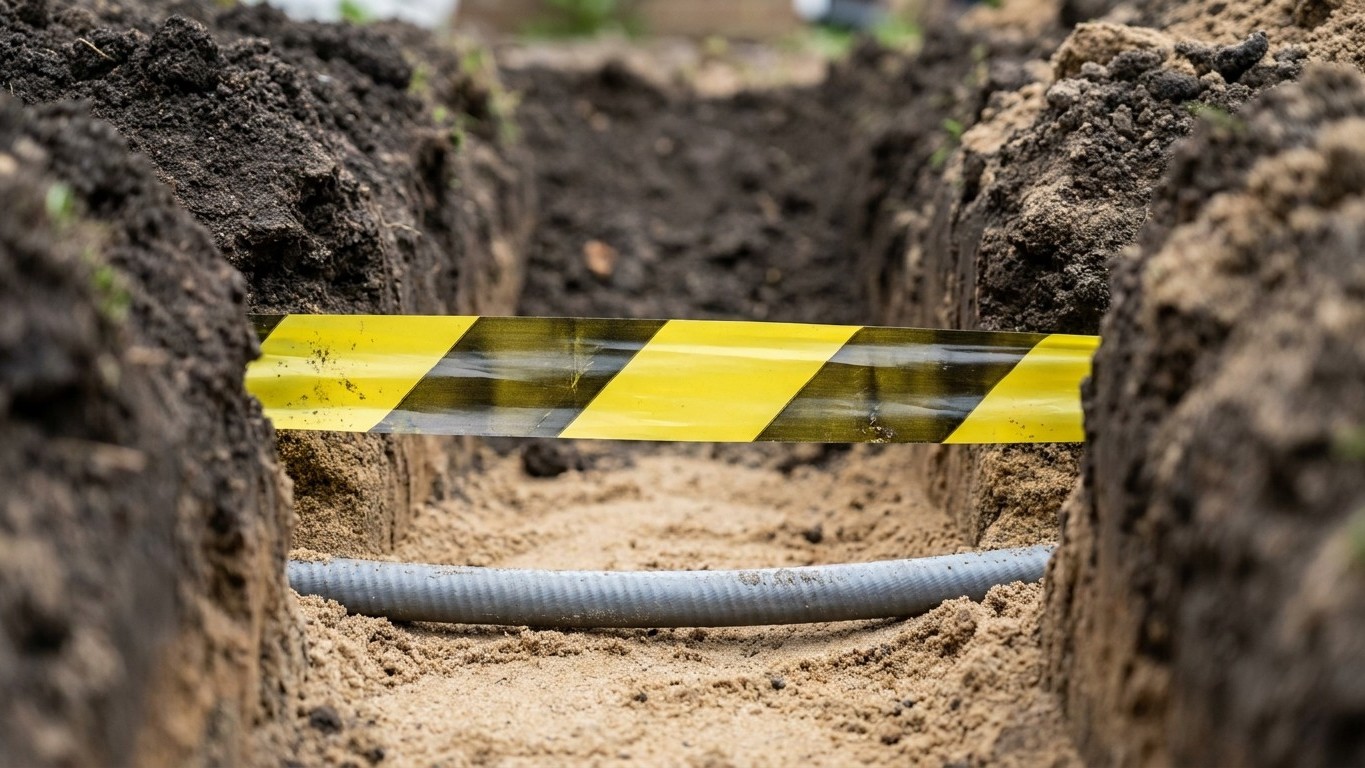
Ordinary twin-and-earth (the flat grey cable found in every consumer unit) has no business going anywhere near open soil. It has no armour, no steel wire, nothing but PVC sheathing between the copper and whatever a fork, spade or fence-post auger might do to it. Yet what actually stops a stray spade from reaching a live conductor buried in the garden isn’t the cable at all. It’s a thin strip of yellow and black plastic laid in the trench above it, and most people bury it wrong, too shallow, or not at all.
Key takeaways
- Twin-and-earth cable has zero armour protection—so what actually stops a spade from reaching live conductors?
- Regulations specify an outcome, not exact depths: the real safety layer isn’t underground at all, it’s what sits above it
- A 150mm gap between finished surface and cable, marked with warning tape, gives diggers a second chance to stop before disaster
Why the cable is never the real safety layer
Steel wire armoured cable (SWA) is the standard choice for taking power to a shed, garage or garden office precisely because unlike twin and earth, SWA complies with BS 7671 Regulation 522.8.10, which requires adequate protection when buried in the ground. That armour matters, but even armoured cable relies on something laid above it to stop anyone digging that far down in the first place. The legal backbone here is the Electricity Safety, Quality and Continuity Regulations 2002. It requires every underground cable to be “kept at such depth or otherwise protected” so as to avoid damage or danger, and that any non-earthed conductor cable is protected, marked or indicated to warn anyone excavating later. Notice what it doesn’t say: an exact number in millimetres. ESQCR doesn’t specify a number. It specifies an outcome.
BS 7671, the wiring regulations your electrician actually works from, is just as unspecific. BS 7671 doesn’t give much advice or particulars other than Regulation 522.8.10 stating that a cable must be adequately protected and at a depth unlikely to lead to a disturbance during natural overground traffic and use, and traffic doesn’t necessarily mean vehicular in this instance and can be anything from general footfall to gardening. In plain terms, the depth you dig to has to suit what happens above it, a border you’ll never touch again needs less than a vegetable patch you’ll be turning over every March. That’s exactly why the marker tape does so much of the practical work: it’s the layer that actually intercepts a spade before it reaches copper, whatever depth was chosen.
The layer that actually does the job
Ask any electrician what saves fingers in practice and they won’t point at the cable, they’ll point at the tape. Regulation 522.8.10 of BS 7671:2018+A2:2022 requires the location of buried cables to be marked by cable covers or a suitable marker tape, laid above the buried duct or cables to provide an early warning that electric cables are present. The positioning is what turns a strip of plastic into a genuine early-warning system. Along with the depth of a buried cable, it needs to be adequately identified using a marker tape or similar, and as a general rule, marker tape should be laid approximately 150 mm from the finished surface level. That gap, roughly the length of your hand, is deliberate. It’s shallow enough that a garden fork or spade blade meets the tape well before it meets the cable, giving whoever’s digging a chance to stop.
Good practice goes further than tape alone. Sand bedding involves placing a 50 mm layer of sharp sand in the bottom of the trench before laying the cable, then adding another 50 mm of sand above the cable before placing warning tape. The sand cushions the cable against sharp stones and settling ground, while the tape sits proud of it as the visible, tactile warning. Many installers now add a second strip of tape higher up the trench too, belt and braces, so that even careless digging gets two chances to stop before reaching anything dangerous. It costs pennies. Skipping it costs a great deal more if things go wrong.
Getting the depth right without overspending
The numbers people quote (450mm, 500mm, 600mm) all come from industry guidance rather than a single hard rule, and that’s worth knowing before you pay for unnecessary digging. The numbers come from industry guidance documents, BS 7671 Guidance Note 7, NICEIC and NAPIT publications, and from ESQCR interpretation. A sensible domestic approach, and one several electricians on trade forums independently arrive at, treats a normal lawn or flower bed differently from a driveway. A minimum installation depth of 450mm underground is typically recommended for best practice, increasing to 600mm in locations where there is a higher possibility for potential disturbance. Under a path that will one day be relaid, or a bed that gets forked over every autumn, go deeper. Under a lawn that only ever sees a mower, the shallower figure is defensible.
Before any spade goes near the ground, though, there’s a free step that costs nothing but ten minutes: checking what’s already down there. Gardens accumulate buried pipes and cables over decades, often at depths nobody documented. Gas pipes, water mains, electricity cables, and telecoms ducts may already be buried in your garden, sometimes at surprisingly shallow depths, so before breaking ground, check with your council’s records or use a cable avoidance tool to sweep the route. The LSBUD (Lines Search Before U Dig) website is a free UK service for locating buried infrastructure. I’d never let anyone dig a trench in my own garden without running that check first, it takes less time than boiling the kettle and it’s the one piece of budget-conscious advice that genuinely costs nothing.
If you’re laying the trench yourself and having an electrician do the final connection (a common and perfectly sensible way to save on labour), consider a length of oversized twin-wall duct rather than direct burial. It lets you pull the cable through later, add another circuit down the line without redigging, and gives an extra physical barrier on top of whatever depth you’ve chosen. It’s the sort of quiet, unglamorous precaution that never gets photographed for a finished garden, but it’s exactly the layer that decides whether next year’s fence post goes in without incident, or with a very unpleasant surprise.
Sources : iwantsolar.co.uk | professional-electrician.com