
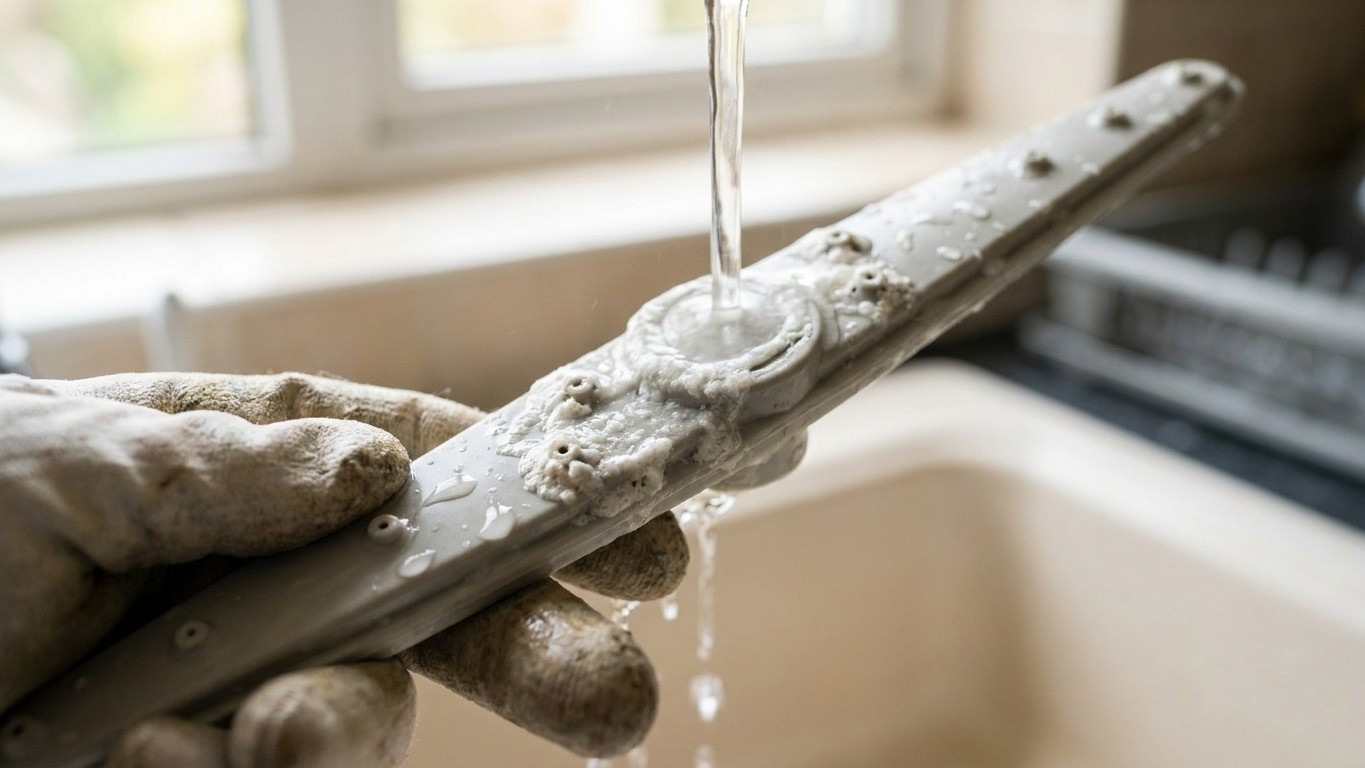
That cloudy, chalky film clouding your wine glasses isn’t necessarily down to skimping on salt at all. Nine times out of ten, the real troublemaker is lurking inside those spinning spray arms at the bottom and top of your dishwasher, where limescale quietly builds up until the little jets can barely dribble out water, let alone blast your crockery clean.
I’ve had readers write in for years convinced their dishwasher salt tub was the answer to every spotting problem, and I understand why. The tub sits right there, practically begging to be topped up, and it feels like doing something proactive. But salt only softens the water flowing into the machine. It does nothing whatsoever for the mineral crust that’s already hardened onto the inside of your spray arm nozzles, and that crust is often the true culprit behind those dull, whitish glasses you keep polishing with a tea towel afterwards.
Key takeaways
- That cloudy film you’ve been blaming on salt might not be your fault at all
- Narrow spray arm jets clog with mineral deposits, causing water to trickle instead of blast
- Your postcode matters more than you think—60% of the UK has hard water that accelerates the problem
Why the spray arm is the real villain
This common maintenance issue is usually caused by an accumulation of hard water mineral deposits, like calcium carbonate, and small pieces of food debris that bypass the filtration system. Those spray arms rely on a set of narrow holes, sometimes no wider than a pencil lead, to fire pressurised water at your dishes from every angle. When even a handful of those holes clog with scale, the whole spray pattern goes lopsided. Water that should be hitting your glasses with force instead trickles out weakly, and when debris clogs the spray jets or filter, water circulation suffers, leading to poor rinsing and residue buildup.
Here’s the bit that surprised me when I first looked into it properly: it isn’t just about dirty water sitting on your dishes. Limescale builds up inside the spray arm and can flake onto dishes, meaning the very deposits clogging the mechanism can end up as the white specks you’re scrubbing off your tumblers. A quick visual check often confirms it, since a visual check can sometimes reveal white, chalky residue around the jet openings, which is characteristic of calcium and magnesium deposits from hard water buildup.
If you fancy playing detective before you do anything else, there’s a simple test. Take a glass straight from a finished cycle while it’s still got that film on it, then wipe a corner with a paper towel dabbed in white vinegar. If the film disappears immediately, it’s mineral deposit, meaning hard water is the cause. If the vinegar does nothing, you’re more likely dealing with detergent residue or a loading problem rather than scale, though in my experience it’s usually a combination of both once a spray arm has been neglected for a year or two.
Getting the scale out for good
The good news is that unclogging a spray arm is a proper five-minute job, no tools bought specially, no engineer called out. Most arms either twist off by hand or pop free after loosening a central clip or nut, and once you’ve got them out you’ll likely spot the tell-tale white crust around several of the holes. Allow the arms to soak for at least three to four hours, or ideally overnight, to give the acid sufficient time to penetrate and weaken the hardened deposits within the water channels. Plain white vinegar from the supermarket does the job nicely, since a mixture of equal parts warm water and plain white vinegar creates acetic acid, which reacts with and slowly breaks down common calcium carbonate deposits.
Once they’ve had their soak, don’t just rinse and reassemble. Use a toothpick, paperclip, or thin wire, like a straightened coat hanger, to gently remove debris from each hole, working along every jet in turn. It’s oddly satisfying, a bit like unblocking a watering can rose, and you’ll often see the difference the moment you run the next wash. Before you clip everything back together, give it a spin by hand. Rinse and spin: run water through the spray arms and spin them by hand to ensure they rotate freely. If an arm feels stiff or won’t rotate at all, the bearing underneath might need a look too, but for most kitchens a good soak and a poke with a wire sorts the problem entirely.
Don’t forget the filter while you’re at it, tucked beneath the lower rack. It works hand in hand with the spray arms, and the filter and spray arms are two of the most important parts, so if they are dirty or clogged, your dishwasher can’t clean properly, and the dirty water with minerals and soap can get stuck on your dishes. A rinse under the tap and a scrub with an old toothbrush takes barely a minute and makes a real difference alongside the spray arm clean.
Where you live matters more than you’d think
Whether this becomes a monthly chore or an annual one depends heavily on your postcode. Around 60% of the UK is classed as having hard or very hard water, with many areas exhibiting over 200mg of calcium carbonate per litre. If you’re in London, the South East, or much of East Anglia, your water is doing the mineral-dumping equivalent of overtime. London, Essex, Kent, Hertfordshire, Buckinghamshire, Bedfordshire, Cambridgeshire and much of the South East consistently report very high mineral content. Meanwhile, if you’re lucky enough to live in Scotland, Wales, Cumbria, Greater Manchester, Merseyside or much of the North West, your spray arms will stay cleaner for far longer thanks to naturally soft water.
Given that, I’d suggest treating your spray arms exactly the way you’d treat your kettle. If you’re in a hard water postcode, give them a vinegar soak every couple of months without waiting for the film to appear. Soft water households can get away with checking twice a year. Either way, keep the salt topped up as normal, it’s still doing an important job protecting the machine’s internal softening unit, but don’t expect it to fix a problem that’s actually sitting inside those little spinning arms.
Sources : appliancecarehub.com | mytapwater.co.uk