
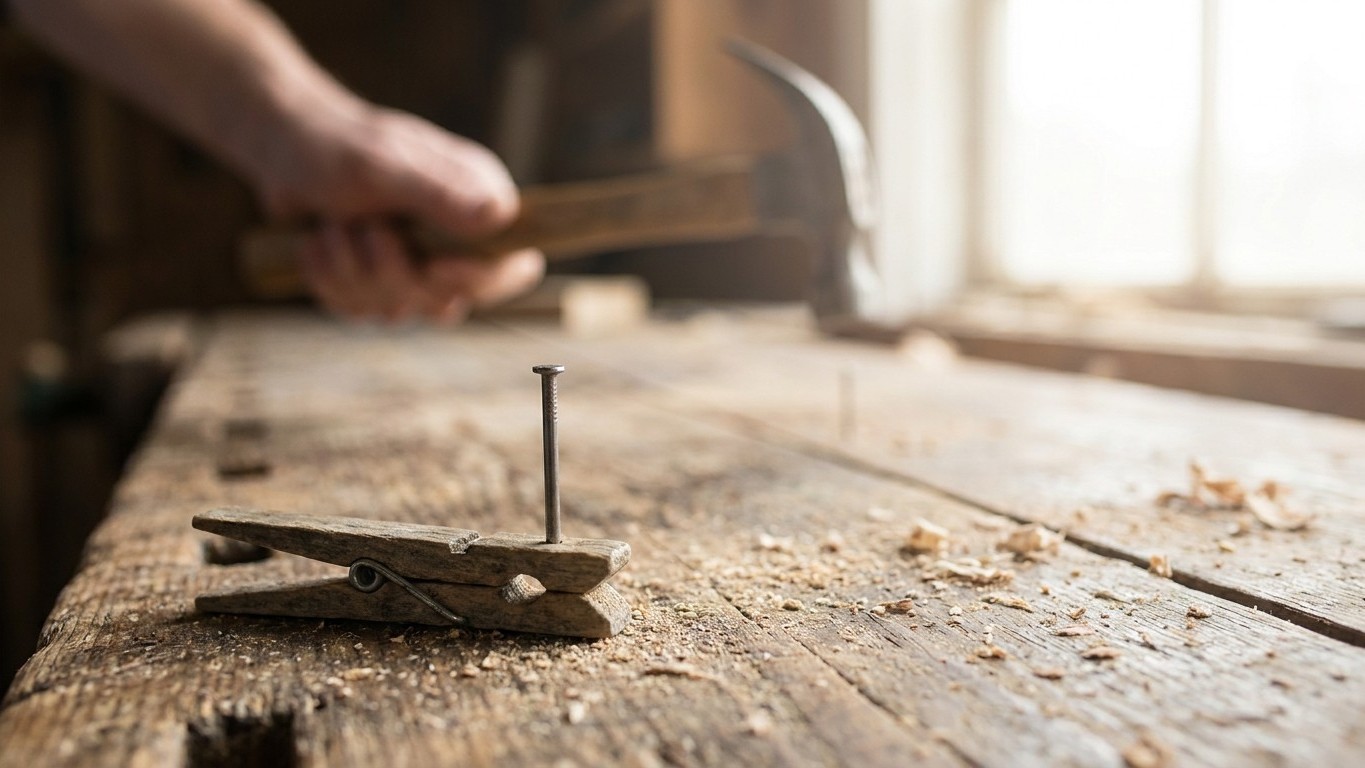
Grandad’s toolbox held exactly one wooden peg, wedged between a tin of tacks and a stub of chalk, and every time I spotted it as a boy I thought he’d wandered off with the washing basket by mistake. He never explained himself. He just clipped that peg onto whatever needed holding and got on with the job. Years later, elbow-deep in my own DIY disasters, I finally understood: that humble peg was doing a job no gadget from the shop could match, and it cost him nothing.
Key takeaways
- A wooden peg holds nails safely during hammering, keeping your fingers three inches from the hammer’s strike zone
- Wood conducts heat differently than metal—it won’t burn your hand or conduct dangerous warmth near electrical work
- One peg replaces dozens of expensive tools: mini-clamps, heat sinks, bag clips, and measuring markers
The trick that saves your fingers (and your temper)
Start a nail by hand and you’re gambling with your thumbnail every single time. The old fix, the one that’s been rediscovered by a whole new generation of weekend joiners, is to slot the nail between the two prongs of a wooden clothes peg and use that as your grip. It’s the smartest and safest trick for protecting your digits when hammering a nail, simply by holding the nail with a wooden clothes pin. Your fingers stay a good three or four inches from the strike zone, so even a wayward swing lands on the peg rather than your knuckles.
It sounds almost too simple to work, and that’s exactly why so many people dismiss it until they’ve tried it once. The peg’s spring tension is just enough to keep a small nail or tack upright while you tap it into place with the first few gentle strokes, after which you can slide the peg away and finish driving the nail properly. Builders on video platforms have been showing this same move for years, proof that a five-pence bit of kitchen kit has quietly earned its place in serious toolboxes, not just Grandad’s.
Why wood, and not plastic or metal, does the job best
Here’s the part that took me longest to appreciate: it isn’t just about keeping fingers out of the way. Wood behaves completely differently to metal or plastic when heat and friction get involved, and That Matters More Than You’d think in a workshop. Wood exhibits a low thermal conductivity, or high heat-insulating capacity, compared with materials such as metals, marble, glass, and concrete. In practice, that means a wooden peg won’t conduct heat into your hand the way a metal clip would if it happened to sit near a soldering iron, a freshly cut pipe, or a bit of metalwork still warm from the workshop.
The American Wood Council puts a number on it too: the thermal conductivity of common structural woods is much less than the conductivity of metals with which wood often is mated in construction, and it’s about two to four times that of common insulating material. That’s why old hands reach for a wooden peg rather than a bulldog clip when they need something to grip a hot wire during soldering, or to hold a small workpiece steady near a heat source. There’s a proper scientific reason your grandad’s peg felt “warm and friendly” in the hand while a metal clamp always felt cold, even at room temperature. Heat will travel faster through a metal as compared to a non-metal, so for a person touching a piece of metal, heat is being removed from their hand at a much faster rate, and this decrease in hand temperature causes the thermoreceptors in your hand to feel the metal as being cold. Wood simply doesn’t steal your warmth the same way, which makes it a far more forgiving material to keep gripping for minutes at a time.
More jobs than you’d ever expect from a two-penny peg
Once you start looking, the clothes peg turns up doing all sorts of odd jobs around a workbench, and none of them cost a penny beyond what you already own. A peg makes a perfectly serviceable mini-clamp for holding two thin strips of wood together while wood glue sets, particularly on fiddly model-making or picture-frame repairs where a proper clamp is too clumsy. Slide one onto a wire near a solder joint and it acts as a crude but genuinely useful heat sink, drawing warmth away from delicate components further down the wire so they don’t cook while you’re working. Electricians and hobbyist tinkerers have leaned on this trick for decades, long before heat-shrink tubing and proper clip-on heat sinks became cheap and common.
A peg also earns its keep as a makeshift bag clip for half-used tins of screws or sandpaper sheets, keeping dust and damp out between jobs. Some people use one to mark a measurement on a length of dowel or pipe rather than fetching a pencil with sawdust-covered hands. None of these uses are glamorous. That’s rather the point. My grandad’s generation grew up mending things rather than replacing them, and a peg that cost fractions of a penny did the work of tools that would set you back a fair sum today.
Building your own habit worth keeping
If you fancy trying it, grab a plain wooden peg (not the plastic spring-loaded kind, which won’t grip a nail properly and melts far too easily near heat) and drop it into your toolbox today. Keep it away from damp, since oven-dry wood is electrically insulating, but as moisture content increases, electric conductivity increases such that the behaviour of saturated wood approaches that of water, meaning a soggy peg loses its safety advantage around anything electrical. A dry peg costs you nothing and asks for nothing in return, which might be the real reason my grandad never bothered explaining himself. Some lessons you’re simply meant to work out for yourself, hammer in hand, thumbnail intact.