
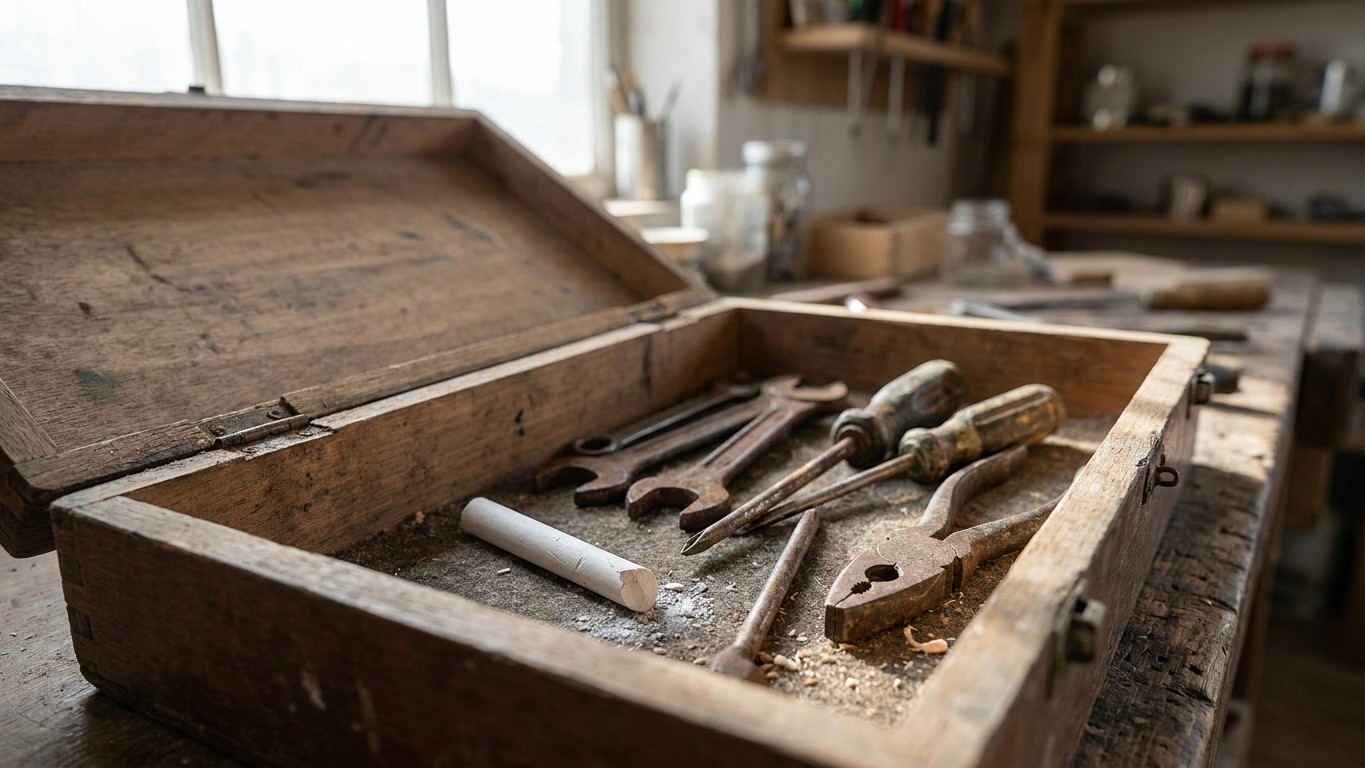
Rust doesn’t need a downpour to take hold. A closed metal toolbox, sitting in a cold shed or garage, is exactly the kind of environment where iron and steel meet oxygen and water, they react, and iron oxide appears, that flaky orange coating that slowly eats away at good tools. My grandfather never used those words, mind you. He just reached for a stick of chalk, snapped it in half, and tucked it into the corner of his toolbox every autumn without fail. I thought it was one of his funny little superstitions, up there with never whistling indoors. Turns out he was simply ahead of his time, and rather cleverer than his teenage granddaughter gave him credit for.
The trick works because ordinary blackboard chalk is naturally porous, meaning it absorbs moisture from the air, and that thirsty quality is precisely what makes it such an unlikely ally against corrosion. Rust is the energetic reunion of iron with oxygen and water, a reaction that accelerates in the cramped, humid air of closed toolboxes. Think about it: every time the temperature drops overnight and then climbs again the next morning, you get tiny condensation films forming on cold metal surfaces. Those micro-droplets are basically an open invitation for oxidation to get started. Chalk interrupts that whole process before it even begins, quietly pulling stray water vapour out of the air and holding onto it within its own porous structure.
Key takeaways
- A common household item your grandfather probably knew about, but modern DIYers have completely forgotten
- The science behind why moisture is your tools’ worst enemy, and how one material fights back
- A maintenance trick so cheap and simple it almost seems too good to work—but it genuinely does
What’s actually happening inside that dusty stick
Most classroom chalk is made from calcium carbonate, occasionally calcium sulphate (gypsum), and both are riddled with microscopic pores and cracks that act rather like tiny capillaries. Chalk’s pores and microcracks act like capillaries, wicking vapour into the solid, so instead of settling on your spanners and pliers, the moisture gets drawn into the chalk itself. It isn’t a chemical reaction so much as a slow, physical soaking-up, what Scientists would call adsorption alongside a bit of genuine absorption. Because of this, capacity is modest compared with proper industrial desiccants. Silica gel, for instance, can pull vastly more water out of the air, but it costs more and needs regular recharging in an oven to keep working. Calcium chloride is even more powerful, yet it turns messy and corrosive if it ever gets wet through. Chalk sits comfortably in between: nowhere near as dramatic, but cheap, safe, and endlessly reusable, which is exactly the sort of unglamorous practicality my grandfather valued in everything he owned.
There’s a small bonus to the chemistry too. Chalk is mildly alkaline, and that slight alkalinity can help neutralise some of the acidic residue left behind by fingerprints or grubby workshop air, nudging the whole environment a touch further away from conditions that favour corrosion. It won’t work miracles on its own, but combined with keeping your tools clean and lightly oiled, it smooths out those humidity spikes that do the real damage over time.
Doing it properly, the way he did
The method itself couldn’t be simpler, which is probably why it survived generations of workshop wisdom without anyone writing it down. Clean and dry your tools thoroughly before you put them away, because trapping existing dampness under the lid rather defeats the purpose. Then scatter a few sticks of ordinary blackboard chalk, not the chunky pavement variety children use for hopscotch, across the different compartments or drawers.
For a small toolbox, two or three pieces will do; a larger chest might want five to seven scattered about so the moisture-absorbing effect reaches every corner evenly. Snap each stick in half before you drop it in, too. It exposes fresh surface area, and more surface means more places for water vapour to latch onto. Close the lid properly afterwards so you’re not letting fresh damp air creep back in through a gap, and swap the chalk out every few months, since a saturated stick has done its job and needs replacing rather than reused indefinitely.
Colour makes no difference whatsoever, so don’t fret if all you’ve got left in the tin are the bright pink and blue sticks from someone’s old chalkboard set. What does matter is texture: rougher, matte sticks tend to outperform the smooth, polished “dustless” varieties, which absorb noticeably less because their surface has effectively been sealed. If you’re buying a fresh box specifically for this job, a plain, inexpensive multi-pack from any stationery aisle will serve you just as well as anything fancier.
Beyond the toolbox
My grandfather had a second trick I only discovered later, which is that a dab of chalk rubbed onto a screwdriver tip stops it skidding off a stubborn screw head, the same friction principle that lets a gymnast grip the bars or a snooker player control the cue. He’d also tuck a small muslin bag of chalk dust into the shed to fight off that musty, damp smell that builds up in enclosed wooden spaces over a British winter. It absorbs the dampness in the air just as readily there as it does among the spanners.
None of this replaces proper tool care, oiling the moving parts, wiping down blades after use, storing everything somewhere reasonably dry to begin with. But as a cheap, low-effort line of defence against the slow creep of rust, a few broken sticks of chalk cost next to nothing and ask for nothing in return except an occasional swap. My grandfather never explained the chemistry because he probably never needed to know it. He’d simply noticed, over decades in that shed, that the tools sitting near a stick of chalk stayed brighter longer than the ones that didn’t. That’s really all traditional wisdom ever is: an observation repeated often enough that it becomes habit, long before anyone gets round to writing down why.
Sources : thestonearms.co.uk | menuthai-fleet.co.uk