
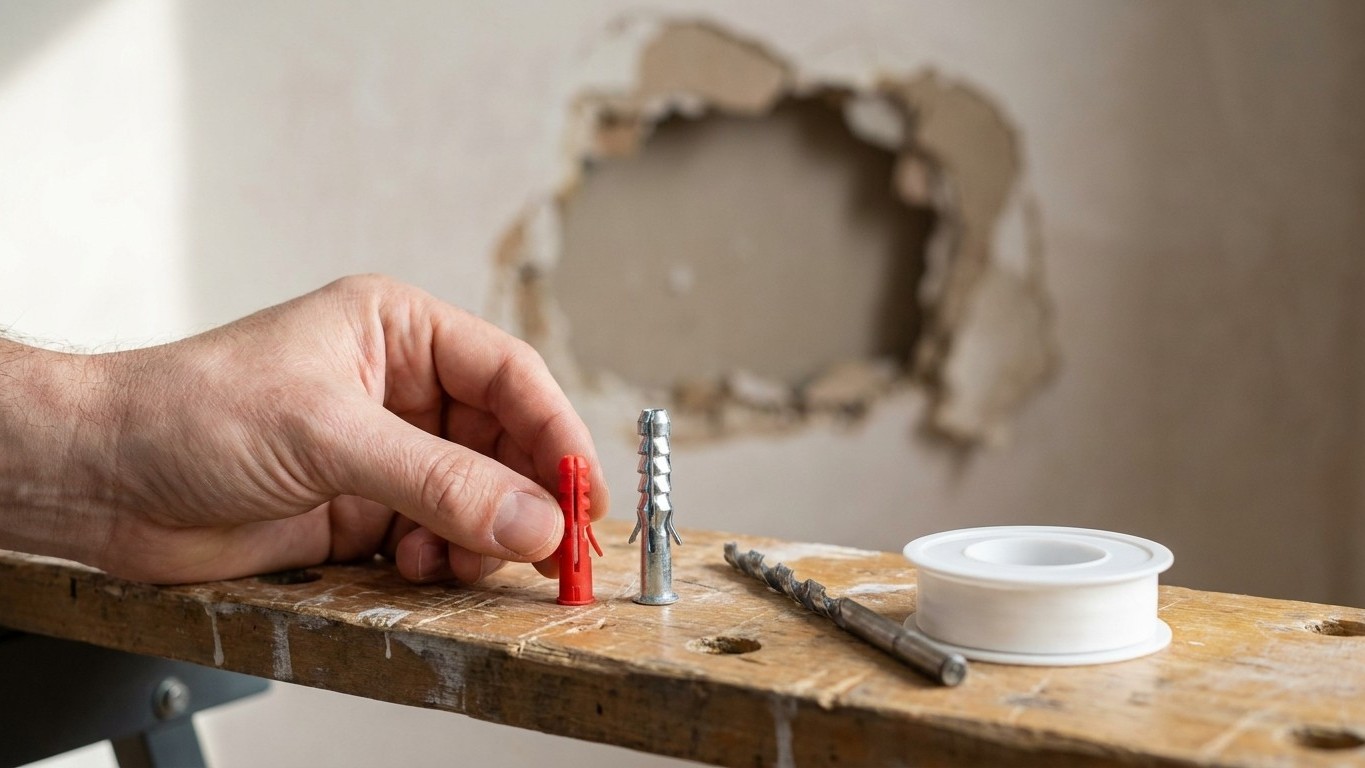
A spinning wall plug is one of those infuriating little problems that nobody talks about because everyone assumes they already know the fix. Pull the screw, push the plug back in, retighten. Except that approach almost never works, and if you’ve been doing it for months, you’re probably making the hole slightly larger each time. The actual solution has nothing to do with the plug itself.
Key takeaways
- Most people spend months tightening the wrong part of a loose wall plug
- The hole becomes enlarged with each failed attempt, making the problem worse
- A simple two-minute fix exists—and it costs less than you’d expect
Why the plug spins in the first place
Wall plugs, those small cylindrical plastic anchors you tap into a drilled hole before inserting a screw, are designed to grip the surrounding wall material by expanding outward as the screw is driven in. When the hole is the right diameter, the plug bites into the wall and stays put. The spinning happens when the hole has become too wide for the plug to grip, usually because the original drill bit was slightly too large, because repeated use has worn the hole smooth, or because the wall material itself has crumbled away around the edges. Plaster and older masonry are especially prone to this.
The builder who spotted my error within about thirty seconds made a simple observation: you cannot fix an oversized hole by reinserting the same-sized plug into it. The hole is the problem, not the plug. All those months of pressing the plug back in and screwing more carefully were irrelevant, because the walls of that hole had nothing left to grip onto.
The proper fix, step by step
The correct approach depends on how much the hole has widened, but the good news is that even a badly chewed hole can usually be rescued without replastering or calling a tradesperson.
For a hole that’s only slightly oversized, the simplest remedy is to move up one size in both plug and drill bit. Remove the old plug entirely, redrill the same hole to the next standard size (typically 7mm if you were using 6mm, or 8mm if you were using 7mm), and insert a correspondingly larger plug. This takes about two minutes and costs only the price of a slightly bigger plug, which is pennies from any hardware shop.
When the hole is more significantly damaged, a better method involves packing the void before reinserting a plug. You can wrap the existing plug tightly in a layer or two of PTFE tape (the white thread-seal tape used in plumbing, sold in rolls for roughly a pound or two) before pressing it back into the hole. The tape adds just enough bulk to restore a firm grip without the need for redrilling. Wrap it tightly around the length of the plug, insert it, tap it home gently with a hammer, and you’ll often find it holds as solidly as the day it was first fitted.
A third option, favoured for heavier fixings like shelving brackets or curtain tracks, is to use a specialist frame fixing or a larger-diameter rawlbolt instead of a standard plastic plug. These are designed for situations where the wall can’t be trusted to hold a conventional anchor, and they distribute the load differently.
The toothpick trick (and why it actually works)
Builders and carpenters have long used wooden cocktail sticks or toothpicks as a packing remedy for loose fixings, and there’s genuine physics behind it rather than just folk wisdom. Wood, when compressed inside a hole alongside a screw, swells slightly with any ambient moisture and grips the surrounding material through friction and expansion. Snap off two or three wooden cocktail sticks, push them into the hole alongside the plug, break them flush with the wall surface, then reinsert your screw normally. The wood fills the gap and gives the screw thread something to bite into.
This method works particularly well in timber, where a stripped screw hole in a door hinge or cabinet frame is a common nuisance. In masonry, the toothpick trick is less reliable for anything load-bearing, but for lightweight picture hooks and the like, it does the job admirably and costs essentially nothing.
The one thing to avoid, and I say this from experience, is using filler or polyfilla to repair the hole before reinserting a plug. Standard decorating filler is not designed to hold fixings. It may seem solid once dry, but it has very little shear strength, meaning a plug driven into it will simply pull the filler away from the wall under any lateral or outward load. Specialist repair plaster or a two-part epoxy filler is a different matter, but those are overkill for most domestic fixing jobs.
Choosing the right plug from the start
Half of these problems arise from mismatched plug and drill sizes in the first place. Every plastic wall plug is colour-coded to correspond with a specific drill bit diameter and screw gauge. Yellow plugs pair with a 5mm bit and take a size 4-6 screw. Red plugs need a 6mm bit and suit a size 6-8 screw. Brown plugs require a 7mm bit and handle a size 8-10 screw. The sizes are printed on the packaging, and following them precisely makes the difference between a fixing that lasts a decade and one that starts spinning within a fortnight.
There’s also the wall material to consider. Standard plastic plugs are fine for brick and dense blockwork, but in lightweight aerated blocks (the kind increasingly common in newer builds) or dot-and-dab plasterboard, you need plugs specifically designed for those materials. They look different, often longer with a broader flange, and they anchor by a different mechanism entirely. Using the wrong plug type in the wrong material is a more common cause of spinning fixings than most people realise, and a small selection of assorted plug types on hand costs very little to maintain as part of a home toolkit.
One detail worth knowing: if your wall turns out to be plasterboard over a cavity rather than solid masonry, the entire approach changes. No standard plug will hold reliably in plasterboard unless it reaches the timber stud behind it. For hollow walls, cavity fixings (sometimes called butterfly or toggle anchors) are the correct tool, and they can hold surprising amounts of weight when fitted properly.