
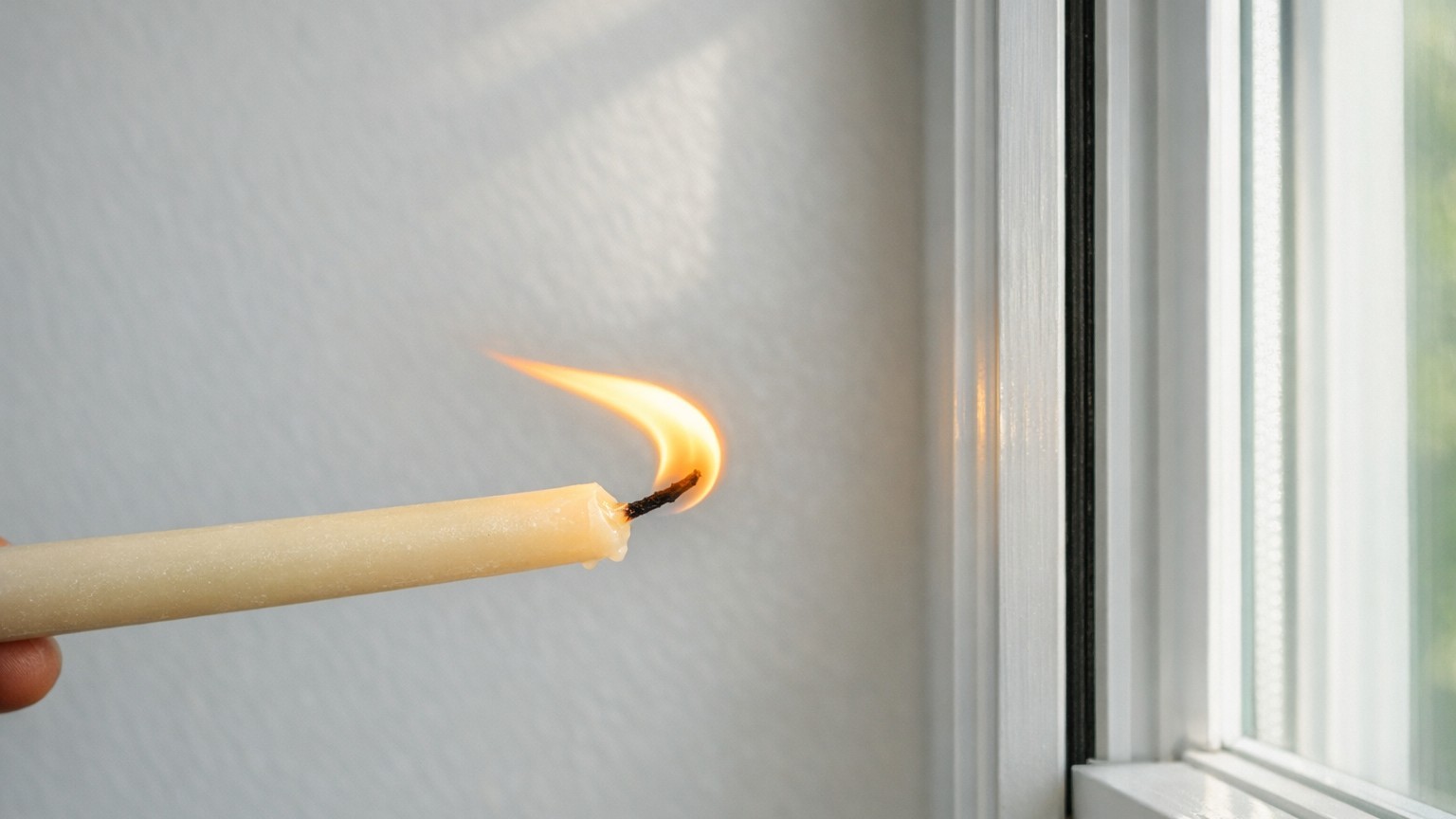
A candle flame near a closed window should do almost nothing. Hold one along the edge of a window frame, watch it closely, and if the flame curves, bends or gutters, there is air moving through a gap that should not exist. That flickering tells you exactly where your home is haemorrhaging energy, and during a heatwave, it tells you something just as alarming: warm outside air is pushing its way in just as freely as cold winter air sneaks out.
Key takeaways
- A candle flame reveals invisible air leaks that single-glazed windows and poorly sealed frames allow to pass through
- The gaps letting winter cold in are actively drawing summer heat into your home—a problem most people never realize
- British homes lose up to 20% of heat through windows, but the fix often costs just £3-£5 and takes an afternoon
Why the candle test works, and what the flame is actually showing you
The candle test is genuinely one of the most reliable low-tech diagnostic tools a homeowner has at their disposal. Move anything flammable like curtains away from the window and turn off any fans to keep the indoor air still. Then light a candle and hold it near the seam of the window across its full perimeter. If the flame curves or moves, it’s because of a draught coming through. An incense stick works just as well, the smoke trail makes the air movement even more visible. What surprises most people is not that draughts exist, but where they find them: corner joints, the meeting rail on sash windows, the gap between frame and wall. Places the eye would never spot.
Be aware of what specialists call “ghost draughts.” Sometimes a window feels cold not because air is leaking through it, but because the glass is single-glazed and the surrounding wall lacks insulation. If your tests show no air movement but the area remains freezing, the issue is likely thermal bridging rather than a physical gap, and identifying this distinction early saves you from unnecessary repair costs. This matters especially in summer. A single-glazed window facing south-west acts less like a barrier and more like a solar oven panel, radiating heat directly into the room whether there is a physical gap or not.
The scale of the problem in British homes is worth pausing over. Old windows in UK homes can account for up to 20 per cent of total heat loss, particularly if they are single-glazed or poorly insulated. Un-draughtproofed homes can lose over 30% of their heat through a combination of gaps, cracks and poor-quality frames, a figure that climbs higher still in Victorian terraces and inter-war semis with original timber sashes. A gap of just 2mm around a standard window frame can be equivalent to leaving a brick-sized hole in your wall. That is not a metaphor designed to alarm you. It is simply physics.
Insulation in summer: the argument most people miss
Here is where the heatwave angle gets interesting. We tend to think of draughts and insulation as winter problems, something to sort out in October before the heating bills land. But the candle test I ran on a sunny morning in June told a different story. The flame near my bedroom window was pulling inward, meaning hot air outside was being drawn into the cooler interior. The very gaps that let cold in during January were now acting as a slow pump for summer heat.
Experts point out that insulation has a dual benefit: reducing energy bills and climate emissions in winter, and helping keep down internal temperatures in summer. “The beauty of insulation is that it slows the process of heat moving through walls,” as one expert put it. “In the summer it does the opposite, it actually slows heat moving into our homes.” The candle test, then, is not just about draught-proofing for heating season. It is an audit of your home’s thermal envelope, year-round.
Built for cold winters rather than scorching summers, much of the nation’s housing stock is poorly equipped to deal with prolonged high temperatures. Climate change is making this worse, with heatwaves now lasting longer, striking more often, and reaching record-breaking extremes. A 2025 study found that the proportion of UK homes reporting overheating had risen from 18% in 2011 to 80% in 2022. Your windows, and the air gaps around them, sit right at the heart of that problem. Sun heat comes through windows, hot air infiltrates from outside, and even everyday activities like cooking and running appliances all generate heat inside the home.
Fixing what the flame reveals: practical steps for every budget
The good news is that most window draughts are genuinely fixable without spending a great deal of money, and often without calling anyone in. For windows that open, buy draught-proofing strips to stick around the window frame. There are two types: self-adhesive foam strips, which are cheap and easy to install but may not last long; and metal or plastic strips with brushes or wipers attached, which last longer but cost a little more.
For casement windows, the kind that swing open on a hinge, self-adhesive foam tape is usually enough. A large roll costs approximately £3 to £5. Applied correctly to the inside of a casement window frame (the surfaces that meet when the window closes), it creates a soft, compressible seal that significantly reduces cold air infiltration. Clean the frame surface with warm soapy water first, let it dry thoroughly for ten minutes, then press the strip firmly into place. A roll that size will cover eight to ten windows. Traditional sash windows need a slightly different approach. Foam strips do not work well on sash windows, it is best to fit brush strips or consult a professional. The sliding motion compresses adhesive strips unevenly, and they tend to work loose within a season.
For gaps between the frame and the surrounding wall, visible cracks, crumbling caulk on the outside, silicone sealant is the answer. Silicone sealant provides a permanent solution for sealing gaps between the window frame and the wall. Clean the gap thoroughly, apply masking tape to create clean edges, apply the sealant in a continuous bead, and smooth it with a wet finger before it dries. One critical caveat: do not use sealant on opening parts of windows, as it will permanently seal them shut.
When gaps are obvious but DIY fixes keep failing, it may be time to look at the mechanical components rather than the seals. Technical assessments suggest that up to 40% of air leakage in older casements stems from hardware misalignment rather than seal degradation. If a window won’t close tightly, the issue usually lies in the mechanical components that govern compression. Tightening hinge screws or replacing worn locking mechanisms can transform a persistently draughty window without a single metre of foam strip.
When sealing is not enough, and the ventilation balance
There is one thing the enthusiasm for draught-proofing can occasionally overlook, and it deserves a mention. According to the Building Research Establishment, an overly sealed home without adequate ventilation can lead to condensation, mould growth, and poor indoor air quality. Sealing gaps is not the same as eliminating all airflow, and it should not be. Those small vents at the top of modern windows provide background ventilation. They’re there for a reason. Do not block them.
The candle test works best on a breezy day when pressure differences across the building envelope are greatest, making leaks easier to detect. Run it systematically around every window and external door frame, top corners first, then down the sides, along the sill. Mark problem spots with a small piece of masking tape as you go. Then, once the gaps are identified and sealed, remember to leave trickle vents open and maintain some controlled airflow, particularly in kitchens and bathrooms. Effective draught-proofing can reduce heating bills by approximately £40 to £50 per year, according to the Energy Saving Trust — and in summer, it helps keep that unwanted heat out too.
One nuance worth knowing: if your double-glazed units show a milky or misty appearance between the panes, no amount of draught-proofing will help. Over time, double glazing can suffer seal failure, where the insulating gas between panes escapes. This leads to condensation, misting, and reduced insulation. Replacing the failed sealed unit or upgrading the frame restores performance. That is a different problem entirely, one a candle flame at the edge of the frame will not detect, because the failure is inside the glass unit itself, invisible from any angle.
Sources : homebuilding.co.uk | amazon.co.uk