
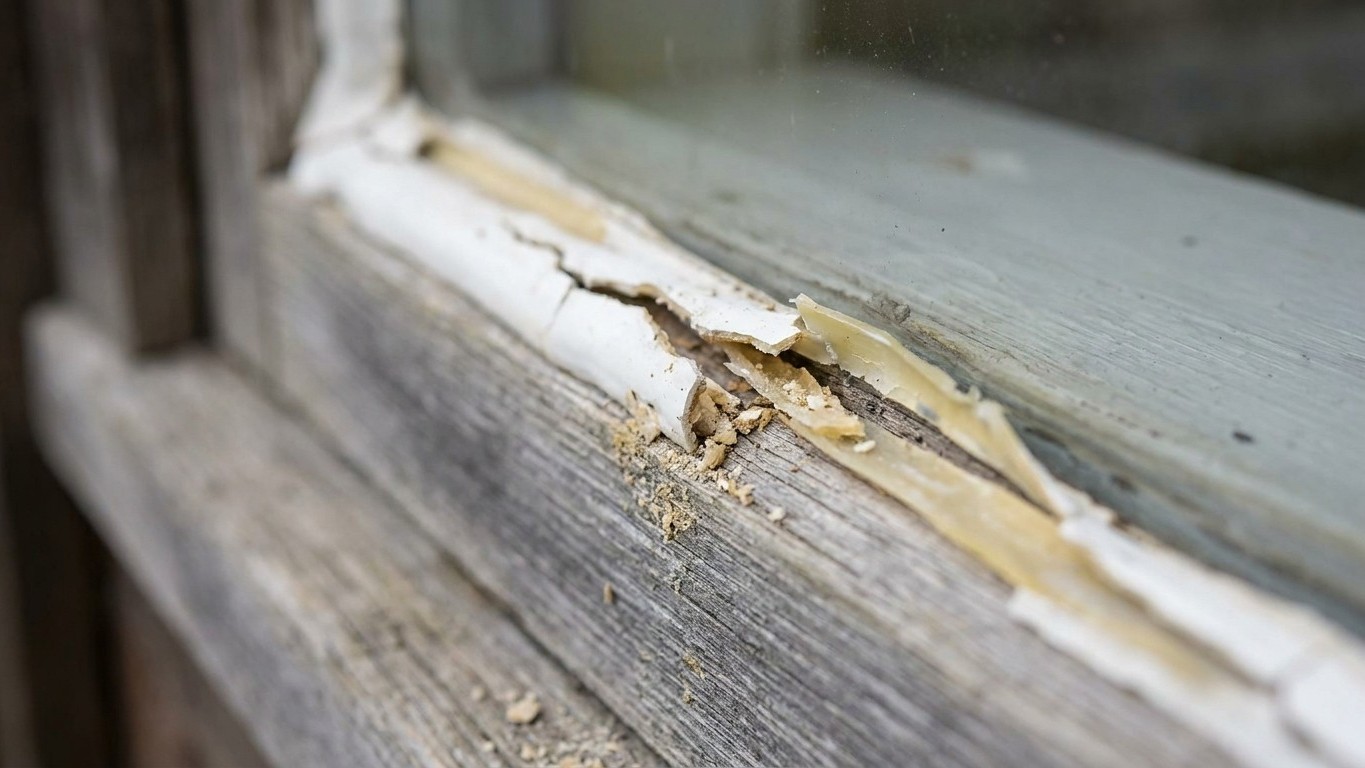
White tubes of sealant all look remarkably similar on the shelf, but what’s inside them behaves very differently depending on where you use it. The crumbling, yellowing strips you’re peeling off your window frames this summer almost certainly mean you used the wrong type for the job, and the good news is that understanding the difference takes about five minutes and saves you repeating the whole miserable process next year.
Key takeaways
- Most people use acrylic caulk on exterior windows, where only silicone will flex with frame movement
- A properly sealed window should last 10+ years, but the sealant removal step is where most projects fail
- The ‘two-point bond’ technique professionals use prevents sealant from tearing itself apart under pressure
Why the same tube keeps failing in the same place
Most of the white tubes sold in British DIY shops fall into two broad families: acrylic decorator’s caulk and silicone sealant. They look identical from the outside. They even apply in much the same way. The difference is in how they behave once the weather gets involved.
Acrylic caulk is water-based, paintable, and wonderfully easy to tool with a damp finger. For interior gaps, skirting boards, coving, the join between a door architrave and a plastered wall — it’s absolutely the right choice. The problem arises when it meets the outdoors. Window frames, particularly on older houses, move. They expand in summer heat, contract in the frost, and flex gently every time the wind catches the glass. Acrylic simply cannot keep up with that movement. It dries rigid, loses its elasticity within a season or two, and then cracks, crumbles, and eventually falls away in those satisfying but dismaying strips. I’ve pulled off lengths that looked like dried pasta.
Silicone, by contrast, stays permanently flexible. It forms a rubbery bond that stretches and compresses with the frame rather than fighting against it. A properly applied silicone seal on an exterior window should last a decade or more without needing any attention. The trade-off is that standard silicone cannot be painted over, it just peels, and it’s a little more finicky to apply neatly. There are “paintable silicones” and hybrid silicone-acrylic products on the market, and these are worth looking at if you need to match a colour scheme, though in my experience nothing beats standard neutral-cure silicone for sheer longevity on an exposed frame.
Reading the label before you squeeze a single millimetre
The phrase to look for on the packaging is “exterior” or “façade” use, combined with some indication of flexibility or elongation, manufacturers sometimes quote a figure like 25% or 50% movement accommodation. Anything rated for bathroom or kitchen use indoors will usually handle moisture well but may not be rated for UV exposure, which is what degrades so many sealants over a British summer. The sun here isn’t the Mediterranean, but even our modest ultraviolet light breaks down cheaper formulations over time.
One thing that surprises people: neutral-cure silicones and acetoxy-cure silicones behave differently on certain substrates. The acetoxy type (the one that smells strongly of vinegar when curing) can corrode some metals and stain porous stone. If your window frames are timber or uPVC, it’s generally fine. If they’re set into natural stone surrounds or sit against copper flashing, a neutral-cure product is the safer option. The smell test is a reasonable guide: strong vinegar smell equals acetoxy; little to no smell equals neutral cure.
Doing the job so it actually lasts
Removing the old sealant properly is the step most people skip, and it’s the one that matters most. New sealant applied over crumbling old sealant will fail just as quickly, because it can’t bond to the surface underneath, it’s bonding to something that’s already detached. A sealant removal tool (a hooked plastic scraper, available for a pound or two) combined with a silicone remover solvent will get most of it off. Finish with a wipe of white spirit and let the frame dry completely, ideally on a dry day above 5°C.
The actual application is straightforward once the surface is clean. Cut the nozzle at a 45-degree angle to a hole slightly smaller than the gap you’re filling, you can always go wider, you can’t go narrower. Hold the gun at that same 45-degree angle and pull it steadily along the joint rather than pushing. Pulling gives you a smoother bead because the sealant presses into the gap ahead of the nozzle. Tool it with a wet finger or a purpose-made smoothing tool within a few minutes, before a skin forms. Silicone typically skins over in 10 to 20 minutes depending on temperature and humidity, so work in sections of about a metre at a time.
Don’t be tempted to paint over fresh silicone to tidy it up, standard silicone rejects paint flatly. If the colour matters, choose a cartridge that closely matches your frame from the outset. Most manufacturers offer a range of colours beyond white, including brown, grey, and a buff tone that sits nicely against stone or brick.
One detail most guides leave out
There’s a principle called the “two-point bond” that professional sealant applicators follow, and it makes a real difference to longevity. A sealant bead should bond to both sides of a joint but not to the back of it. When sealant sticks to three surfaces, both sides and the back, any movement in the frame tears it apart from the middle. To prevent this, professionals press a foam backer rod into deep gaps before applying sealant, so the product only contacts two faces. For shallow window frame joints this usually isn’t necessary, but for any gap deeper than about 10mm, it’s worth the extra minute. Foam backer rod costs very little and is sold by the metre in most larger builders’ merchants.
One last thing worth knowing: silicone sealant has a shelf life, typically around 12 months once opened and sometimes 18 months unopened. A tube that’s been sitting at the back of the shed since the last bank holiday may cure unevenly or not cure at all in the centre of the bead. If you’re not sure how old a tube is, a small test squeeze onto a piece of card will tell you within 20 minutes whether it’s still forming a proper skin.