
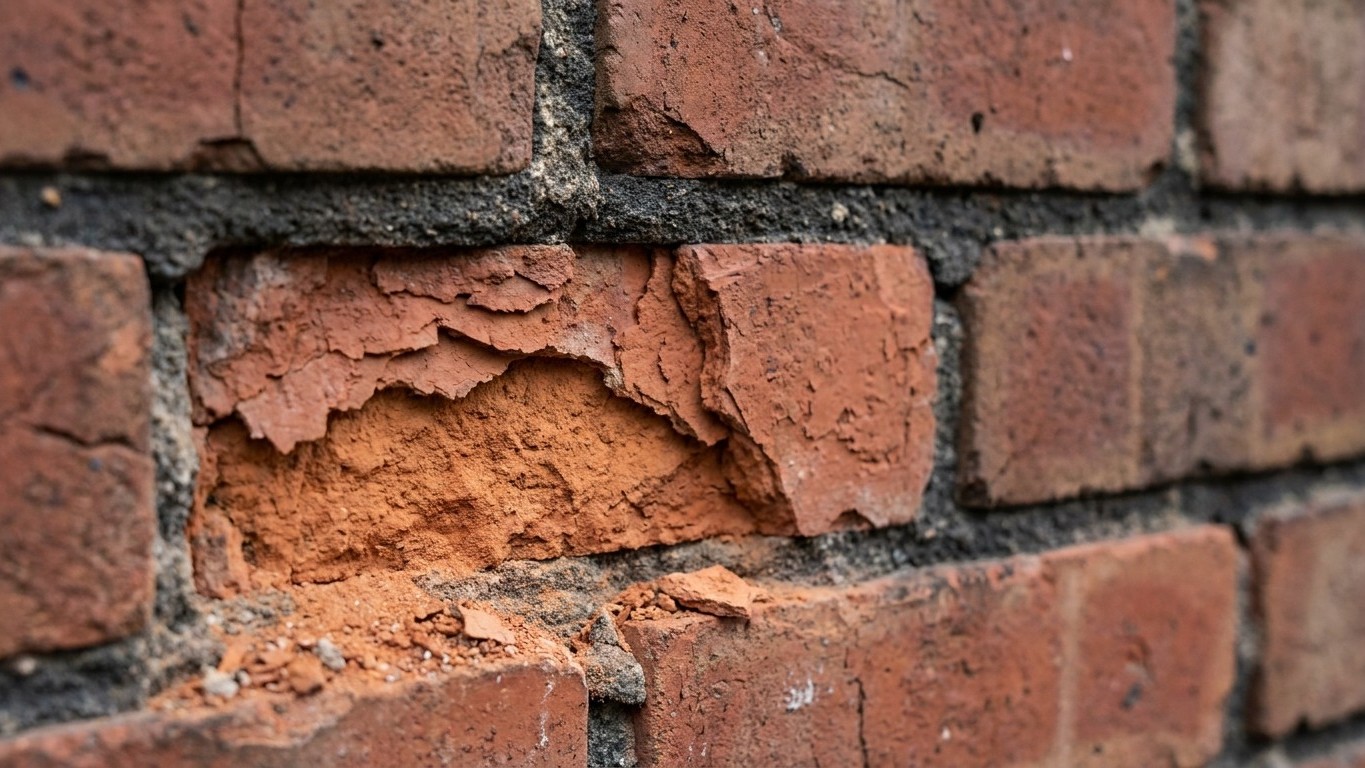
Repointing a Victorian brick wall with modern cement mortar is one of the most well-intentioned mistakes a homeowner can make, and the consequences can be devastating. Two winters of frost is often all it takes before you find yourself standing in the garden, holding fragments of your own brickwork. The bricks haven’t failed. The mortar has trapped them, and the damage is irreversible without significant remedial work.
Key takeaways
- Why Victorian bricks are designed for a completely different material than what most builders use today
- The freeze-thaw mechanism that turns solid walls into crumbling surfaces in just 24 months
- How the ‘sacrificial joint’ principle saves irreplaceable brickwork from becoming rubble
Why cement and old bricks are a genuinely bad combination
Victorian bricks, made before the era of industrialised firing, are softer and more porous than modern engineering bricks. They were designed, almost accidentally, to work with lime mortar, a material that stays slightly flexible, breathes, and crucially, sacrifices itself before the masonry does. When a wall expands and contracts with temperature changes, lime mortar accommodates the movement. It may crack hairline-thin over decades, but those cracks are repairable. The bricks themselves remain intact.
Cement mortar does the opposite. Once set, it is harder than the surrounding Victorian brick, often dramatically so. Moisture that enters the wall, through rain, condensation, or rising damp, cannot escape through the mortar as it once did. It is forced instead through the brick face itself. When that moisture freezes, it expands by roughly nine percent in volume. The brick face, caught between a hard cement joint and an icy interior, has nowhere to go. It spalls, that is, it pops, flakes, and eventually crumbles away. The technical term is spalling, and once it begins, it accelerates with each freeze-thaw cycle.
The frost damage tends to concentrate along the mortar line because that is precisely where moisture accumulates, unable to disperse. After two winters, what looked like a sound repointing job can leave a wall that resembles a rather sorry-looking cracker, with the surface of the brick flaking off in satisfying but alarming sheets.
The real cost of a well-meaning repair
Many people reach for cement mortar because it is what builders’ merchants stock most prominently, it sets quickly, and it looks tidy. There is also a persistent idea that stronger is better, if standard mortar cracks, surely a harder mix will hold? The logic is understandable. It is also, unfortunately, backwards.
The Society for the Protection of Ancient Buildings has long advocated for lime mortar in historic masonry, and their technical guidance on this subject is freely available and worth reading before any repointing project on a pre-1920s building. The principle is sometimes called the sacrificial joint: the mortar is intended to be the weaker element, taking the stress so the irreplaceable brickwork does not have to. Victorian bricks cannot be sourced new; matching them requires reclaimed yards, specialist suppliers, and considerable expense. Cement mortar saved on the materials bill can cost many times its value in brick replacement.
There is also the question of planning constraints. If your Victorian property is listed, or sits within a conservation area, using cement mortar on original brickwork may actually contravene planning conditions, something worth checking with your local authority before any work begins, not after.
What to do if the damage has already been done
The first step is to stop the situation from worsening, which means getting the cement mortar out. This is painstaking work. A thin angle grinder disc is typically used with great care, cutting along the mortar bed rather than touching the brick arrises (those are the sharp edges of the brick face). Many conservators prefer to finish by hand with a plugging chisel, which is slower but far less likely to cause additional damage. The goal is to remove the cement to a depth of roughly 20 millimetres without disturbing what remains of the brick face.
Once the cement is out, the wall needs time to dry properly, ideally several weeks in dry weather, before any new pointing goes in. The replacement mortar should be a lime-based mix, traditionally a hot-mixed lime putty mortar or, more conveniently for most homeowners, a natural hydraulic lime (NHL) mortar. For Victorian brickwork, an NHL 2 or NHL 3.5 is generally appropriate; the numbers refer to the compressive strength. You want something that sets slowly, remains slightly permeable, and moves with the structure.
As for the spalled bricks themselves, some can be stabilised with specialist consolidants, and a conservator may be able to advise on options. Severely damaged bricks will need replacing with matched reclaimed stock. A good builder’s merchant or specialist reclaim yard can often help with colour and size matching, though it takes persistence. Victorian bricks varied considerably by region, a London stock brick is quite different from a Staffordshire blue or a Cheshire red — so sourcing like-for-like is worth the effort.
Getting it right the second time
Repointing with lime is not inherently more difficult than using cement, but it does require different handling. Lime mortars take longer to cure and must be kept damp for the first few days, particularly in warm or windy weather. They should not be applied when frost is forecast within 24 hours, nor in temperatures below about five degrees Celsius. Applying them in autumn or early spring, when the weather is mild and damp, actually suits them rather well.
A small test panel in an inconspicuous spot is always sensible before committing to a full wall. This lets you check the colour match once the mortar carbonates and lightens, which can take several weeks. Lime mortar finishes slightly differently to fresh cement, and some people are caught out by how pale it goes as it cures.
One thing that surprises most people is that a properly repointed lime wall, done correctly, should need minimal attention for fifty years or more. Victorian buildings that have retained their original lime pointing, never touched by cement, are quite often in better structural condition than those that have been repeatedly “modernised.” The original builders, working without power tools or polymer additives, happened to get the fundamentals exactly right.