
There’s a particular kind of misery that comes with thin walls. You’re trying to sleep, and your neighbour is apparently hosting a one-man theatre production next door. Or you’re working from home, and every word of the postman’s cheerful chat drifts straight through your front door as though the wood were made of tissue paper. Sound travels through gaps and hollow-core doors with astonishing ease, and the good news is that you don’t need a builder, a big budget, or even a whole weekend to do something meaningful about it.
Key takeaways
- Why most interior doors are practically invisible to sound waves
- A solution costing just a few pounds that delivers results within hours
- What soundproofing methods actually don’t work (and why people keep trying them)
Why Your Door Is Probably the Worst Offender
Most interior doors in British flats, and plenty of front doors too, are what’s called hollow-core. Run your knuckles across the surface and you’ll hear a dull, papery knock rather than a solid thud. That gap-filled interior offers almost no resistance to sound waves, which simply travel around and through the door as if it weren’t there. The frame is often just as guilty. Even a well-fitted solid door will leak noise freely if there are gaps around the edges, and in older properties those gaps can be wide enough to feel a draught with your hand.
A friend of mine in a converted Victorian house once told me she could hear her flatmate’s phone conversations so clearly she felt obliged to pretend she hadn’t. The problem wasn’t the walls. It was the gap beneath the door, a good centimetre of open air, doing absolutely nothing to stop the sound.
The Fix That Costs Less Than a Takeaway
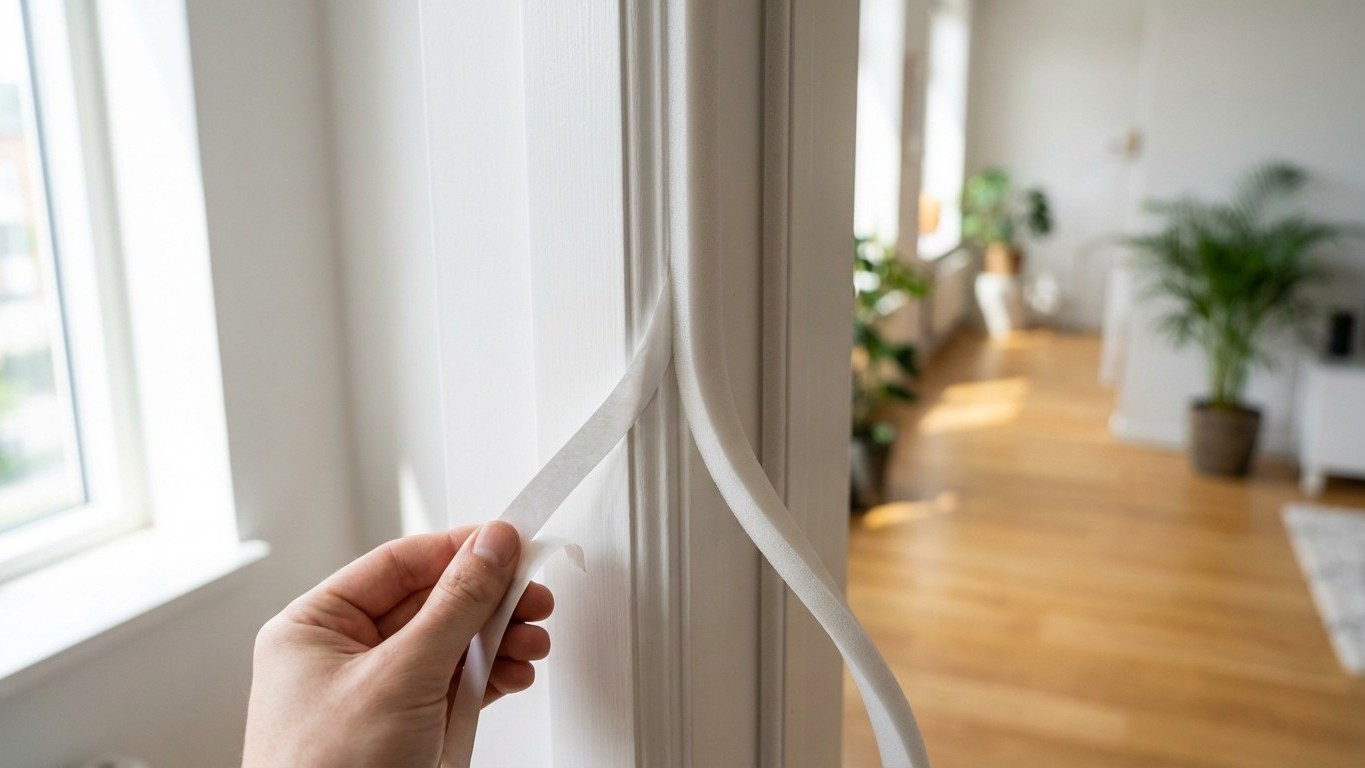
The single most Effective cheap solution is a door Draught excluder strip, the self-adhesive foam or rubber kind that you press around the door frame. These cost a few pounds from any DIY shop or online, and a full door kit typically covers all four sides of a standard door. The foam compresses when the door closes, sealing those edges and dramatically reducing the path sound has to travel. You won’t achieve studio-grade silence, but the difference is genuinely striking, especially for voices and television noise.
The bottom of the door deserves separate attention. A door sweep, which is a brush or rubber seal fixed to the base of the door, addresses that notorious gap at the floor. Some versions screw in place with just a screwdriver; others use adhesive. For renters who’d rather not drill anything, a good old-fashioned draught excluder sausage (the fabric tube you simply lay against the door) does a reasonable job, though it won’t seal as tightly as a fixed sweep. Either way, closing that floor gap makes an immediate difference.
If your door is hollow-core and you own your flat, there’s a slightly more involved option worth considering: adding mass. Sound needs to vibrate surfaces to pass through them, and heavier surfaces vibrate less. A layer of acoustic mass-loaded vinyl, cut to size and attached to the door face, adds real density for a modest outlay. It’s not a glamorous solution, and you’ll probably want to cover it with something more presentable, but the physics is sound (so to speak).
The Room Where It Matters Most
Think carefully about where you direct your efforts. In a flat, the bedroom door and the main living room door tend to matter most. Sealing both can transform your sleep, and if you work from home, sealing your home office door might be the single most practical thing you do this year. Sound isolation isn’t about perfection; it’s about reducing distraction to a manageable level, and even a modest drop in noise can shift your brain out of that exhausted, hyper-alert state that comes from constant background intrusion.
Curtains and soft furnishings help absorb sound within a room, but they do very little to stop it travelling between rooms. The door seal is doing the structural work. Heavy curtains across a door can add a small extra barrier, and in period properties people have hung floor-length velvet curtains over internal doorways for exactly this reason, but the seal comes first.
A Word on What Won’t Work
Foam tiles, the kind sold for children’s play areas, stuck to a wall will have almost no effect on sound transmission between rooms. They absorb echo within the space, which can make a room feel quieter, but they don’t stop airborne sound travelling through structures. The same applies to egg boxes, which have persisted as folk wisdom despite doing essentially nothing useful for soundproofing. I say this kindly, because I’ve seen many well-meaning DIY attempts that put effort into the wrong place entirely.
White noise machines are worth a mention too. They don’t stop sound coming in, but they mask it, and for sleep especially they can be a genuinely helpful complement to physical sealing. A small fan or a simple white noise app does much the same job at no cost at all.
The draught seal strip remains, after all of this, my top recommendation for renters and homeowners alike. A few pounds, half an hour, a clean pair of scissors and a steady hand. The transformation isn’t magic, but it is the sort of quiet satisfaction you get when something simple actually works. And once you’ve slept through a whole night without hearing your neighbour’s television, you do start to wonder what else in your home might be fixed with something equally unglamorous and equally effective.