
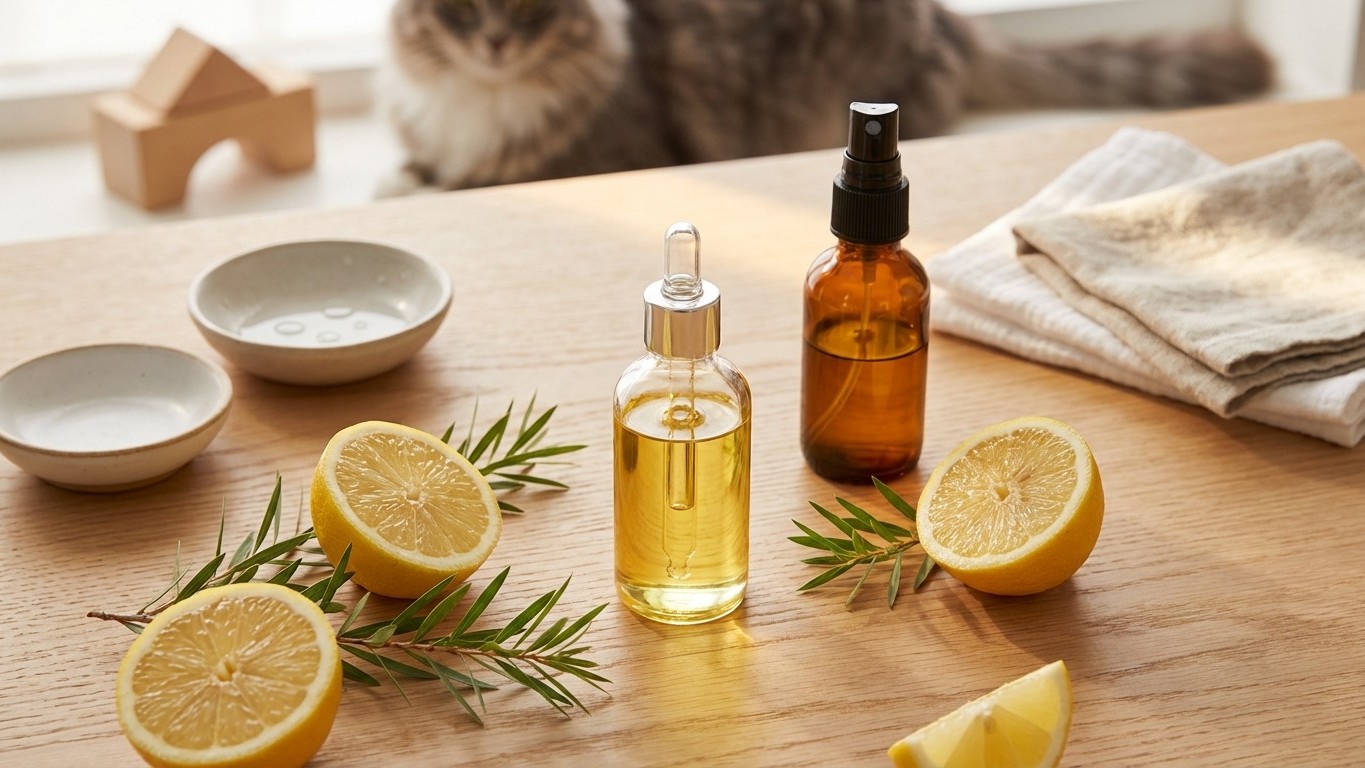
A few drops of the right oil can transform your cleaning routine from a chore into something that actually smells wonderful, and genuinely works. Essential oils have been used in households for centuries, long before the words “eco-friendly” or “non-toxic” became fashionable. The renewed interest in them makes complete sense: they clean, they disinfect, they deodorise, and they leave your home smelling like a French apothecary rather than a chemical factory. The catch? They’re potent, concentrated botanical extracts, and when used carelessly around children, babies, cats or dogs, they can cause real harm. This guide gives you both sides of the story: the useful hacks and the honest safety advice.
Why essential oils work so well for cleaning
The cleaning power of essential oils isn’t just pleasant folklore. Many contain compounds, terpenes, phenols, aldehydes, that have documented antimicrobial, antifungal and antiviral properties. Tea tree oil, for instance, contains terpinen-4-ol, a compound that disrupts the cell membranes of bacteria and fungi. Lemon essential oil contains limonene, which cuts through grease with the same mechanism as commercial degreasers, just without the synthetic solvents. These aren’t marketing claims; they’re the chemistry behind why your grandmother’s lemon-scented cupboard stayed fresh.
There’s also the question of smell. Synthetic fragrances in conventional cleaners often contain phthalates and other compounds that linger in indoor air. Essential oils, used sensibly, offer a genuine aromatic experience that dissipates cleanly. Your kitchen smells of eucalyptus for twenty minutes, then nothing. No cloying chemical ghost.
For natural cleaning hacks that go well beyond essential oils, there’s a whole world of simple ingredients that work together brilliantly, and essential oils slot into that world as powerful finishing touches rather than standalone solutions.
The best partners: other natural ingredients
Essential oils almost always work better in combination with other natural cleaners. White vinegar cuts limescale and kills mold spores. Bicarbonate of soda deodorises and gently abrades. Castile soap lifts grease and dirt. Essential oils bring the antimicrobial boost and the scent. Think of them as the seasoning, not the main course. A spray bottle of diluted white vinegar with ten drops of tea tree oil is a genuinely effective bathroom disinfectant, the vinegar does the heavy descaling, the tea tree handles the microbes. For more on how these ingredients complement each other, the cleaning with vinegar and baking soda hacks guide covers the chemistry and the combinations in satisfying detail.
The best essential oils for your home, and the ones to handle carefully
Lemon, tea tree, lavender, and their particular talents
Lemon essential oil is the cheerful all-rounder. It degreases, brightens, and smells unmistakably clean. Use it on kitchen surfaces, inside the fridge, on greasy hob surrounds. Ten drops in a spray bottle with diluted castile soap and water handles most kitchen messes with ease.
Tea tree (Melaleuca alternifolia) is your bathroom’s best friend. Its antifungal properties make it the go-to for tackling mould and mildew on tile grout, around the bath, or on the shower curtain. It’s effective, but its smell is medicinal and quite strong, some people find it overpowering. A few drops go a very long way.
Lavender brings calm to the cleaning cupboard. It’s antimicrobial enough to be useful, gentle enough to use around most surfaces, and its scent is universally adored. It works beautifully in fabric freshening sprays and as a finishing touch to floor cleaners. Combined with bicarbonate of soda, it makes an excellent carpet deodoriser.
Eucalyptus oil handles grease, kills dust mites, and tackles sticky residue (think label glue left on jars). Peppermint is a natural insect deterrent, ants, spiders and mice reportedly dislike it intensely, making it useful for spraying along skirting boards. Clove and cinnamon bark oils have powerful antimicrobial properties but require extra caution as they can irritate skin and are particularly hazardous to cats.
Oils to approach with real caution
Not all essential oils belong in a family cleaning routine. Pennyroyal, wintergreen, and undiluted oregano oil are aggressive compounds that can cause skin burns and are toxic to most household pets at very low concentrations. Clove, cinnamon bark, and thyme (thymol) are effective but harsh, they can damage certain surfaces and cause skin sensitisation with repeated exposure. Pine and citrus oils, while generally safer for humans, are metabolised poorly by cats and should be kept away from any surface a cat might walk across and then groom from their paws.
A practical rule: if an oil smells aggressively “hot” or medicinal straight from the bottle, treat it with the same respect you’d give a strong chemical cleaner.
Ten practical cleaning hacks with recipes
Each recipe below uses a 2% dilution or lower for general cleaning, that’s roughly 10-12 drops of essential oil per 100ml of carrier liquid (water, vinegar, or castile soap solution). This is the standard safe dilution for surface cleaning in a home where adults are the primary users. Adjustments for households with children or pets follow in the next section.
All-purpose disinfecting spray: 200ml water, 50ml white vinegar, 10 drops tea tree, 5 drops lemon. Shake before each use. Excellent for worktops, door handles, and bathroom surfaces. Do not use on granite or marble (the vinegar will etch the stone, stick to diluted castile soap on natural stone instead).
Floor cleaner: Add 5-8 drops of lavender or eucalyptus oil to a bucket of hot water with a small splash of castile soap. Mop as normal. Your floors will smell fresh without any chemical residue. Avoid on unsealed wood floors, which don’t love water in any form.
Fabric and carpet freshener: Mix 200g bicarbonate of soda with 15 drops lavender and 10 drops lemon oil. Stir well, leave for 24 hours for the scent to infuse, then sprinkle on carpets and soft furnishings. Leave for 15-20 minutes and vacuum thoroughly.
Drain and siphon cleaner: Pour half a cup of bicarbonate of soda down the drain, followed by half a cup of white vinegar. Wait ten minutes for the fizzing to do its work. Finish with a kettle of boiling water and 3-4 drops of tea tree oil poured directly into the drain to discourage bacterial buildup. This is a maintenance trick rather than a cure for a serious blockage, but it works beautifully as a weekly routine.
Bin deodoriser: Place a cotton wool ball with 5 drops of tea tree and 3 drops of lemon at the bottom of the bin before inserting the bag. Replace weekly. The smell of a clean kitchen bin is something to be genuinely proud of.
Anti-dust mite spray for mattresses and sofas: 200ml water, 10 drops eucalyptus, 5 drops lavender, a teaspoon of white vinegar. Spray lightly over the mattress surface, allow to dry completely before replacing bedding. Once a fortnight is sufficient.
Anti-mould bathroom spray: 200ml water, 20 drops tea tree, 5 drops clove (for adults-only households, see safety section if children or pets are present). Spray on affected grout or silicone, leave for an hour, scrub and rinse. For persistent mould, the cleaning hacks with lemon for limescale guide covers complementary approaches that work well alongside this treatment.
Fridge and microwave freshener: A bowl with half a cup of water and 3 drops of lemon oil, microwaved for 90 seconds, softens any dried spills and leaves the interior smelling clean. For the fridge, a small open container with bicarbonate of soda and 3 drops of lemon oil absorbs odours passively over several weeks.
Window and glass cleaner: 200ml water, 50ml white vinegar, 5 drops peppermint oil. Spray on glass, wipe with a crumpled sheet of newspaper or a microfibre cloth for a streak-free result. The peppermint deters flies from lingering near windows, a pleasant bonus in summer.
Natural insect repellent spray for skirting boards: 200ml water, 10 drops peppermint, 5 drops eucalyptus, 5 drops lavender. Spray along skirting boards, window frames and entry points. Refresh every two weeks. Do not apply where cats walk (see safety section).
Safety around children, babies, and animals, the part that really matters
Which oils to avoid entirely in a family home
Cats are the most vulnerable domestic animal when it comes to essential oils. Their livers lack certain enzymes needed to metabolise many plant compounds, meaning oils that are perfectly harmless to humans can accumulate to toxic levels in a cat’s body. The oils to avoid in any home with cats are clove, cinnamon, tea tree, eucalyptus, pennyroyal, wintergreen, pine, citrus-family oils (including lemon, orange and bergamot), and peppermint. That’s quite a list. If you have cats, lavender in low dilutions is generally considered the safest option, but diffusing any essential oil in a room where a cat spends time is best avoided entirely.
Dogs are somewhat more resilient but still sensitive to tea tree (even diluted), pennyroyal, cinnamon, clove, and citrus oils. Cleaning surfaces they regularly lick, food bowls, certain floor areas, with essential oil solutions is not advisable.
For babies under three months, all essential oils are too strong. For children under two, lavender in very low dilutions (0.5% or below, that’s 2-3 drops per 100ml) on surfaces they don’t touch is the maximum advisable approach. For children aged two to six, a 1% dilution maximum applies to any surface cleaning that takes place in their environment.
Sensible dilutions and safe methods
The cleaning with vinegar and baking soda hacks approach is actually the safer baseline in a household with very young children or sensitive pets, essential oils can then be added very sparingly to adult-only cleaning tasks, or omitted entirely where needed. There’s no shame in using the simplest, safest option.
Always dilute in a carrier before adding to water. Adding essential oils directly to water without first mixing them into a small amount of castile soap or washing-up liquid means the oil floats rather than dispersing, you end up with concentrated droplets rather than an even solution. This matters both for effectiveness and for safety.
Ventilate the room after cleaning. Open a window for ten minutes. This is good practice with any cleaning product, natural or otherwise, and it allows volatile compounds to dissipate rather than accumulate in the air your family breathes.
Frequently asked questions
Can essential oils replace vinegar or bicarbonate in cleaning? No, not as direct substitutes. Vinegar descales, bicarbonate deodorises and abrades, essential oils do neither of those things on their own. They are antimicrobial and aromatic enhancers that work beautifully alongside other natural ingredients, not instead of them.
How many drops should I use in a homemade cleaner? For general household cleaning used by adults, 10-12 drops per 100ml of liquid gives you a 1-2% dilution, which is both effective and safe. For households with children under six or sensitive pets, halve that amount and choose gentle oils only (lavender, lemon in low doses).
Is it safe to diffuse essential oils in the kitchen while cleaning? For adult households, briefly, yes. Keep diffusion sessions under 30 minutes and ensure good ventilation. With cats or very young children present, skip the diffuser and use your cleaning solution with a cloth instead.
Five principles for a safe natural cleaning routine with essential oils
Before you head to the kitchen to mix your first batch, these five principles are worth keeping close. Always dilute, never use essential oils neat on any surface or skin. Choose your oils based on who (and what) lives in your home, not just what smells nicest. Label every bottle you make with the ingredients and date, just as you would any cleaning product. Store out of reach of children, in a cool dark place (heat and light degrade both the oils and the plastic bottles). And when in doubt, leave the essential oil out — a simple vinegar and water solution is often all you actually need, and it’s never hurt a cat or a toddler yet.
Natural cleaning is, at its heart, about choosing what goes into your home with the same care you’d choose what goes into your meals. Essential oils can be a genuinely joyful part of that, the smell of a freshly mopped floor with lavender and lemon is one of life’s quiet satisfactions. The question worth sitting with is: are you reaching for them because they’re right for this task, or because the bottle smells lovely? Both are valid starting points, as long as you know the answer.