
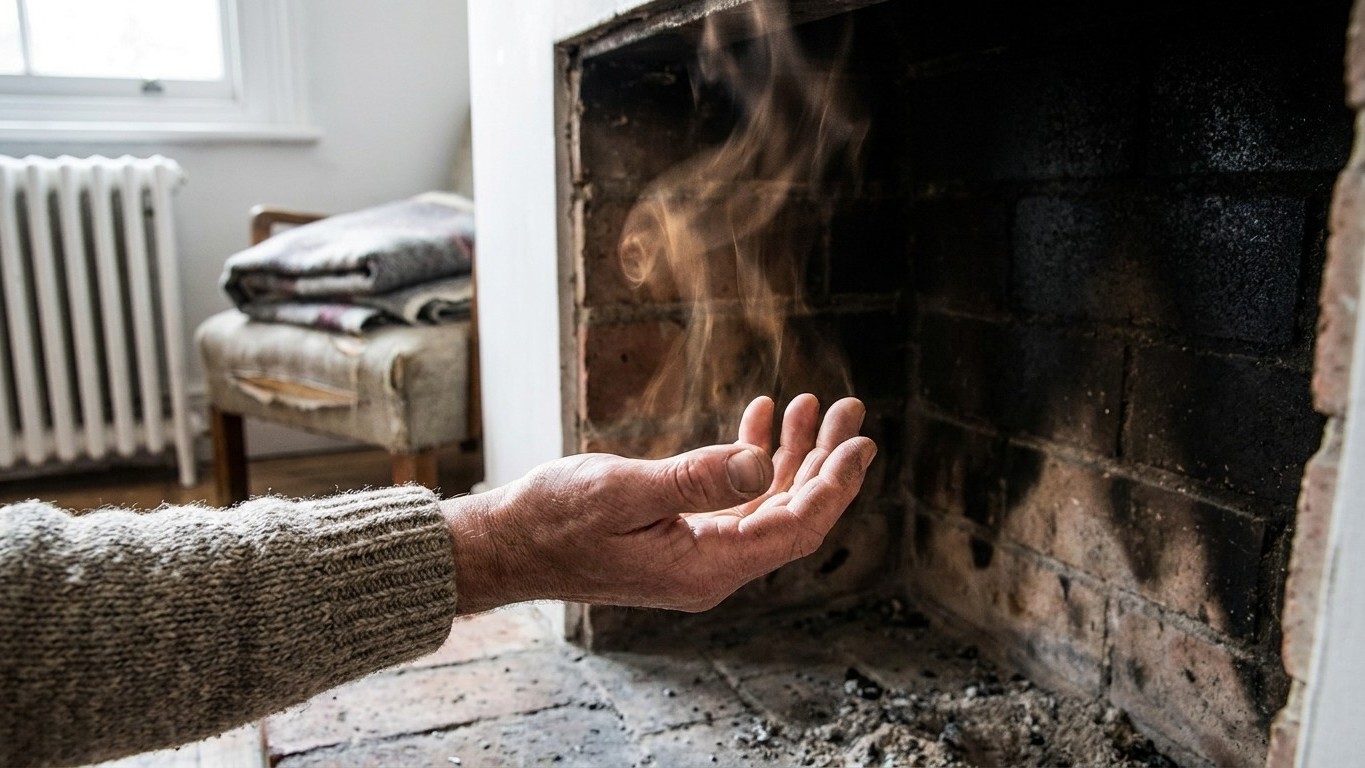
That chill creeping back into your living room by eight o’clock, even with the radiators blazing, has nothing to do with your double glazing. Walk over to the fireplace and hold your palm just inside the opening. Feel that pull of air? An open chimney is often the biggest source of heat loss in a house because it draws warm air out of your home all of the time, even when it’s not in use, with an average of 80 cubic metres of air travelling up an open chimney every hour, which is like leaving a window open all the time. Windows get blamed for draughts constantly, but a hearth with nothing blocking it is doing far more damage, quietly, hour after hour.
Key takeaways
- One unsealed chimney loses 40–80 cubic metres of warm air per hour, equivalent to leaving a window permanently open
- Across the UK, unused chimneys waste 6.4 billion kWh annually—the output of a major power station
- Proper draught excluders can save the average household £125 per year, with payback in a single winter
Why your fireplace behaves like a permanently open window
The physics here has a name: the stack effect. It’s called the stack effect, when warm air is drawn up an open chimney and cold air is pulled into your home from outside replacing it. Your central heating warms the air, that warm air rises straight up the flue because heat always seeks the coolest route out, and the room then has to pull in cold air from somewhere else to replace what’s vanished. That “somewhere else” is usually under doors and around window frames, which is exactly why people wrongly point the finger at their windows when the real leak is sitting above the hearth. If central heating is on when a fire isn’t lit, a roomful of 40 cubic metres of warm air will disappear up the flue within an hour, and this escaping air needs to be replaced, so cold air is pulled in from under doors and round windows, creating cold draughts. Whether the true figure for your particular flue is closer to 40 or 80 cubic metres an hour depends on the width and height of the chimney, but either way, that’s a lot of hard-earned heat vanishing into the Yorkshire sky (or wherever your chimney pot happens to be pointing).
The Building Research Establishment actually went and measured this properly rather than just estimating it. Their airflow study found that 15 out of 20 monitored homes had open fireplaces, with 8 never used, yet still leaking heat. Never lit in years, and still behaving like a permanent hole in the wall. Scaled up across the whole country, the numbers get properly startling. Across the UK, the total energy loss from unsealed chimneys could exceed 6.4 billion kWh per year, comparable to the output of a large power station. That’s not a rounding error in anyone’s energy bill; that’s a genuinely enormous drain, and it’s happening in millions of front rooms up and down the country while people quietly resent their boiler for “not working properly.”
What it’s actually costing you in pounds and pence
Sustainable building specialist Tim Pullen puts the scale of the problem in stark terms: “An unused chimney can account for up to 50% of the heat escaping from a house.” Half. Even taking a more conservative estimate, as much as 5% of your home’s heat will be lost because of open fireplace draughts, and that’s before you factor in the knock-on effect of the thermostat working overtime to compensate, which pushes your gas usage up right alongside it.
Blocking that airflow properly makes a measurable dent in your bills, according to independent testing. Chimney Sheep draught excluders can reduce draughts by blocking 93% of airflow, while the Chimney Balloon has been tested by BSRIA and was found to block 87% of airflow up the chimney. Translated into money, one supplier calculated that this helps ensure households are heated efficiently, saving consumers over 4% on their household energy bills, equating to a saving of £125 for the average household based on the Energy Price Guarantee of £2,500. A separate retailer’s figures put it more modestly at around £23 a year per chimney for a typically sized flue, which sounds unremarkable until you remember most Victorian terraces have two or three of the things dotted about the house, each one leaking away independently.
Fixing it without inviting damp back in
Here’s where I’d urge a bit of caution, because sealing a chimney completely and sealing it sensibly are two different jobs. Chimneys need a little airflow to stay dry; brick and mortar are porous, and a flue with zero ventilation at all can turn damp surprisingly fast. A disused flue still needs some residual ventilation to help keep it dry. This is precisely why the sensible products on the market, wool pads, magnetic blankets, inflatable balloons, are designed with a deliberate gap or vent built in rather than forming an airtight plug. A wool draught excluder, for instance, wedges into the throat of the flue just above the fireplace opening and can simply be pulled out again whenever you fancy lighting a fire, while an inflatable version sits a little further up and has a small vent in the side which allows some airflow, permitting your chimney to “breathe” and ensuring damp doesn’t occur in your property.
If you’re keeping the fireplace as a feature rather than sealing it forever, a register plate above the opening, combined with insulation packed into the flue void above it, does a similar job on a more permanent basis, though as one draught-proofing guide notes, if the fire opening is closed off the insulation will sit on the slab, but if you keep the fireplace open then a register plate will be needed to retain the insulation in the flue. Either route costs a fraction of what you’d spend re-glazing a window, and the payback, given the savings figures above, tends to arrive within a single winter.
One thing worth remembering before you get too enthusiastic with the draught excluder: take it out again every single time before you light a fire, no exceptions, and give the flue a proper sweep once a year regardless of whether you’ve burned anything in it. A wool pad or balloon left in place behind a lit fire is a genuine hazard, not just an inconvenience, so treat it as a seasonal fitting rather than something you forget about until next spring.
Sources : chimneysheep.co.uk | chimneycowls.uk