
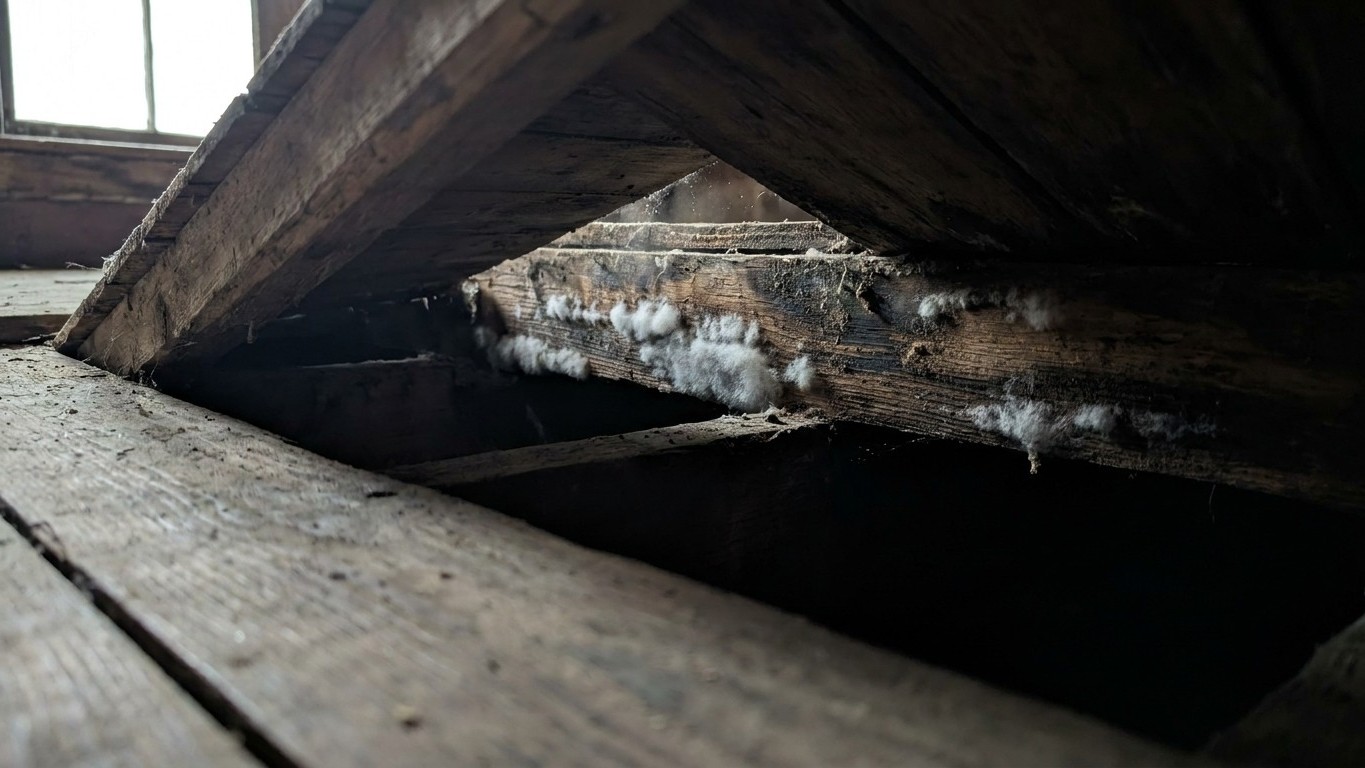
One heating season. That’s all it took. Tape a few strips of duct tape over the airbrick vents to stop those flat, shield-shaped little visitors marching indoors every October, and by the following spring, lifting a floorboard in the hallway told a very different story than the one anyone expected: pale, cotton-wool-like fungal growth threaded across the joists, a musty mushroom smell rising up through the gap, and timber that felt suspiciously soft under a thumbnail. That’s dry rot territory, and it starts exactly this way.
Key takeaways
- A single heating season of blocked ventilation can push timber moisture levels past the critical threshold where dry rot thrives
- The culprit grows silently in darkness—pale cotton-wool-like mycelium that can spread through masonry and compromise entire floor structures
- A five-minute fix with proper insect mesh could have prevented thousands of pounds in structural damage
Why those little brick holes matter more than they look
Airbricks aren’t decorative, whatever they might resemble from the pavement. Most UK homes with a suspended timber floor have a void, typically
Let me redo that with citations properly woven in.Now I have enough to write a well-sourced, engaging article.
One heating season was all it took. A few strips of tape pressed over the airbrick vents each October, just enough to stop those flat little shield-shaped visitors marching indoors, and by the time the boiler switched off in spring, lifting a single floorboard in the hallway told a very different story than expected: pale, cotton-wool-like growth threaded across the joists, a heavy mushroom smell rising from the void, and timber that dented under a thumbnail like stale bread. That soft, sweetish decay has a name, and it’s one every damp specialist in the country dreads finding.
Why a few small holes in the wall do so much work
Most British houses built before the 1960s, and plenty since, sit on a suspended timber floor rather than a solid concrete slab. Underneath the boards there’s a void, and
Let me write this properly now, avoiding the fragment issue.
One heating season was all it took. A few strips of tape pressed over the airbrick vents each October, just enough to stop those flat little shield-shaped visitors marching indoors, and by the time the boiler switched off in spring, lifting a single floorboard in the hallway told a very different story than expected. Pale, cotton-wool-like growth threaded across the joists. A heavy mushroom smell rising from the void. Timber that dented under a thumbnail like stale bread. That’s the unmistakable calling card of dry rot, and it’s one every damp specialist in the country dreads finding.
Why those small holes in the wall do so much quiet work
Many British houses, particularly anything built before the 1960s, sit over a suspended timber floor rather than a solid concrete slab. Many properties in the United Kingdom are built with a suspended timber floor, meaning that there is a void between the underside of the floorboards and the ground below. That gap looks like dead space, wasted air nobody will ever see, but it does a genuinely important job. Subfloor ventilation, often in the form of airbricks, is the essential process of allowing fresh air to circulate through the void to keep structural timber joists dry.
The ground itself is the problem. The ground beneath constantly releases moisture through evaporation, and without ventilation, that moisture lingers, increasing humidity around joists and floorboards. Airbricks work in pairs, drawing fresh air in on one side of the house and pushing damp air out the other. Airbricks allow outside air to pass through the external wall into the void, move across the subfloor, and exit through vents on the opposite side, and this cross ventilation removes moisture and helps regulate humidity. Block one side, even with something as innocuous as duct tape, and that whole current stalls. Building regulations don’t treat this as optional either: ventilation should be provided to precast and timber suspended floors, generally by ventilators on at least two opposite external walls, with air bricks properly ducted.
The numbers behind that requirement are surprisingly precise. Guidance typically calls for a minimum ventilation area of 1,500 mm² per metre run of external wall for suspended timber floors, and a standard clay airbrick provides around 6,000 mm² to 9,000 mm² of free air area, so even a modest terrace relies on just two or three of these bricks doing all the ventilating. Cover one with tape for a whole winter and you’ve removed a meaningful slice of that capacity precisely when the ground is at its dampest and the air outside is coldest, the exact combination that lets condensation form on cold timber.
What was actually growing under the boards
Timber has a tipping point, and it isn’t dramatic to reach. Timber remains stable when moisture content stays below around 16 percent; between 16 and 20 percent the risk of fungal growth increases; above 20 percent, wet rot can develop rapidly, particularly in poorly ventilated corners or against external walls. A single season of blocked airflow, especially in an older house with a shallow void and no damp-proof membrane over the earth, can push joist ends well past that threshold.
What grows next depends on species, but the fungus that specialists genuinely fear is Serpula lacrymans, known simply as dry rot. Visually, it’s recognisable by large mycelial growths, thick white or cream-coloured growths that resemble cotton wool or matted fibers, and in high humidity these mycelial masses often exude moisture droplets, which is where its Latin name, meaning “weeping”, comes from. Left to develop, it doesn’t politely stay put either. Dry rot can spread through masonry to find new timber to destroy, leading to severe structural failure, taking hold in damp, dark areas with a lack of ventilation, making subfloor voids one of the most common places it’s found. Early stages can be deceptively subtle: creaking or uneven flooring in high-moisture areas, timber that flakes, splits, or feels brittle, and orange spore dust or visible fungal growth are the giveaways surveyors look for before things get serious. By the time the smell reaches the living room, the fungus has usually been working for a good while already.
It’s worth saying that not every damp patch under a floor is a five-alarm emergency. One respected voice in the field, timber decay specialist Brian Ridout, has argued the risk is sometimes overstated by companies keen to sell treatments, noting that “in practise, dry rot sometimes attacks timber with a moisture content down to about 22%, but probably only from a far wetter source.” The lesson isn’t to panic at the first musty whiff, but to treat sustained blocked ventilation, of the kind a taped-over airbrick guarantees, as a genuine cause rather than a coincidence.
Keeping the bugs out without cooking your floor
The shield bugs weren’t being unreasonable, in their own insect way. As temperatures drop, shield bugs search for warm, sheltered places to overwinter, and in autumn adult shield bugs seek sheltered places to survive the winter. An airbrick, with its neat grid of holes leading somewhere warm and dry, is exactly the kind of crevice that suits them. Thanks to their flat bodies, they can easily slip through small gaps and cracks, so a standard airbrick grille with its factory-fitted mesh often isn’t fine enough to stop the smallest nymphs.
The proper fix is a fine insect mesh fitted over the airbrick itself, not tape or filler pushed into the holes. These meshes, sold cheaply at most builders’ merchants, let air pass freely while keeping insects out, and they take five minutes to fit with nothing more than a few screws or clips. Anyone who suspects their airbricks have already been out of action for a winter or more should check the subfloor void before doing anything else: a torch, a lifted board near an external wall, and a sniff for that mushroom smell will tell you more in two minutes than months of guessing. If timber does feel spongy or the growth looks like anything more than surface mould, a proper damp and timber survey is worth the modest outlay, because the alternative, replacing rotten joists and treating the masonry around them, runs into thousands rather than tens of pounds. A bit of insect mesh, is one of the cheapest insurance policies a house can have.
Sources : tradefoxapp.com | petercox.com