
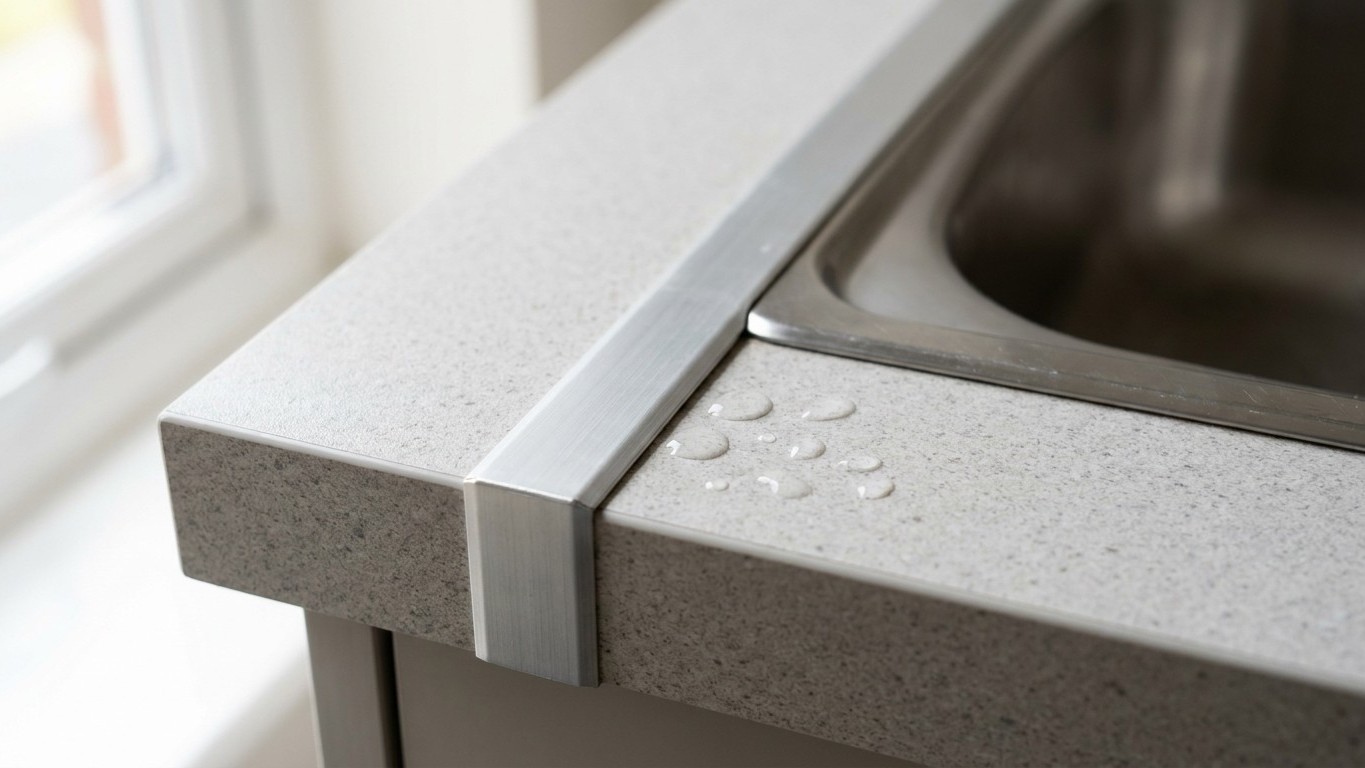
That slim strip of aluminium screwed across the corner of a worktop is doing far more than hiding an untidy join. It sits there as the last line of defence against water creeping down into the chipboard core beneath your laminate, and when it’s fitted properly, with a bead of sealant underneath rather than just screws, it can be the difference between a kitchen that lasts decades and one that quietly rots from the inside out.
The story behind this particular discovery is a familiar one to anyone who’s ever tackled a kitchen fitting job on a Saturday afternoon with more enthusiasm than patience. Two worktop sections meet at a corner near the sink, there’s a small gap where they butt together, and rather than faff about with sealant and precise measuring, the quickest fix is to screw a metal strip straight over the top and move on to the next job. It looks tidy. It closes the gap. Job done, or so it seems.
Key takeaways
- That metal strip is just protection—the sealant underneath does the real waterproofing work
- Unsealed joins let water creep into chipboard cores, causing invisible rot over 18-24 months
- Dark, damp cabinets beneath sinks become mold incubators when water seeps down from above
What that little bar is really holding back
Corner and joining strips exist for one very specific reason: joining strips bridge the gap where two worktops butt together in a straight line, and the strip covers the join and seals it against water. Left untreated, that gap isn’t just an eyesore. Where two worktops meet, where a worktop runs up to a wall, or where it ends at a cooker or a run of units, the join needs closing, because left open, that gap lets water down into the chipboard core of the worktop, and a laminate worktop swollen from underneath cannot be repaired, only replaced.
Here’s the bit most weekend fitters miss, though. The metal itself isn’t what stops the water. Most joining strips and end caps are screw-fixed to the worktop and bedded on a thin line of clear silicone sealant, which does the actual waterproofing. Screw the strip straight down onto bare chipboard with no sealant underneath, and you’ve essentially created a metal roof with no waterproof membrane beneath it. Water finds its way along the join, under the aluminium, and settles exactly where you can’t see it. Even the fixing screws themselves puncture the surface, and if that’s not sealed too, you’ve given water a direct route in.
Why two years of splashing at the sink adds up
A kitchen sink corner gets more moisture thrown at it than almost anywhere else in the house. Washing up water splashes over the edge, condensation from a kettle settles nearby, and every wipe of a cloth pushes a little dampness towards that seam. None of it looks dramatic on any given day. But water is patient, and chipboard is not. Given eighteen months to two years of steady, unnoticed seepage, the core beneath a worktop can swell, soften and eventually crumble, all while the surface above looks perfectly normal.
What compounds the problem is what’s happening underneath the sink cabinet at the same time. The cabinet beneath a kitchen sink checks nearly every box on the conditions mould needs to thrive: it is dark, often poorly ventilated, and regularly exposed to moisture through leaking pipes, condensation on cold water lines, and the occasional plumbing drip that nobody notices for weeks. Add a slow drip working its way down from an unsealed worktop join above, and you’ve created a damp, dark, airless pocket that’s practically an invitation to mould. Add in the organic materials present in the cabinet itself, such as wood, particleboard and paper labels on cleaning products, and you have a surprisingly hospitable environment for mould spores to settle and colonise.
This is precisely why pulling out a sink unit after a couple of years can be such an unpleasant surprise. What was invisible from above, a small metal strip doing its job perfectly well from the outside, has been sitting on top of a slow, silent problem the whole time. The tricky part is that a slow drip or minor condensation issue can persist for months before it is even visible to the naked eye, and by the time anyone notices a musty smell or a soft patch of board, the damage has usually been building for far longer than expected.
Getting it right without spending a fortune
None of this means aluminium strips are a bad idea. Quite the opposite. They’re a perfectly sensible, budget-friendly way to finish a worktop join, provided the sealant does the actual work and the metal simply protects it. If you’re fitting or refitting one yourself, run a proper bead of silicone sealant along the join first, press the strip down into it so the sealant squeezes out slightly at the edges, then screw it in place and wipe away the excess before it cures. Cut the strip to length with a fine-tooth hacksaw, position it over the join, mark and drill the fixing holes, run a bead of sealant along the join, then screw the strip down and wipe away the squeeze-out before it sets. It takes perhaps twenty extra minutes compared with screwing bare metal onto bare board, and that small effort is what actually keeps water out for years rather than months.
If you’ve already got a strip fitted and you’re not entirely sure how it was installed, it’s worth having a look every year or so, particularly if it sits near a sink or hob. Lift the edge gently with a thin scraper, check whether there’s still a flexible seal underneath rather than a dried, cracked line or nothing at all, and top it up with fresh sealant if it looks tired. It’s a five-minute job with a tube of sealant that costs a few pounds, done at the kitchen table with the kettle on, and it’s considerably cheaper than replacing a swollen worktop or scrubbing mould out of a cabinet floor. Old habits of checking the joins in wood and stonework every spring served our grandparents well for good reason, and a kitchen worktop is really no different from a roof or a windowsill in that respect: the join is only as good as what’s hidden beneath it.
Sources : indoordoctor.com | stairsnosinguk.co.uk