
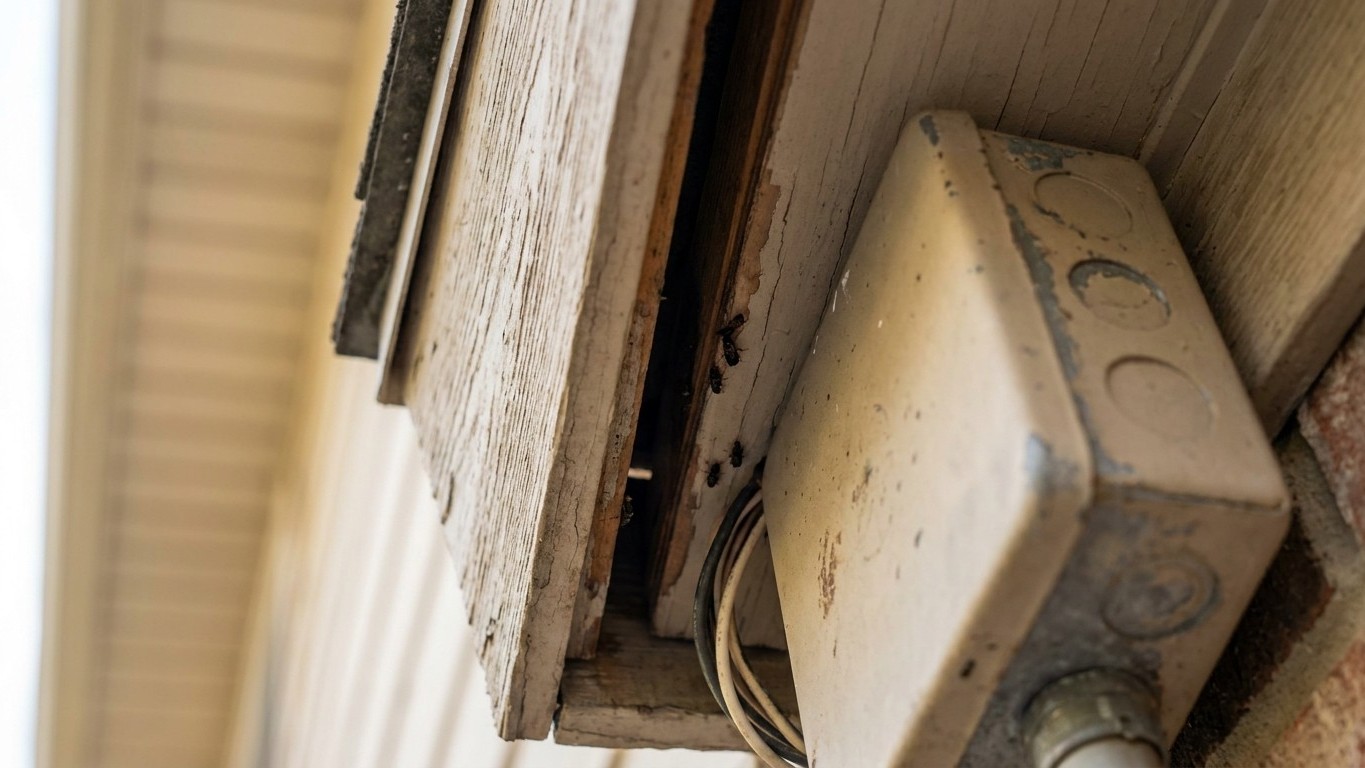
Reach for a can of wasp or fly killer this summer and aim the nozzle up into the eaves, and you might be sending a fine mist of flammable, faintly conductive liquid straight onto something that has no business getting wet: a live electrical connection. Soffits and eaves are exactly where builders tend to tuck the junction box for outdoor lights, the cable run for a doorbell camera, or the wiring feeding an alarm bell box, and they’re also exactly where wasps love to nest. Spray blindly into that gap and you’re not just tackling insects. You’re potentially dousing exposed terminals in something that was never designed to touch them.
It sounds like an unlucky coincidence, but it isn’t really. Insects go looking for dark, sheltered voids that are protected from the weather, and most insect pests prefer to establish nesting sites in conditions that are dark, moist, and located near accessible food sources, which is why they’re often found in wall voids, ceiling voids and attics. Eaves tick every box on that list. Unfortunately, electricians run their cables through the very same voids because they offer a neat, hidden route from the loft down to an outside light or a security camera. Two completely separate trades, working towards the same convenient gap in the brickwork, without ever meaning to create a hazard together.
Key takeaways
- Two trades unknowingly create the perfect hazard: insects nest where electricians hide live wires
- Aerosol insect sprays are flammable and conductive—one electrician forum compared the rating to petrol
- Even missed sprays can corrode electrical contacts invisibly for months before causing fires or failures
Why the spray itself is the real problem
The active ingredient in most wasp and hornet killers isn’t the dangerous part. It’s the aerosol carrier. Most sprays are flammable and corrosive, and you could damage the wiring or cause a fire. That’s not scaremongering from an overcautious relative; it’s the exact warning given by electrical trade advisers to anyone tempted to blast an outdoor socket or fitting clean with a can of insecticide. A forum thread among working electricians on the subject of spraying insects near a live panel put it bluntly, noting that one popular wasp spray carried a flammability rating of 4, the highest rating, meaning it’s not the best thing to spray into an energised panel. That’s the same rating given to petrol.
Then there’s the shock risk, which people underestimate because they’re thinking about the wasp, not the current. If you spray near an electric box or where wires enter your house you run the chance of an electric shock, because you’re creating a steady stream of liquid from your hand to wires and electric current. A can of aerosol produces a continuous jet for several seconds. If that jet happens to cross a gap between the nozzle and a live terminal, you’ve effectively built yourself a temporary, unwanted circuit, and you’re holding one end of it.
None of this means the wasps are harmless bystanders, mind you. Left alone, they can do their own quiet damage. Mud dauber wasps in particular can create nests that compromise electrical circuits, using their strong jaws to breach walls and build nests near wiring or insulation, which increases the risk of electrical failure and fire. So you genuinely do need to deal with a nest that’s settled against a cable or box. The trick is doing it in a way that doesn’t swap one hazard for another.
What to do instead, and why timing matters more than force
The single most useful habit, and one that costs nothing, is switching off the relevant circuit at the consumer unit before you go anywhere near an outdoor light fitting or camera junction with any liquid at all. If you’re not sure which breaker feeds the eaves lighting, isolate the whole board while you work; it’s a five-minute inconvenience against a genuine fire risk. Once the power’s off, a nest that isn’t actually inside the box can usually be treated safely from a sensible distance, using an extended nozzle or wand attachment rather than standing directly beneath it with your face and free hand in the firing line.
Timing helps too, and it’s advice that’s been printed on wasp spray labels for decades: treat nests in the evening, once the insects have returned home and settled, rather than during the day when a defensive swarm is more likely to scatter towards you, or towards that open junction box. Old pesticide product labels registered for exactly this purpose instruct users to apply after dark when all of the insects have returned to the nest, aiming the valve opening at the nest and depressing the button to soak it. Soaking a nest hanging from a fence panel is one thing. Soaking one that’s wedged behind a soffit light is a different job entirely, and one where the power really must come off first.
If the nest is genuinely tucked inside or against a light fitting, junction box, or the cable entry point itself, that’s the moment to stop and call in help rather than improvise. A pest controller can remove the insects without introducing liquid to the wiring at all, and an electrician can then check the fitting for any hidden contamination or heat damage before you switch it back on. It’s a slightly more expensive afternoon than a two-pound can of spray, but a house fire or a scorched consumer unit costs considerably more than that, and insurers aren’t always sympathetic to damage traced back to DIY pest control gone wrong.
Here’s the detail most people never think to check afterwards: even a spray that never directly touches bare copper can leave a residue that sits there quietly corroding contacts for months, so the hidden damage can build up behind the scenes, and many people don’t know there’s a problem until something smells like burning, or stops working entirely. If you’ve ever fired an aerosol up into your eaves and the outside light has flickered or died since, it’s worth having it looked at properly rather than simply changing the bulb and hoping.
Sources : quora.com | integraelectrical.co