
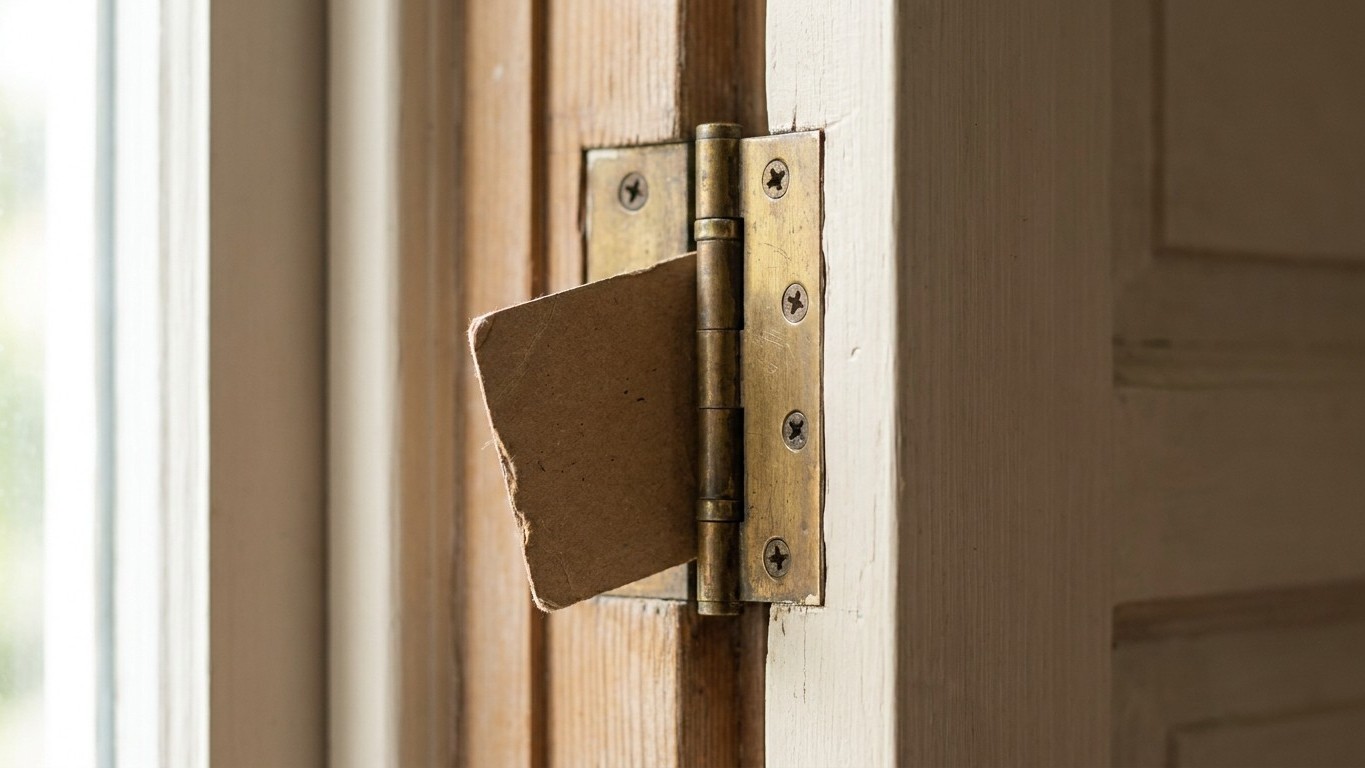
A door that catches on the frame doesn’t automatically need wood shaved off it. For generations, the real fix has been a scrap of cardboard tucked behind the hinge, not a plane taken to the edge. It costs absolutely nothing, takes five minutes, and in most cases solves the problem for good without permanently altering the door itself.
This isn’t some quaint bit of folklore that modern joiners have abandoned. It’s still the first port of call recommended by tradesmen today, precisely because it treats the cause of the sticking rather than hacking away at the symptom. When the door itself has swollen beyond what hinge adjustments can fix, material removal is the answer, but sanding or planing should only happen after you’ve identified exactly where and why the door sticks. Nine times out of ten, that “why” turns out to be something you can correct with cardboard rather than a saw.
Key takeaways
- Most sticking doors aren’t too big—they’re misaligned due to loose hinges or humidity swelling
- A cereal-box cardboard shim behind the hinge moves the door just enough to eliminate binding
- Planing removes wood permanently based on a diagnosis you probably haven’t made—and you can’t put it back
Why the plane became such a blunt instrument
Doors rarely start sticking for no reason at all. Usually the problem develops gradually as hinges loosen, wood swells from humidity, paint layers build up, or the house settles slightly over time. Reach straight for a plane and you’re removing wood permanently, based on a diagnosis you haven’t actually made. Get it slightly wrong and you’re left with a gap you can’t put back.
Hinge sag is the culprit far more often than people assume. The most common cause of a sticking interior door is hinge sag, because the upper hinge supports most of the door’s weight, and over time the screws can loosen slightly inside the framing behind the jamb. That’s not a wood problem at all, it’s a hardware problem, and no amount of sanding will fix loose screws. Equally, multiple layers of paint accumulate under hinge leaves on older doors, pushing the hinge out of its mortise and tilting the door, which again has nothing to do with the door’s edge being oversized.
Then there’s humidity, the great British seasonal villain. Wood is naturally hygroscopic, meaning its cellular structure readily absorbs and releases water vapour based on ambient humidity, so when the air is damp the fibres swell and expand across the grain, causing the door to bind against the frame. Come a dry spell, that same door often shrinks back to a perfect fit. Plane it while it’s swollen in November and by July you’ll have a rattling gap you never asked for.
Slipping cardboard behind the hinge, step by step
The shim trick works because a door that catches is usually sitting at a very slight, correctable angle in its frame, not because it’s genuinely too big for the opening. Cut a small rectangle from a cereal box (about the thickness of a business card does nicely) and follow the door’s own logic about where it rubs.
Unscrew the offending hinge leaf, whether that’s the top or bottom depends on where the door actually catches. Place the shim behind the hinge on the side where the door rubs: hinge side for a bottom rub on the hinge side, latch side for a bottom rub on the latch side. If it’s the top corner that’s fouling the frame, the fix runs the other way. Add a cardboard shim behind the top hinge leaf on the door side, which tips the top of the door slightly away from the jamb and creates clearance at that corner. Screw the leaf back down over the cardboard, rehang the door, and test.
Go gently. Use one layer of cereal-box cardboard, roughly a millimetre thick, as a starting point, and test after each layer you add. The movement is tiny but effective: a single layer of cardboard moves the door about a sixteenth of an inch, which is often enough to eliminate the bind entirely. Resist the urge to stack in three or four layers hoping for a bigger fix in one go, because too many shims can weaken the hinge attachment altogether. One thin layer, tested, then perhaps a second if needed, is the sensible order of operations. A cereal packet in the recycling bin will keep you going for every door in the house.
When cardboard genuinely isn’t enough
Sometimes the door really has swollen along its whole length, not just at one rubbing point, and no amount of hinge trickery will create clearance that isn’t there. That’s the moment a plane earns its keep, but even then it should be treated as a last resort rather than a first response. Sanding the bottom, or planing, is a permanent fix and should be done with caution to avoid removing too much material. Before any of that, though, it pays to rule out the cheaper culprits: if a hinge screw spins without tightening, the hole has probably stripped, and replacing it with a longer two-and-a-half or three-inch wood screw can reach the framing behind the jamb and pull the whole door back into alignment. That single screw swap has rescued more sagging doors than any plane ever will.
If you do end up needing to remove material, mark the trouble spot properly first. Rubbing chalk or a pencil lead along the edge of the door works well, as it transfers to the jamb exactly where the door is binding when opened and closed. Only then take the door off its hinges and work in tiny increments, checking the fit repeatedly rather than trying to solve everything with one long pass of the plane.
Stopping the sticking before it starts
Prevention here is genuinely more reliable than cure. Maintaining consistent indoor humidity, ideally between 30% and 50%, minimises wood swelling and takes most seasonal sticking off the table entirely. An unfinished or unpainted door is far more vulnerable, since raw wood soaks up ambient moisture like a sponge, so a coat of primer and paint on all six faces, top and bottom included, slows that moisture creep considerably.
One quirky detail worth knowing: British winters cause just as much trouble as damp summers, because central heating raises indoor moisture from cooking, showers, and drying laundry even while it’s freezing outside. So don’t assume your sticking door is a summer-only nuisance and reach for the plane the moment October arrives. Check the hinges first, slip in your scrap of cardboard, and give the wood a season to settle before you commit to anything permanent.
Sources : woodworkinsights.com | hometips.com