
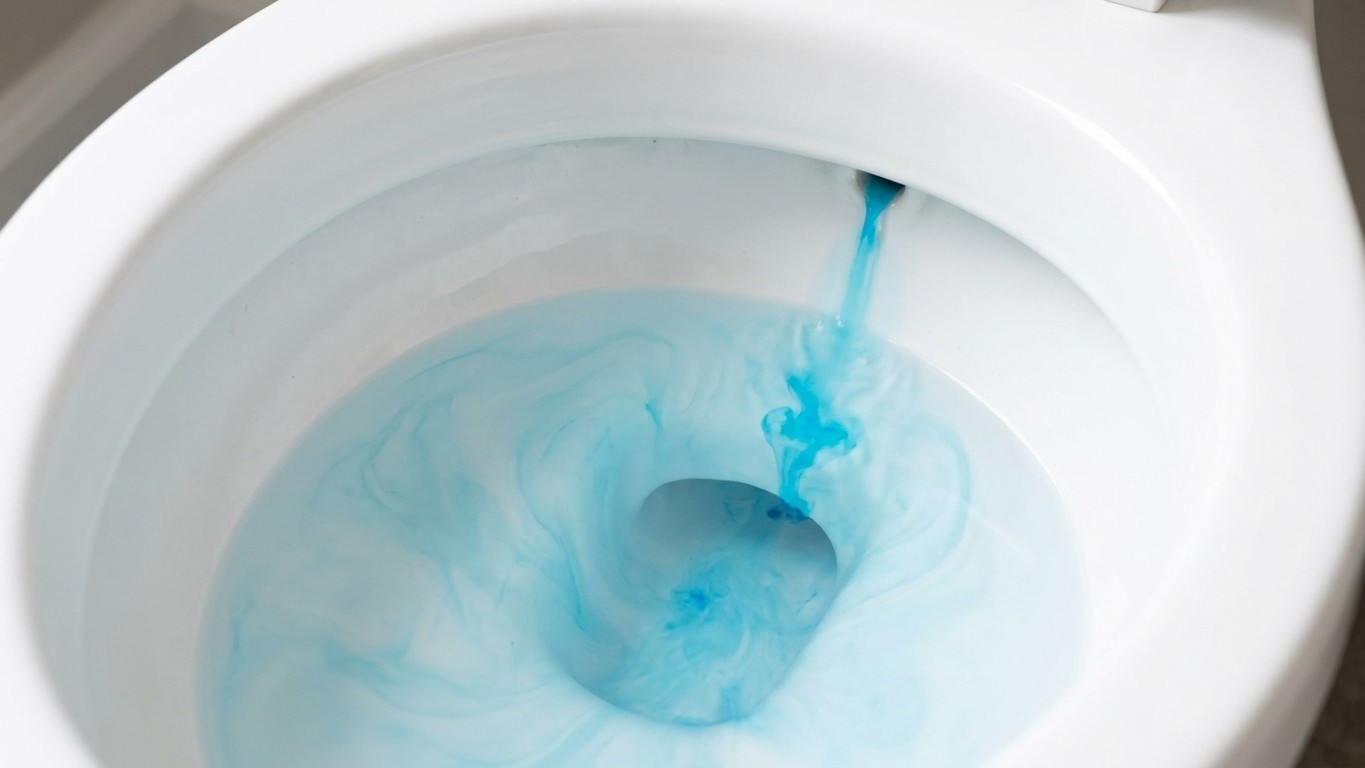
Twenty minutes. That’s all it took for a few drops of blue food dye to reveal what my toilet had been quietly doing behind my back for who knows how long. No flushing, no fiddling, just watching the water in the bowl slowly turn the same colour as the cistern above it. That little blue tinge told me my toilet was leaking, and it was almost certainly costing me a small fortune every single day.
The test itself couldn’t be simpler, and it costs practically nothing, which is exactly the sort of household trick I love. You lift the cistern lid, flush once to reset the water level, then drop in several drops of food colouring, ideally a dark shade like blue or red so it shows up clearly against the white porcelain. Drop 5 or 6 drops of food colouring into the tank, using a dark colour such as blue or red so it will be more clearly visible. Then you simply put the lid back, walk away, and resist the urge to flush. In some cases, you may be able to hear the sound of the toilet running, which is water leaking from the tank into the bowl, but if the leak is slow, you may notice an abnormally high water bill before you ever hear indications of an overactive toilet.
Come back ten to twenty minutes later and have a look in the bowl before you touch anything. If coloured water appears in the bowl within 15 minutes, there is a leak in the flapper. The intensity of the colour tells its own story too, since the darker the colour in the bowl, the more severe the leak is likely to be. Mine wasn’t a dramatic gush, just a faint wisp of colour creeping down the inside of the pan, but that’s precisely how these leaks tend to operate. They’re not the dramatic, puddle-on-the-floor sort of problem. They’re sneaky, silent, and they’ve usually been running for months before anyone notices.
Key takeaways
- A 20-minute dye test exposed what three years of water statements missed
- One silent leak could waste 400 liters daily—enough to fill five baths
- The fix costs just a few pounds and takes under 30 minutes without a plumber
What’s actually going wrong inside the cistern
Once I knew there was a leak, the next question was obvious: what on earth was letting water dribble through without anyone hearing a thing? The usual suspect is the flapper valve, the rubber seal at the bottom of the cistern that’s supposed to sit tight against the outlet once the tank refills. Leaks occur when the flapper valve does not create a watertight seal, and this can be compromised by the chain snagging, a worn valve seat, or a warped flapper, with a worn flapper being the most common cause by far. Sometimes it’s simpler still. There may be a small stone or some grit under the actual flushing valve in the cistern itself, preventing it from fully closing, and it doesn’t take much at all to stop this from sealing, which keeps the cistern filling to make up the loss of water fed to the pan unnecessarily.
Modern dual-flush toilets, the sort with two buttons for a “small” and “large” flush, seem to be particularly prone to this. Severn Trent’s water resources lead, Doug Clarke, has been blunt about it: “Having a leaky loo, is basically the equivalent of turning the tap on and leaving it to run all day.” His team reckons between 5% and 8% of all toilets are leaking, mostly dual flush ones, with the new eco-friendly dual flush toilets being prime culprits because their more complex internal valve systems fail more easily than the old-fashioned single lever. There’s a certain irony there. A design meant to save water ends up wasting far more of it once the seal gives out.
The numbers that made me sit down and do some sums
I’ll admit I underestimated just how much water a “small” leak could shift, and apparently I’m far from alone in that. Water UK ran a poll and found that 69% of people estimate that a leaky loo wastes less than 50 litres a day, less than a quarter of the real volume. The reality is considerably worse. Yorkshire Water, which has been running its own awareness campaign, states plainly that a leaky loo is one of the most common household leaks that could be wasting as much as 400 litres of water a day, that’s nearly three baths full. Their water efficiency manager, Emma Rattigan, put it even more starkly, noting that a leaking toilet can waste between 200 and 400 litres of water every single day. One of their own customers, she added, had a leak amounting to 300 litres per hour, 87.6% of their household’s daily water consumption, which is a genuinely eye-watering figure for something nobody could see or hear.
Multiply that across the country and the scale becomes almost hard to picture. Severn Trent estimates that a leaky toilet can waste up to 400 litres of drinking water a day, which is enough to fill 5 baths and can more than double the average family’s water bill. Nationally, campaigners at Waterwise put the figure at roughly 400 million litres of estimated to be leaking from UK toilets every day, enough water to supply 2.8 million people, the combined population of Edinburgh, Cardiff, Belfast, Manchester, Sheffield, Liverpool and Bristol. That’s not pipes bursting under the road somewhere. That’s toilets, in ordinary houses, quietly running up bills nobody’s watching.
Sorting it out without calling a plumber first
The good news is that once you’ve confirmed the leak with the dye, fixing it is usually a job you can tackle yourself before spending a penny on a callout. A leaking toilet cistern is usually caused by a faulty valve or worn seal and can often be fixed in under 30 minutes without a plumber. Flappers and washers are cheap, a few pounds at most from any hardware shop, and swapping one out is genuinely fiddly rather than difficult. If you’re at all unsure, take the old part with you to the shop so you get the right match, since cisterns vary more than you’d expect between makes and ages.
If your dye test comes up clear but your bill still looks suspicious, it’s worth checking with your supplier before assuming the worst. Many water companies in the UK offer free services to detect and even fix leaky loos. It’s a call worth making, particularly given that on a metered supply, as SES Water points out, the real figure for household use is 323 litres a day, against a widely-believed 62 litres, so a hidden leak can distort your sense of “normal” usage for years without you ever twigging. My twenty minutes with a bottle of blue dye cost nothing and told me more about my water bill than three years of statements ever did. Worth doing tonight, while you’re waiting for the kettle to boil.
Sources : libdems.org.uk | youtube.com