
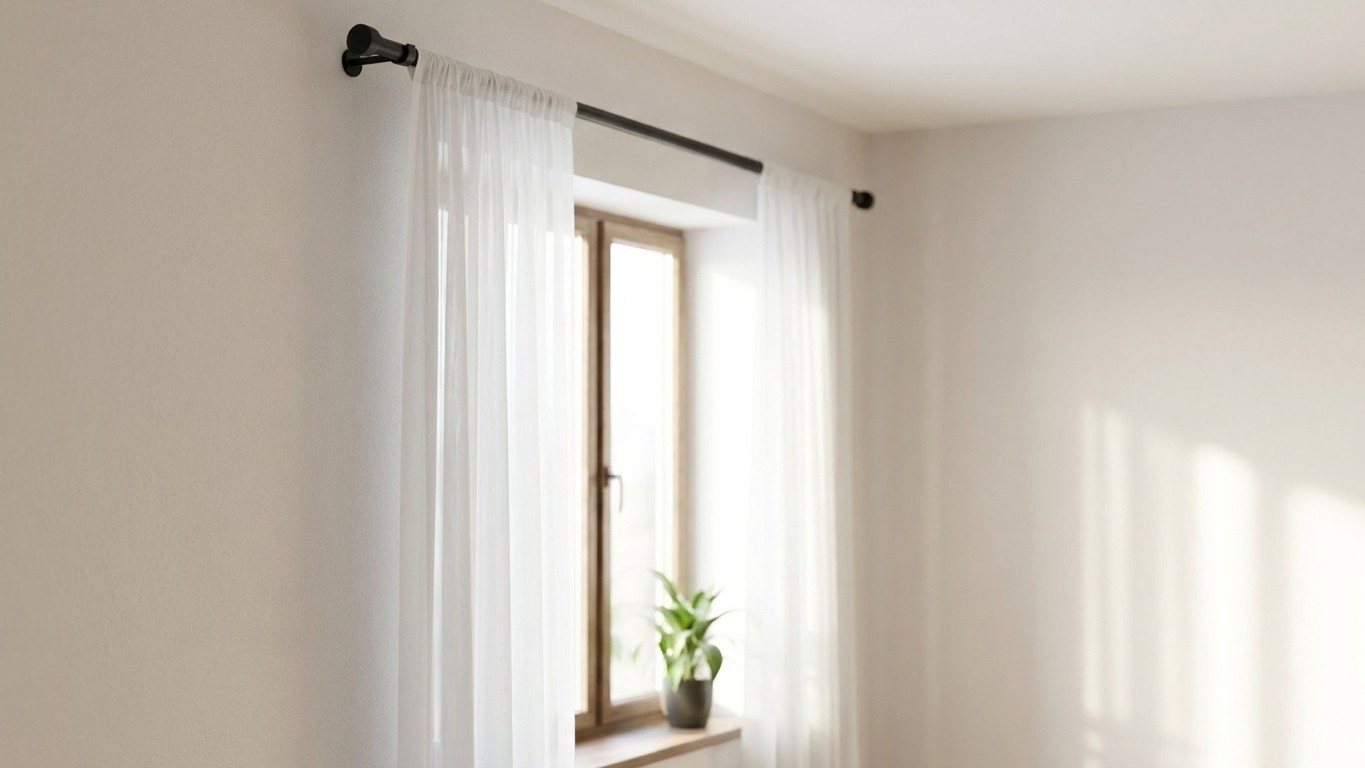
Screw the bracket straight onto the window frame, hang the pole, job done. That’s how most of us have always fitted curtains, and it’s exactly why so many windows in British homes look shorter and narrower than they actually are. Two simple numbers, the height of the pole above the frame and how far it stretches beyond it on each side, are doing all the visual work. Get them wrong and even the loveliest fabric won’t save a window that looks squashed. Get them right and you’ve essentially added inches to your room without lifting a single wall.
Key takeaways
- Why mounting a pole directly on the window frame actually makes your windows look smaller
- The exact distance above the frame that creates an illusion of height and higher ceilings
- How extending the pole sideways changes everything about natural light and window proportions
Why the frame itself is the wrong starting point
Fitting a bracket directly onto the top of the window frame feels logical, tidy even. But it’s a habit that dates back to when curtain poles were purely functional rather than decorative. The trouble is that a pole mounted right on the frame line has nowhere to go but down, visually speaking. Your eye stops at the top of the curtain, which is also roughly the top of the window, and the whole opening reads as smaller than it is.
Trade professionals have known this for years. If you want to avoid the window looking any wider than it already is and wish you had a taller more portrait proportioned window, then mount the curtain pole a good distance above the window and only take it an additional 15 to 20cms to either side of the window. That single adjustment, lifting the fixing point off the frame and onto the plain wall above it, is what design writers call the “high and wide” trick, and it costs nothing beyond a slightly longer pole and a bit more plaster to drill into.
The height that flatters, and the one that doesn’t
Most fitting guides converge on a similar figure. Curtain poles should be installed 10–15cm above the window frame, or higher for a more dramatic effect. Some suppliers push that range a touch further: a good rule of thumb is to fit your curtain pole 15-20cm (6-8 inches) above the window frame, which creates a visually appealing balance, draws the eye upwards, and gives the illusion of taller ceilings.
If your ceilings are generous, don’t be shy about going higher still. For rooms with high ceilings, you can position the pole closer to the ceiling, about 20-30cm (8-12 inches) above the window frame. One useful rule of thumb from the trade, rather than a strict measurement, is that the pole should sit somewhere between the top of the window and the ceiling, roughly a third of the way up that gap for a subtle lift, or closer to the ceiling for real drama. A reliable guideline for hanging curtains is to position your curtain rod at ½ to ⅔ of the distance between the top of your window trim and the ceiling, meaning the rod should be closer to the ceiling than the window.
There’s a practical reason for lifting the pole beyond pure aesthetics, too. Fitting the pole 8-12cm above the window frame will ensure that the header tape of the curtains is not on show once the curtains are hung. Nobody wants to see the workings of the heading tape peeking above the rail; a modest gap hides it neatly. And if your ceiling is stingy, don’t panic. Most fitters suggest a sensible minimum clearance from the ceiling itself, so brackets never look cramped against the coving even in a low-ceilinged Victorian terrace.
Width matters just as much, if not more
Height gets most of the attention, but the second measurement, how far the pole extends sideways, is the bigger culprit behind gloomy, light-starved rooms. Fit the pole exactly to the frame width and your curtains, once open, will always overlap the glass by several centimetres on each side, blocking light and making the window look smaller than it is even when the curtains aren’t drawn.
The fix is straightforward. Ideally, extend each end of the pole or track 15 – 20cm beyond the window frame, which allows curtains to open fully without partially covering the window, maximising natural light. That’s roughly the consensus across British suppliers, though some push it slightly wider for bigger windows or heavier fabrics. A 12 in / 30 cm overhang lets curtains stack clear of the glass, maximising natural light when open.
Do the sums on a typical window and the numbers add up quickly. A 150cm window typically requires a 180–210cm curtain pole. That’s not wastage, it’s the difference between curtains that swallow half your daylight and ones that frame it properly. If you’re working with heavier, lined curtains, lean towards the wider end of that range; thick fabric needs more room to stack back without crowding the glass.
Projection from the wall matters too, though it’s the measurement most people forget entirely. Curtain poles should project 7–15cm from the wall, depending on curtain thickness. Skimp on this and heavy curtains will brush against the wall or radiator below, creating an ugly kink in the fabric that no amount of steaming will fix.
Putting both measurements together
None of this requires a laser level and a design degree, whatever the glossy interiors magazines suggest. Measure up from the top of the frame by your chosen height (10 to 20cm is the sweet spot for most rooms), mark it in pencil, then use a spirit level to run a horizontal line out to your bracket positions, each one 15 to 20cm beyond the sides of the frame. The ultimate test is to measure the distance from the ceiling down to each of your bracket marks; if the two measurements are identical, your pole will be perfectly level. A cheap spirit level from any hardware shop does the job perfectly well, no need for anything fancier.
One last thing worth knowing before you reach for the drill: if your curtain pole or track run exceeds 180cm in length, or you’re hanging heavy fabric, a central support bracket will prevent sag and improve stability. It’s an easy detail to overlook when you’re focused on getting the height and width right, but a sagging pole undoes all that careful measuring in an instant. Get all three elements sorted, height, width and support, and even the most modest window in the house will start punching above its weight.
Sources : maminteriors.co.uk | terrysfabrics.co.uk