
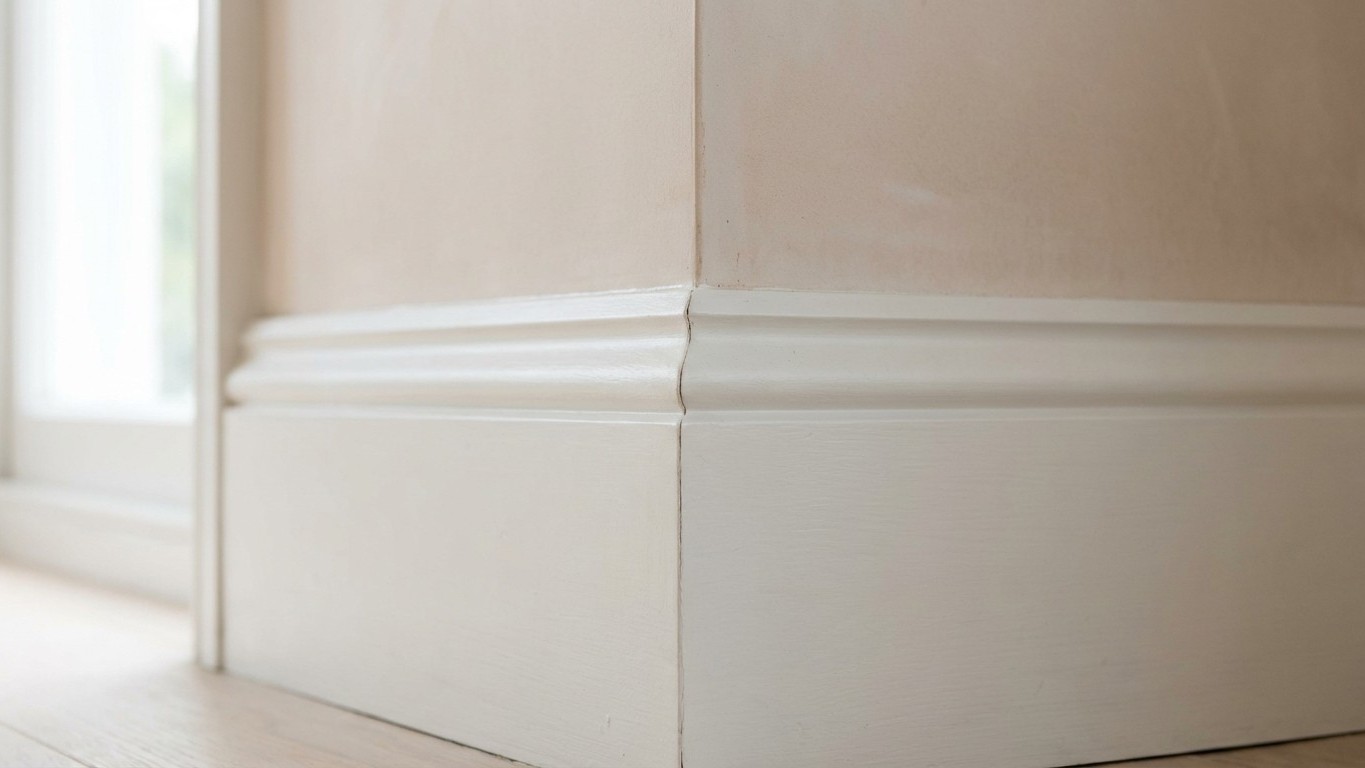
You’ve spent twenty minutes carefully setting your mitre saw to exactly 45 degrees, cut both pieces of skirting with tremendous care, offered them up to the internal corner, and there’s a gap you could post a letter through. Sound familiar? That gap isn’t a sign of poor cutting. It’s a sign that the 45-degree mitre joint was never the right tool for the job in the first place, at least not on internal corners. Experienced carpenters have known this for decades. The technique they actually use is called scribing, or coping, and once you understand it, you’ll wonder why nobody told you sooner.
Key takeaways
- Why that carefully cut 45° angle keeps leaving visible gaps in your corners
- The one technique professionals use that creates virtually invisible joints
- The surprising reason most British homes make perfect 45° mitres impossible
Why the 45-degree mitre fails you every time on internal corners
The mitre joint looks so logical on paper: two boards, each cut at 45 degrees, slot together to form a perfect right angle. The problem is that it only works when the corner itself is a perfect 90 degrees. The main reason you don’t simply mitre the two pieces at 45 degrees is partly because if your internal corners aren’t exactly 90 degrees, it can be very tricky to get the angles right, any more than 90 degrees and you get an unsightly gap opening up. And here’s the quietly alarming truth about British homes: how many inside corners are exactly 90 degrees? Not many.
There’s a second problem that emerges over time, even in rooms where the corners happen to be perfectly square on the day you fit the boards. A simple internal mitre involves cutting two boards at opposing 45-degree angles, but this joint is susceptible to separating and gapping as the house settles. Wood and MDF both move slightly with changes in temperature and humidity, and unlike a true mitre, a scribed joint will not open up leaving an unsightly gap as the wood naturally shrinks with changing humidity in the room, and it is also far more tolerant of rooms that are a little out of square. So a mitre that looked immaculate in October can be showing a hairline crack by February. That’s not a trade secret, it’s just physics.
It’s one of the first things that usually catches out chancers on a site: watching them do internal mitres. The telltale sign of a professional’s work isn’t speed or expensive tools, it’s the absence of those thin gaps in the corners.
What the professionals actually do: scribing explained
To scribe a skirting board means shaping one board to perfectly match the profile of another, usually at an internal corner, a joinery technique that creates a tight, seamless fit, ideal for uneven walls. The result looks, from across the room, like a beautifully mitred corner. Up close, however, the joint works in a completely different way.
The method goes like this. One board butts square into the corner and the second board has its profile cut to fit over the face of the first. To create the coped joint, the second board is first cut with a 45-degree mitre, this cut acts as a template, exposing the board’s profile. A coping saw is then used to remove the waste material, carefully following the profile line created by the mitre cut. So yes, a 45-degree cut is still involved, but it’s used as a guide, not as the finished joint itself.
There’s one more little refinement that separates the careful craftsperson from the merely competent: the back-cut. It is advisable to “back-cut” the profile slightly, meaning the cut is angled back away from the face of the board, allowing only the front edge of the profile to make contact with the square-cut board, which ensures a tight fit even if the corner is slightly out of square. Think of it like the bottom of a door being planed at a slight angle, only the leading edge does the work, so small imperfections behind it don’t matter.
A scribed joint gives you a tighter fit than other forms of joints. It is a bit trickier to cut than a mitre joint, but will give you professional results, and is commonly used in older homes where corners may not be completely square. That last point matters enormously in a country full of Victorian terraces and Edwardian semis where no two walls are plumb and no two corners are square.
The external corner is a different story entirely
Here’s where a great many people get muddled. The rule isn’t “never use a mitre”, it’s “never use a mitre on an internal corner.” A mitre joint is best used on external corners, those are where two sections of wood are cut at a 45-degree angle to slot together and meet on a corner. A mitre joint is the best option on external corners because the joint will be at an exact angle with the corner, and you won’t be left with any cut ends visible.
So the professional approach is actually a simple combination: scribe the internals, mitre the externals. Always scribe internal and mitre external. Once you have that principle lodged in your mind, fitting skirting boards becomes a much more satisfying business.
How to have a go yourself
The good news is that you don’t need a workshop full of expensive power tools. A coping saw, ideally a fine-toothed wood saw, and some 120-grit sandpaper are all you really need, it’s much easier to do it properly than you might think.
Start by fitting the first board straight into the corner with a plain square cut, fixing it firmly before you touch the second piece. Place the second piece onto the chop saw, standing up exactly as it will be on the wall, and turn the saw to 45 degrees, as though you were mitreing the internal corner all the way, but only cut down through the top part of the moulding, stopping when the saw blade reaches the flat surface. That angled cut reveals the profile of your skirting board like a drawing. Now follow that line with your coping saw, cutting away the waste. Once the cut is complete, you can fine-tune it if necessary by wrapping some 120-grit sandpaper around a wooden spoon or dowel.
You’ll find the scribed section has much more tolerance if your walls aren’t a perfect 90 degrees, which, in a typical British home built before 1980, they almost certainly aren’t. A scribed joint, done well, serves two purposes: it hides any errors in cutting boards to exact lengths, and also allows for out-of-square walls.
There is one area where the choice becomes genuinely nuanced. Mitres are quicker to cut, but for internal corners, scribing almost always gives a cleaner result, especially in older or less-than-perfect rooms. If you are fitting square-edged MDF skirting with no profile to speak of, a neat butt joint with a touch of decorator’s caulk can be perfectly acceptable. The scribing technique shines brightest on profiled boards, the torus, the ogee, the chamfered, where a gap in the corner would draw the eye straight to it.
The real question, once you’ve tried scribing for the first time and stood back to admire a corner that fits as snugly as a hand in a glove, is why any of us ever persevered with the mitre approach at internal corners in the first place. The answer, probably, is that 45 degrees is the angle printed on every mitre box ever sold. It’s the default. But defaults, in carpentry as in life, aren’t always right.
Sources : forums.moneysavingexpert.com | contractortalk.com