
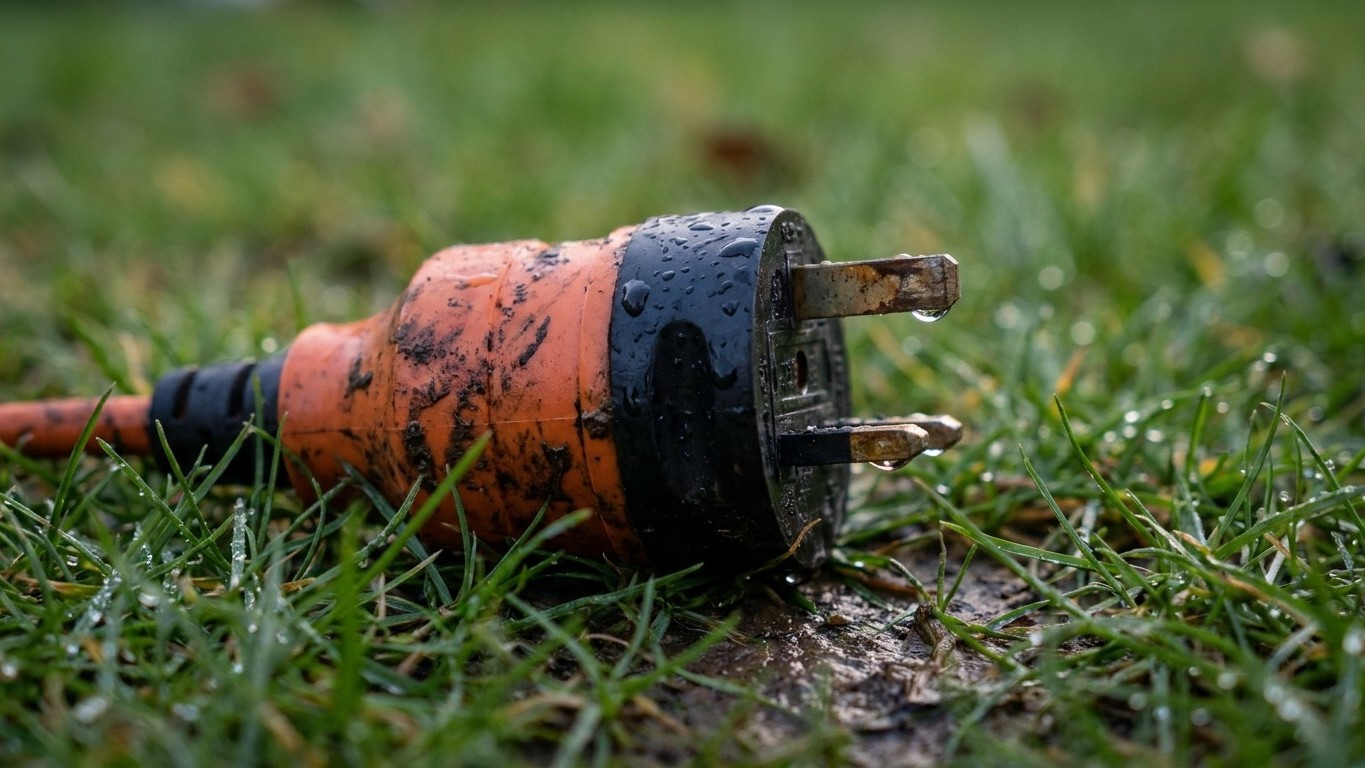
Flip the little switch on the extension lead’s socket instead of yanking the connector apart, and you’ll spare your consumer unit a nasty nuisance trip. That one-second habit, switching off rather than unplugging, is the difference between a quiet, uneventful bedtime and stumbling downstairs in the dark because half your sockets have gone dead.
Most of us do the opposite without thinking. Fairy lights get strung along the fence in June, and every night from then until September you march out, kneel on the damp lawn, and prise the two halves of the plug apart by hand. It feels sensible. It’s actually the thing causing the fault.
Key takeaways
- Separating damp connectors nightly exposes metal pins to oxidation and corrosion over the season
- A single faulty garden connector can trip your entire house’s RCD, especially in older split-load consumer units
- One tiny switch instead of unplugging eliminates the moisture exposure that causes the fault in the first place
Why pulling the plug apart causes the problem
Garden connectors sit low to the ground, right where dew settles thickest. Every time you separate that joint while it’s cold and slightly damp outside, you expose two sets of metal pins to moist air for hours before you reconnect them the next evening. Over a season, that moisture does what moisture always does to bare metal: it oxidises the contacts, and a light film of corrosion or dirt builds up on the pins. Indoor extension leads are not waterproofed, and even those labelled “outdoor use” should only be used temporarily and never left outside unattended. A connector that’s been mated and unmated forty or fifty times over a summer, sitting exposed to condensation in between, is not the same connector it was in May.
That degraded contact Matters More Than it sounds. A slightly corroded or loose pin creates resistance, and resistance under load creates heat and, occasionally, a tiny arc as current jumps a microscopic gap. An RCD is built to notice exactly that kind of imbalance. A built-in RCD continuously monitors the electrical current and disconnects power in under 30 milliseconds if a fault or imbalance occurs, preventing electric shock and fire risk. Good, you might think, that’s the safety device doing its job. But it’s also why the same string of lights that behaved perfectly in June starts tripping the RCD by August, and why the fault so often shows up right at the moment you plug back in after a night of dew has had its way with the pins.
Why one trip can take out the whole house
Here’s the part that catches people out. Plenty of British homes, especially anything wired before the last decade or so, still have a split-load consumer unit where a single RCD covers a whole bank of circuits rather than each socket having its own dedicated device. Trip that one RCD with a faulty garden lead, and you don’t just lose the patio, you lose every socket on that side of the house, sometimes the kitchen, sometimes the upstairs plugs, depending on how the electrician split the board years ago.
Newer installations are better protected against this. Under BS 7671:2018+A4:2026 Regulation 411.3.3, any new or replacement socket outlet up to 32 A in a dwelling must be RCD-protected at 30 mA or less, with no omission permitted. Many modern boards now use RCBOs, which combine overload and earth-fault protection per individual circuit rather than in one shared block, so a fault outside stays outside. Some houses may have RCBOs in the consumer unit, which are basically an MCB and RCD combined into one unit. If yours doesn’t, and plenty of houses built in the 1990s and early 2000s don’t, a grubby garden connector really can bring down half the house.
Any socket outlet or wiring installed outside must be protected by a 30mA RCD as a minimum, tripping the circuit within milliseconds if a fault occurs, fast enough to prevent a fatal electric shock. That’s why the RCD reacting isn’t the enemy here. The enemy is repeatedly creating the conditions for a fault in the first place by disconnecting a damp joint every single night.
The one-second fix, and how to do it properly
Rather than separating the connector, use the on/off switch built into most decent extension leads and simply flip it. The plug stays mated, the seal (such as it is) stays closed, and no fresh moisture gets a chance to creep between the pins overnight. In the morning, flip it back on. No corrosion builds up, no arcing, no mystery trip three weeks into the summer.
If your lead has an inline RCD with its own reset button, rather than the household’s protection, resist the urge to fiddle with the plug to “fix” a trip. That type of device is designed to behave this way. As one long-running DIY forum thread on the subject put it plainly, “that type of RCD will always trip when you remove power from it, and need resetting when you switch the power back on. It’s a drawback of the way they work.” The proper habit is to press its own test and reset buttons occasionally to confirm it’s still functioning, not to keep unplugging and replugging the connector itself.
A few small habits make the whole arrangement safer over a season:
- Keep the connector raised off wet grass on a brick, hook, or cable clip rather than left lying in the dew
- Check the plug and socket faces are fully closed and undamaged before each use
- Never daisy-chain a second extension lead onto the first to reach a further corner of the garden
- Uncoil the lead fully rather than leaving it wound on the reel, since a coiled lead under load can overheat
On that last point, it’s worth knowing that a coiled 13A lead can overheat and melt its own insulation if left fully wound while carrying a load, which is a separate hazard entirely from the RCD tripping, and one that’s easy to forget when you’re just trying to get the fairy lights on before guests arrive.
None of this means garden lighting is dangerous when treated properly. It means the small ritual of switching off, rather than pulling apart, is doing far more protective work than most of us realise, and it costs nothing more than the one second it takes to flick a switch.
Sources : laelectrical.com | elec-mate.com