
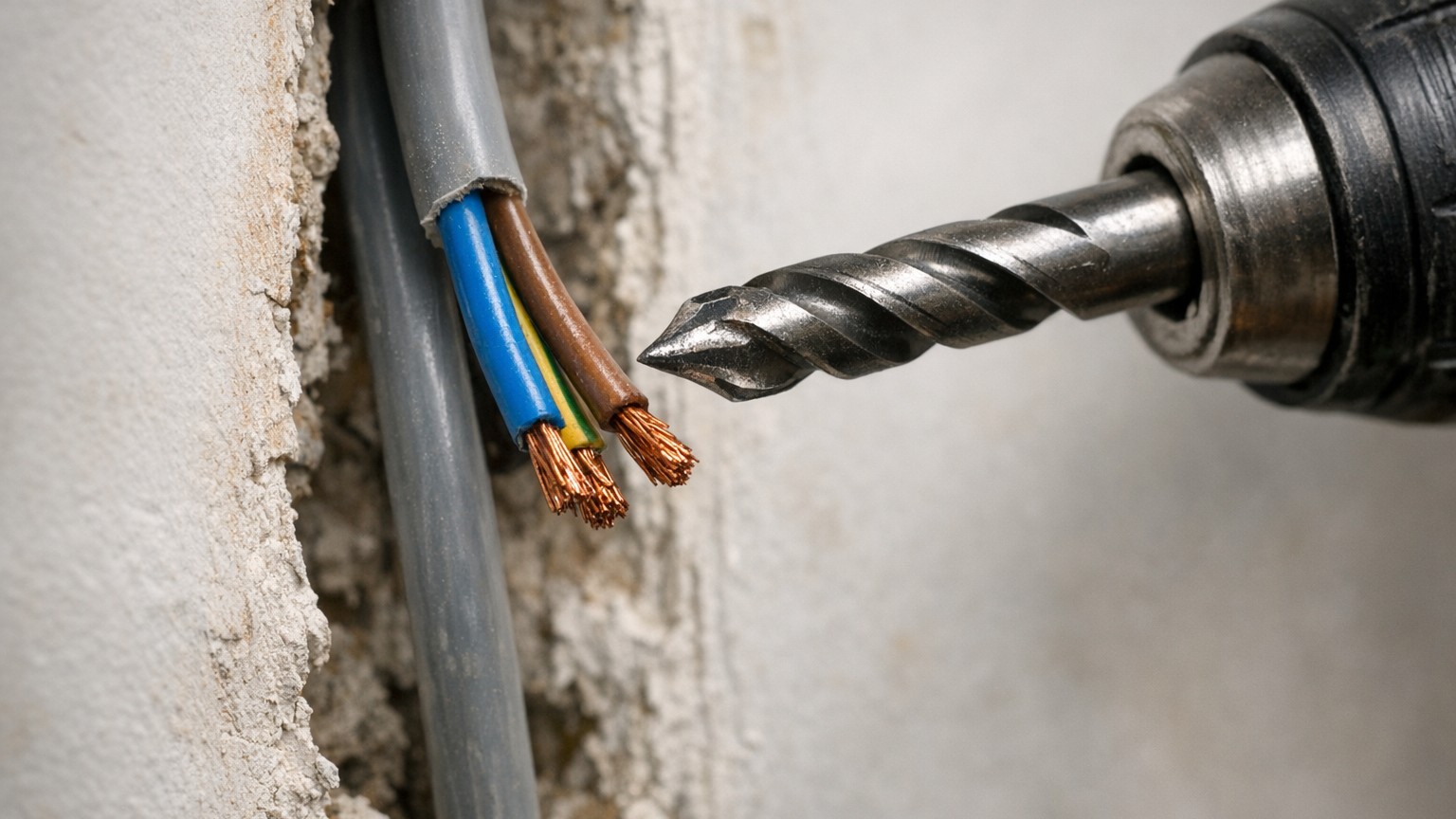
The cable runs vertically from the light switch upward through the wall cavity, and most of us never give it a second thought until something goes wrong. Drilling into live electrical wiring is one of those household accidents that can maim, start a fire, or worse, and it happens in ordinary British homes more often than the statistics suggest. A moment of confidence, a shelf bracket, a picture hook — that’s all it takes.
Key takeaways
- Cables don’t always follow the rules — especially in older properties where decades-old DIY rewires created unpredictable pathways
- A margin of just one centimetre separated a clean hole from electrocution, fire, or worse
- Most homeowners don’t know what detection tools actually work, and when they fail, on old plaster walls
What’s actually hiding inside your walls
British wiring regulations follow clear conventions, though “convention” is the operative word here. Cables are supposed to run in safe zones: vertically above sockets and switches, horizontally to the nearest corner or junction, and never diagonally across a wall. The logic is that a competent electrician can predict where the cables are, and a homeowner can do the same, in theory. The problem is that older properties, extensions, and DIY rewires from decades past don’t always respect those conventions. In a Victorian terrace or a 1970s semi, you may find cables running at curious angles, bundled with other services, or buried at inconsistent depths.
The cable feeding a standard light switch typically rises vertically from the switch back up to the ceiling, heading toward the lighting circuit above. That path, directly above the switch, straight up, is precisely where someone confident with a drill is most likely to work. You need a shelf bracket near the door. The switch is just below. You measure up, mark the wall, and drill. The near-miss I had taught me that the margin between a clean hole and a catastrophic one can be as little as a centimetre.
The tools that can save you from a very bad day
A cable and pipe detector, sometimes called a stud finder with electrical detection, costs relatively little and earns its place in any toolkit. The better models detect both live cables and plastic or copper pipes, which is worth having since a punctured water pipe in a wall cavity is its own brand of misery. These detectors work by sensing the electromagnetic field around a live cable, so the circuit needs to be switched on for reliable detection. Run it slowly across the surface you plan to drill, overlapping your passes, and mark anything it flags.
Here’s something most packaging won’t tell you: the detectors are less reliable on older plaster-and-lath walls than on modern plasterboard, because the signal has further to travel and more interference to contend with. In an older property, treat any flagged area with extra caution, and consider widening your no-drill zone to ten centimetres on either side of a reading rather than the standard five. Old cables can also be unsheathed or have degraded insulation, meaning a nick that would merely trip a breaker in a modern home could arc unexpectedly in an older one.
The other tool worth knowing about is an endoscope camera, a thin flexible camera on a cable that you feed through a small pilot hole. Drill a 6mm exploratory hole first, away from where you suspect cables run, and look inside the cavity before committing to your full fixing. It sounds like overkill until you’ve seen what a wall cavity actually contains: timber noggins in unexpected places, old pipework, cables looped in ways no regulation anticipated. Endoscope cameras have become affordable enough that they belong in the same category as a decent spirit level.
The safe zones and the danger zones
The 150mm exclusion zone around switches, sockets, and light fittings is the figure that British electricians quote, and it comes from Part P of the Building Regulations, which governs electrical safety in dwellings. Cables should be installed at a minimum depth of 50mm in walls, but again, older work may not meet this standard. Running your detector over the wall is not a substitute for respecting the exclusion zone; it’s an additional check within a framework of caution.
Diagonal runs are the hidden danger that catches careful people out. A socket on one wall and a switch on an adjacent wall, installed at the same time by the same electrician, might share a diagonal cable run through the corner. There’s no way to predict this without detection equipment or prior knowledge of the wiring. If you’re drilling anywhere near an inside corner, slow down and scan thoroughly.
Gas pipes follow similar vertical and horizontal conventions, and a combined detector will flag those too. The habit worth cultivating is simply this: before every drill, scan. Not before big jobs, before every single drill. A small shelf, a curtain pole bracket, a towel rail. Each one is a potential incident waiting to happen if you skip the check.
After a near-miss: what I actually changed
Opening up the wall to investigate after my close call was instructive in ways I hadn’t expected. The cable had no protective capping around it in that section of wall, which is legal in older properties but means the plastic sheath is the only barrier between the copper conductor and your drill bit. The wall itself showed no sign of anything untoward from the outside. Smooth plaster, no telltale bulge or shadow.
One practical change I made was to photograph the wall cavity before replastering, with a ruler in frame for scale. Those photographs now live in a folder with the other property records. When someone else takes on this house in twenty years, they’ll have a fighting chance of knowing where that cable runs. It’s the kind of information that doesn’t exist for most homes, which is exactly why the near-misses keep happening. The 2023 Electrical Safety First research found that DIY electrical accidents spike sharply during home improvement seasons, not among people who ignored safety, but among people who simply didn’t know what they were working next to.