
Most UK home boilers should read about 1.0 to 1.5 bar when cold. When the heating is running, around 1.5 to 2.0 bar is typical. If your needle climbs past 2.5 bar with the radiators on, something is off, and the cause is often a simple one you can sort out yourself.
Near 3 bar, though, the advice changes.
- A running boiler typically reads between 1.5 and 2.0 bar.
- Most domestic boilers have a relief valve set to open around 3 bar.
- Overfilling is the most common cause of excessive boiler pressure.
- A faulty filling loop can keep feeding mains water into the sealed system.
What the gauge should read, and why it moves
Water expands as it warms. When the boiler fires up, the water expands and pushes up the pressure across the whole central heating system. So a needle that creeps upwards after the Heating Comes on is doing exactly what it should. A sealed system is a bit like a hot water bottle with the cap on, and the squeeze has to go somewhere (the expansion vessel, which we’ll come to).
Sources don’t agree to the decimal point, which is worth knowing before you panic. Some put the ceiling for a running boiler at 2.0 bar, while others tolerate up to 2.5 bar. One manufacturer-based guide describes a green zone of 1 and 2.5 bar, with an ideal point of around 1.3 bar. Your own boiler manual or the marked green arc on the dial is the final word for your model.
The safety net is a pressure relief valve. Most domestic boilers have one designed to open at around 3 bar. If you ever see water dripping from the discharge pipe outside, usually a copper pipe poking through an external wall, that valve has probably been doing its job.
A reading of 3.5 to 4 bar that keeps recurring needs an engineer, not a DIY afternoon.
Four causes worth checking
Overfilling is the commonest culprit. It usually follows a recent top-up after the boiler suffered low pressure. It’s an easy mistake, because the filling loop (the braided hose under the boiler) has no gentle brake, and a minute’s distraction can add a full bar. The giveaway is a cold reading above 1.5 bar before the heating has even started.
A filling loop that isn’t fully closed, or has a failing internal valve, is the second suspect. It lets mains water keep feeding the sealed system, and since mains pressure is typically 3 to 4 bar, even a slight leak can push readings well above safe levels. If the pressure creeps up again a day or two after you’ve lowered it, look here first. Check that both valves on the hose are turned fully off, and that the hose itself is disconnected if yours has a detachable one.
Then there’s the expansion vessel, the small tank that absorbs the extra volume as water heats. When it fails, the system has nowhere to put that expansion. One heating guide describes the pattern as pressure spiking at the start of a heating cycle, then decaying slowly. A needle that leaps to 3 bar every time the radiators warm up, but settles back overnight, points strongly this way.
A faulty pressure relief valve or a blockage rounds out the list, though both are rarer. Blocked or stuck valves can trap pressure in one part of the system, and a damaged relief valve may fail to release it. Neither is a home repair.
Hot-water demand muddies the picture on combi boilers. One guide says a reading pushed towards 2.5 bar by heavy hot water demand is usually nothing to worry about. Look at the cold reading before you decide anything is broken.
Bringing it down safely
Switch the heating off and wait. Let the radiators and pipes cool completely, ideally for a few hours, because hot water coming out of a bleed valve can scald and a hot reading will mislead you. Read the gauge on the cold system, and only act if it sits above roughly 1.5 bar.
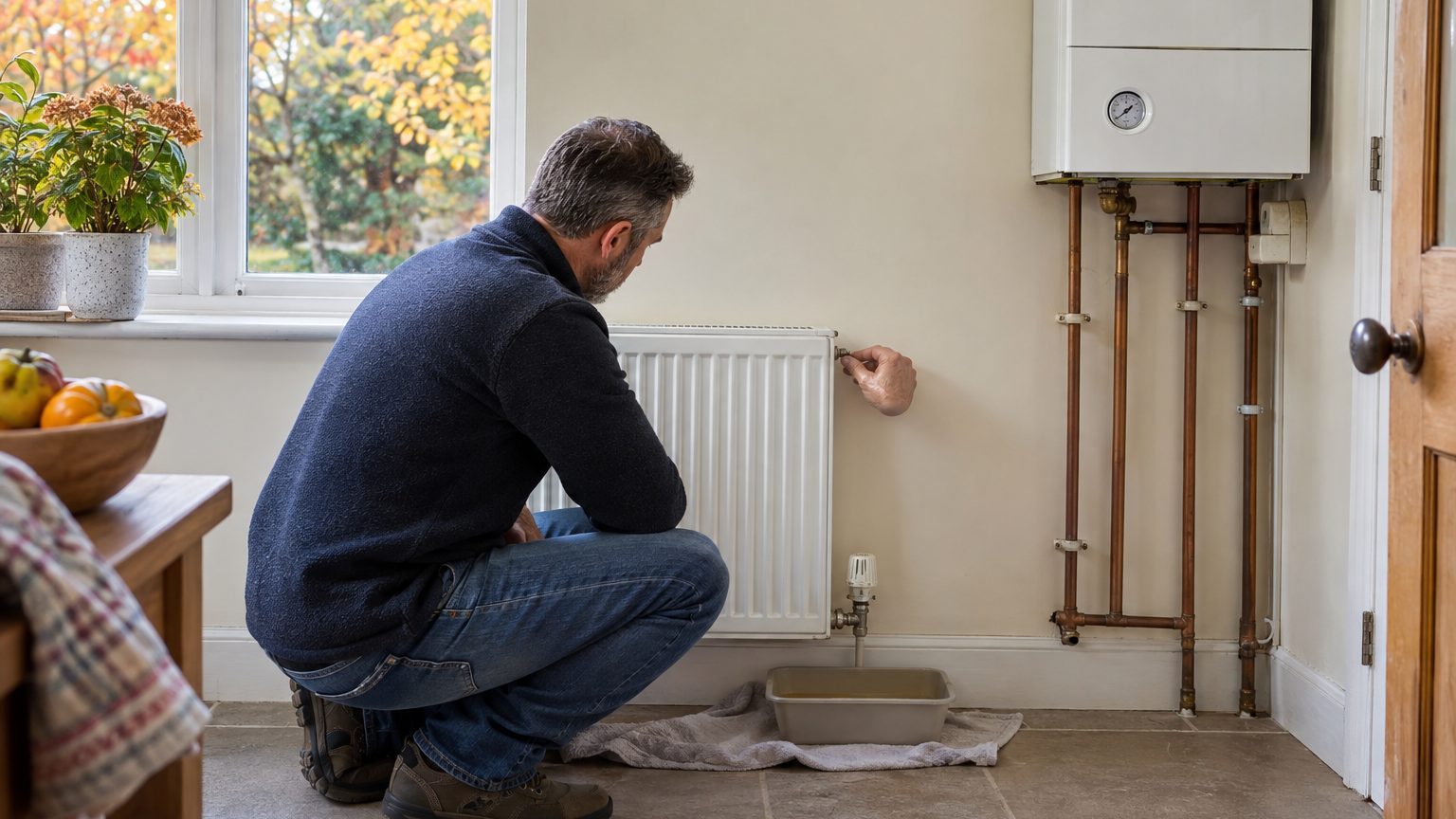
The gentlest method is to bleed a radiator. Bleeding releases trapped air and can also lower the water pressure. Use a radiator key, hold a towel under the valve and keep a shallow tray or old washing-up bowl beneath it. Turn the key only a quarter turn or so, watch the gauge, and close the valve as soon as it drops to about 1 bar. Choose the radiator closest to the boiler, as the pressure drop shows faster there.
Some homes have a dedicated route. If there’s no filter, you may find a drain-off valve (a “drain cock”) in the central heating pipework. Put a bucket underneath, open it, keep checking the boiler gauge, and close it when the pressure reaches 1 bar. Water from a heating system is often dark and sooty, so protect the floor with an old towel.
Go slowly.
Taking out too much leaves you with low pressure, and then you’re back to the filling loop for another top-up. Short, patient bursts of a few seconds each work far better than one long release. Once you’ve reached 1 to 1.3 bar, check the filling loop is closed, then switch the heating back on and watch the gauge as the radiators warm. A rise of a few tenths of a bar is normal.
When to stop and ring an engineer
Call a Gas Safe registered engineer if the pressure climbs back up within days, if the relief valve keeps dripping, or if the gauge touches 3 bar. One source warns that regular readings above 2.5 bar, or a single push past 3 bar, call for immediate action. Banging or thumping from the pipes is another sign not to carry on regardless. And if the boiler has locked out, don’t keep pressing reset. High pressure may cause the boiler to shut down or “lockout”.
It’s tempting to leave a relief valve dripping, because it’s only a few drops. I wouldn’t. High pressure can still damage your heating system, and a small drip is often a sign that the expansion vessel is on its way out, a repair that costs far less if caught early than after seals have failed.
Prevention costs nothing. One heating supplier recommends checking your pressure once a month, and again after bleeding any radiators. Stick a small note beside the boiler with the “right” reading for your model, perhaps 1.3 bar, so everyone in the house knows the target before anyone reaches for the filling loop.
Sources : iheat.co.uk | bestheating.com