
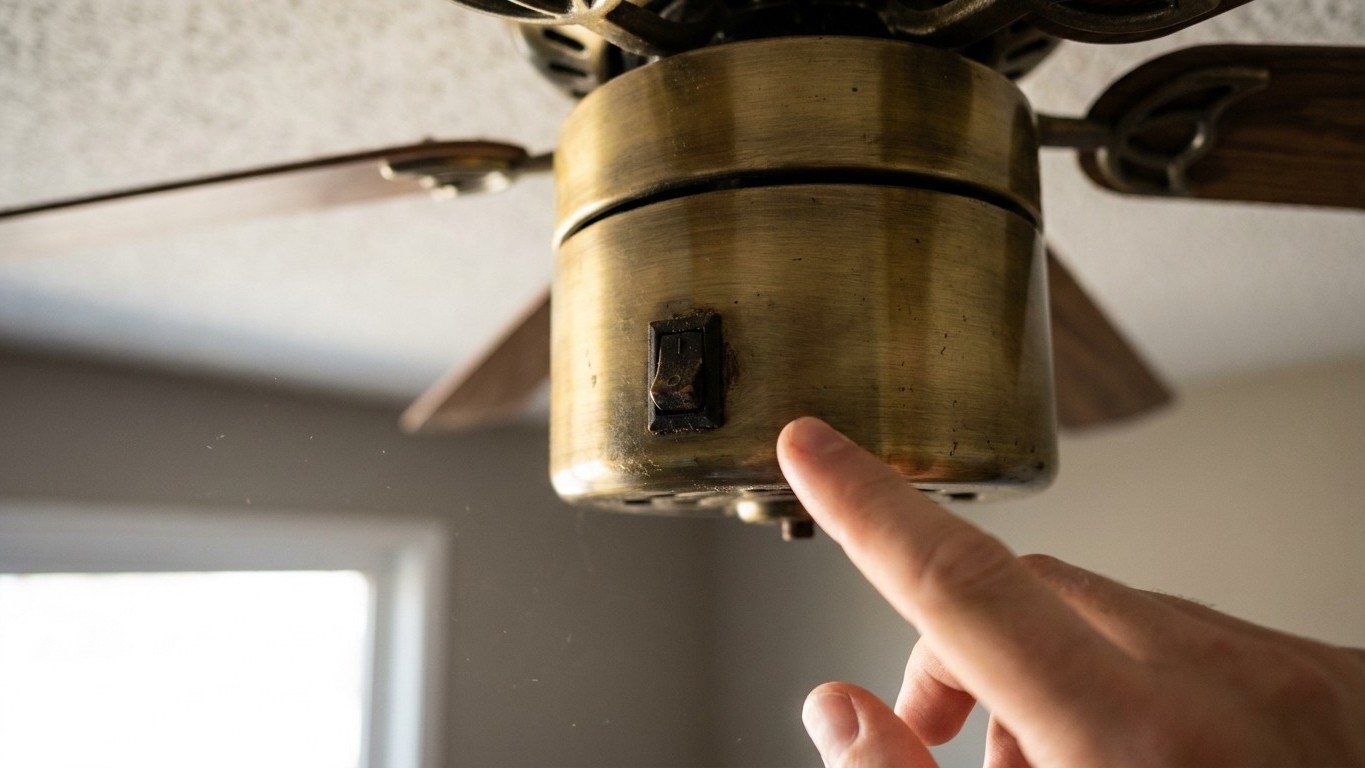
Buying a bigger, pricier fan won’t help if the little toggle switch on the motor housing is sitting in the wrong position. That switch, no bigger than a fingernail, decides whether the air your fan pushes around actually swirls down to cool your skin, or simply stirs the warm layer hovering uselessly near the ceiling. Get it wrong and you could be paying for a fan that’s working against you rather than for you.
Key takeaways
- Most people never touch the direction switch, leaving their fans working against them instead of for them
- Winter mode could reduce your heating bills by up to 15%, but only if you keep it on low speed
- The switch position doesn’t cool the room—it cools you, and getting it backwards is pure wasted electricity
The tiny switch that changes everything
Nearly every ceiling fan sold in the last few decades has this feature tucked away on the side of the motor housing, the cylindrical bit where the blades attach. Nearly all ceiling fans have a switch located on the side of the fan base that lets you change the direction of the fan blades. Flick it one way and the blades spin counterclockwise, pushing air straight down in a column, the kind of breeze that hits you square on the shoulders the moment you step underneath. Flick it the other way and the blades spin clockwise, gently pulling air upward instead of down.
Here’s the bit most people never think about: this pushes air straight down, creating a wind-chill effect that makes you feel 4-8°F cooler without actually lowering the room temperature. The fan isn’t cooling the room at all. It’s cooling you, the person standing in the airflow. That’s why an empty room with the fan blasting away is just wasting electricity, and why some manufacturers now build in sensors that switch fans off automatically when nobody’s in the room.
In winter, most of us switch the fan off entirely and forget it exists. That’s the second mistake. The colder it gets, the harder your furnace works to warm the air. Since warm air is lighter than cold air, it can stay trapped at the ceiling. Flip that same switch to clockwise, run the fan on its lowest speed, and it quietly nudges that trapped warm air back down along the walls without you ever feeling a draught. When blades spin clockwise on low speed, the fan pulls air upward toward the ceiling, then pushes that warm air outward along the ceiling and down the walls, gently recirculating heated air back to the living zone without creating a direct draft that would make you feel cold. No breeze, no chill, just warmer feet and a boiler that doesn’t have to work quite so hard.
How much this actually saves you
The figures here aren’t marketing fluff, they come from proper household energy guidance. A high-speed, counterclockwise ceiling fan direction can let you increase your thermostat 4 degrees and still be comfortable, and using it correctly can reduce your energy costs up to 30 percent. On the winter side, the savings are more modest but still worth having: this greatly reduces your energy use and can lower your energy bills by as much as 15 percent. Multiply that across a British winter of radiators running from October through April and it adds up to real money, not pennies.
The bit that catches most people out is speed. Running a fan fast in winter, even in the correct clockwise direction, creates enough airflow that you’ll feel it, and any breeze at all in a cold room feels colder than no breeze, even if the air temperature hasn’t dropped. In the winter, ceiling fans need to spin clockwise on low speed, any faster and you’ll start to feel a cool breeze. Slow and steady is the whole point. You’re moving warm air, not manufacturing a chill.
Finding and flipping the switch
Turn the fan off completely first and wait for the blades to stop, obviously, because nobody fancies a finger near a spinning blade. Get a step stool, look at the side of the motor housing just above where the blades attach, and you’re hunting for a small toggle, usually black or brown, roughly the size of a chunky match. There is a small toggle switch on the side, usually black or brown, about half an inch long. Slide it to the opposite position, step back, switch the fan on, and stand underneath it to check.
Working out which way it’s now spinning is easier than it sounds. Clockwise rotation means the blades at the top of your view are spinning to the right, in the direction of a clock’s hands, and counterclockwise is the opposite, spinning to the left. Or forget the visual entirely and just trust your skin: stand right underneath and if you feel a direct rush of air on your head and shoulders, that’s summer mode. Feel next to nothing, just a faint stir, and you’re in winter mode. Some households test this with a strip of tissue paper held under the fan; if it flutters straight down, you’ve got the summer setting.
Newer fans with remotes or smart hubs make this even simpler, often with a dedicated reverse button so you never need the step stool at all. You can set some smart ceiling fan models on seasonal schedules, or they can even work automatically with your home’s smart HVAC system. If your fan is one of the very old models without any reverse switch, don’t panic and don’t rush out to buy a new one straightaway. Some can be adjusted manually by altering the blade pitch instead, though that’s a fiddlier job best done with the fan’s instruction booklet to hand.
A quick note on the rooms that need special treatment
Not every room benefits from the same setting. Kitchens and dining rooms are the obvious exception, since nobody wants their dinner going cold under a downdraught. Vaulted ceilings behave differently too, simply because the fan sits so much higher above your head that the summer downdraught rarely reaches you with any force anyway. It’s worth testing each fan in your home individually rather than assuming the same switch position suits every room, since ceiling height, room size and even furniture placement all change how the airflow actually behaves once it leaves the blades.
Sources : evapolar.com | saveonenergy.ca