
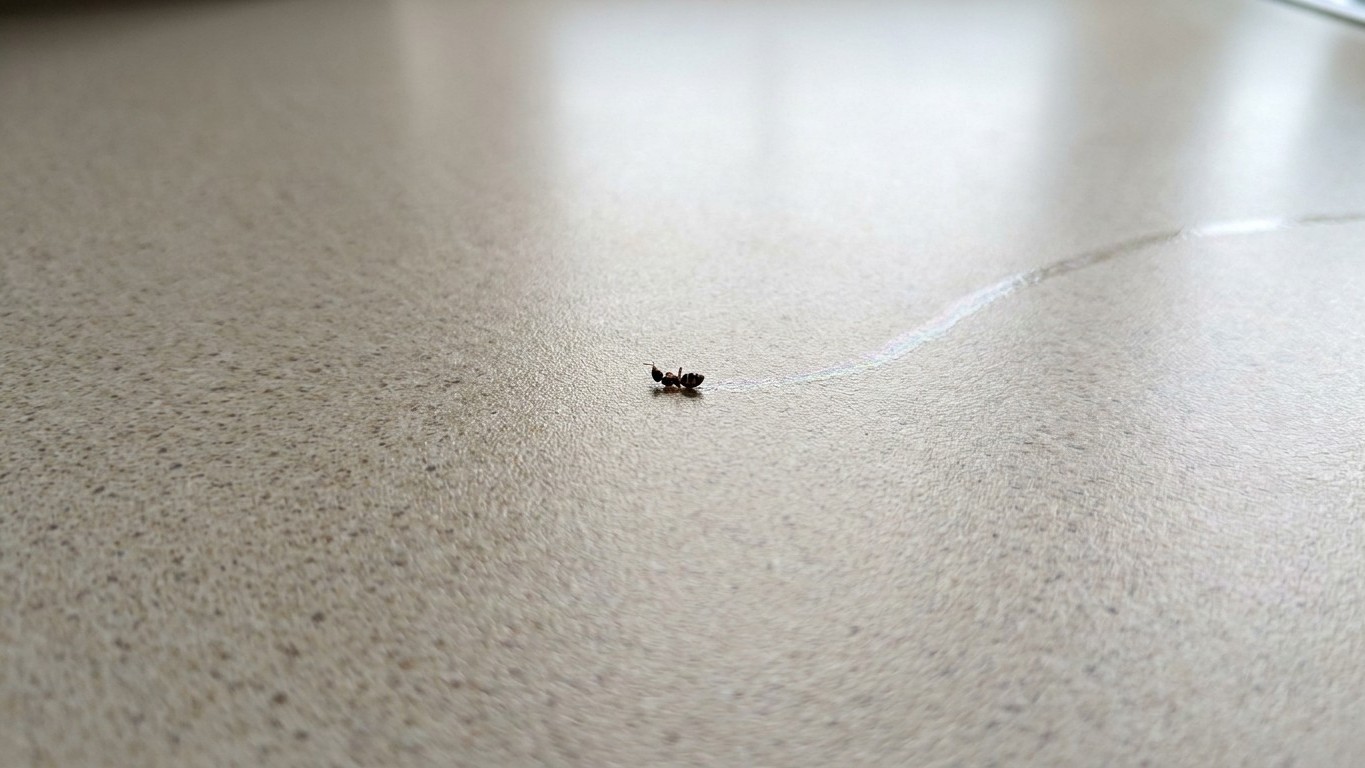
Squashing that ant on the worktop feels satisfying, but it does almost nothing to the invisible motorway she’s already painted across your kitchen. The chemical trail she laid down on her way to your biscuit tin is still sitting there on the laminate, and her sisters back at the nest can smell it perfectly well, thank you very much. Simply killing the ants you see won’t solve the problem, because the ant pheromone trail they’ve created doesn’t disappear when the ants are killed. It remains as a navigator trail for other ants to follow. That’s the bit Nobody Tells You at school.
Key takeaways
- Ants use two completely different chemicals: one for navigation to food, another for alarm signals when crushed
- A single dead ant barely registers against trails reinforced by dozens of foragers over time
- The solution isn’t violence—it’s chemistry: vinegar and water actually erase the pheromone signals
Two Different Chemical Signals, Two Different Jobs
Here’s what I find genuinely clever about ants, and I say this as someone who has spent more Tuesday mornings than I’d like wiping down a worktop with a tea towel in one hand and a grudge in the other: they’re not using one smell for everything. Ants leave pheromone trails to point the way to food. When an ant hunter finds food, she leaves a pheromone trail while traveling back to the colony with the food, and soon other ants follow the trail to the food source, depositing pheromones on the way back to the colony. That’s your foraging trail, the one still glued to the worktop after your thumb has done its worst.
Squashing releases a completely different chemical altogether. Ants use alarm pheromones to signal danger, and if you’ve ever stepped on an ant on your front sidewalk, only to see hundreds of ants a while later tearing the squashed ant apart, it’s because the crushed ant emitted an alarm pheromone, sending other ants into attack mode. So the squishing itself is a bit like setting off a car alarm rather than pulling up the road markings. You’ve made a noise, but the map underneath is untouched. Pest control specialists quoted by Homes & Gardens have observed something similar in common household invaders: in species like Argentine ants, odorous house ants, and pavement ants, squashing even one worker can trigger more intense foraging activity within hours as other ants respond to the alarm and begin searching the area for food or threats, rather than reducing ant activity.
Why the Trail Barely Notices the Casualty
The scale of a trail pheromone is what makes it so stubborn. It isn’t laid down by one ant for one crossing, it’s built up drop by drop by every forager who’s ever walked that route since the sugar bowl lid went missing. After feeding, the ant returns to the nest and drops small amounts of pheromones at regular intervals on its way back, and this incipient trail has an attractive influence on other nestmates, so although unaware of the food source location, nearby ants tend to modulate their random exploration behaviour toward a trail-following behaviour. Each new ant that finds the crumbs reinforces the same chemical line, so by the time you’ve noticed a queue of them on your worktop, you’re looking at layers of scent, not a single thread that one flattened body could interrupt.
There’s also a rather stubborn streak built into the ants themselves. Researchers at the University of Regensburg tested whether ants could learn to avoid a pheromone trail even when it led somewhere unpleasant, and the results were oddly humbling for the ants. Many ants deposit pheromone trails to resources and innately follow such trails, and the researchers investigated whether ants could overcome this innate tendency to avoid a trail predicting a negative stimulus. Even after dozens of attempts, ants stopped relying on the pheromone trail after roughly 10 trials, but even after 25 exposures they failed to improve beyond chance levels. One dead scout isn’t remotely enough to override millions of years of “follow the smelly line, get fed.”
What Actually Breaks the Chain
The good news, and this is where my grandmother’s approach to cleaning turns out to have decent science behind it, is that the trail is chemical, not permanent. It can be wiped away, it just needs the right approach rather than a rolled-up newspaper. Wiping down surfaces with a solution of vinegar and water or soapy water breaks down the chemical signals in the ant pheromone trails, preventing other ants from following it, and you should be sure to clean countertops, floors, and areas where you’ve seen ant activity. A pest expert interviewed by Homes & Gardens recommends much the same ratio: cleaning with vinegar, mixed 50-50 with water, on countertops, floors and any surfaces where ants have travelled, since the vinegar neutralises the pheromone trails and makes it harder for other ants to follow the path. Do bear in mind, though, that vinegar isn’t an insecticide in itself, it simply erases the signposts.
Once you’ve scrubbed the visible route, the job isn’t quite finished, because a determined colony will simply send out a fresh scout to redraw the map if the original attraction, your crumbs, your fruit bowl, your cat’s dinner, is still sitting there. Ants always have their attractants inside the home, in many cases food crumbs and sugary spills, so make sure to store food in sealed containers, clean up spills immediately, and pay attention to pet food bowls and trash bins, as these are common attractants. It’s worth checking skirting boards and window frames too, since ants get inside your home through small gaps, cracks and openings around windows, doors, walls and utility lines, which can be sealed with caulk or weather stripping.
One last thing worth knowing, and I rather love this bit: the ants queuing on your worktop aren’t necessarily blindly obedient to a single trail either. Mathematicians at Florida State University modelling foraging behaviour found that upon finding two food sources at an equal distance from their nest, ants will travel to both sources equally, forming parallel motorways rather than one. So if you’ve got ants coming from two directions towards your fruit bowl, you’re not imagining a double invasion, you’re watching two separate, equally reinforced chemical roads doing exactly what they were built to do. Wipe both down, and you’ve genuinely dismantled something rather more sophisticated than it first appears.
Sources : aptivepestcontrol.com | homesandgardens.com