
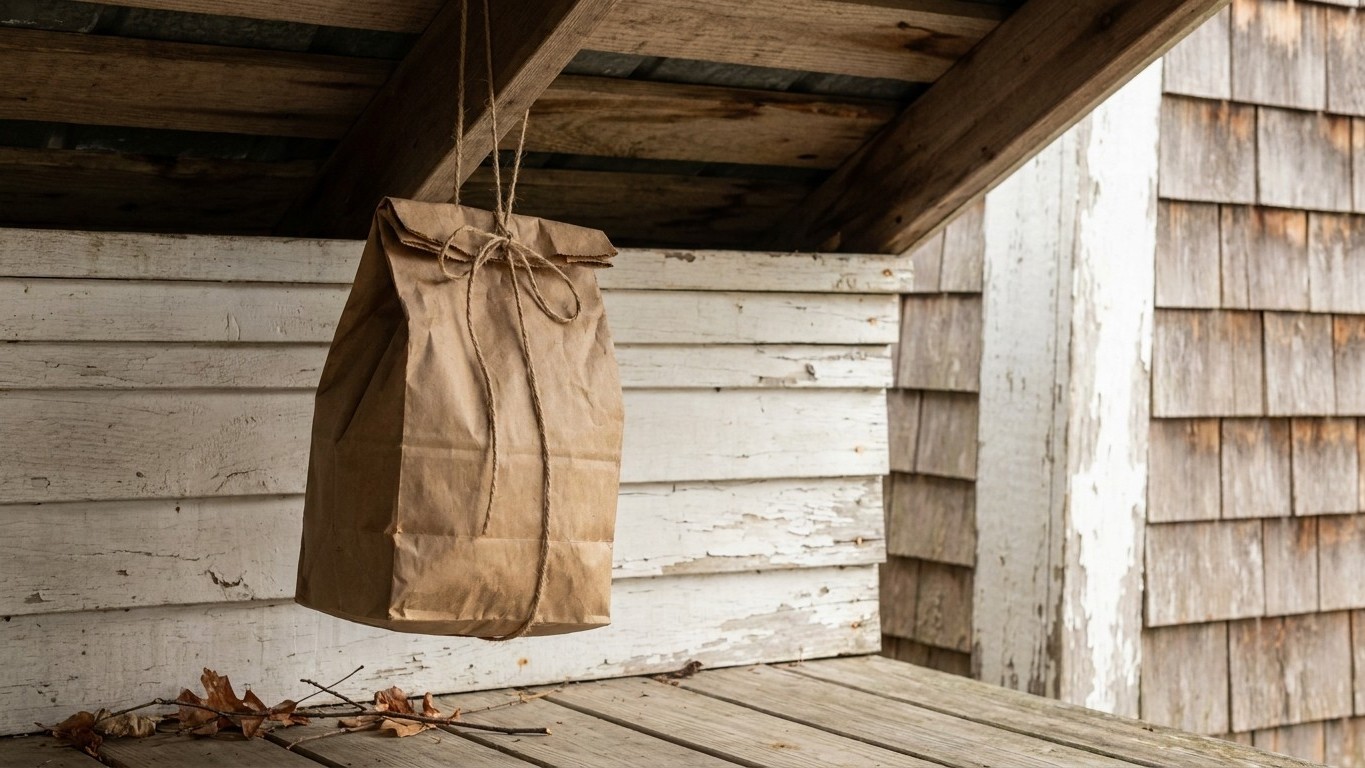
My grandfather’s trick had a name he never used: a decoy nest. That crumpled paper bag swinging gently under his porch roof wasn’t there to hold scraps or kindling. It was doing a very specific job, fooling any wasp queen flying past into thinking the territory was already taken.
Here’s what he understood long before pest control websites started explaining it: social wasps are fiercely territorial, and a founding queen scouting for a nesting spot in spring will generally steer clear of anywhere that already looks occupied. Social wasp species, particularly paper wasps, actively avoid establishing new colonies near existing wasp nests, and a wasp queen looking for a nest site will scout an area and turn away if she detects a rival colony already present. The risk of a fight she can’t win simply isn’t worth it to her. A stuffed paper bag, roughly nest-shaped and hung where she’d expect to find one, does the trick of looking exactly like competition she’d rather avoid.
Key takeaways
- A crumpled paper bag mimics an existing wasp nest, triggering territorial avoidance instincts in scout queens
- The trick only works during the critical spring scouting season before colonies establish—miss the window and it’s useless
- Paper wasps might fall for it, but hornets, yellow jackets, and other species won’t even glance twice
Why the Shape Alone Can Be Enough to Send Her Packing
The reasoning is more about self-preservation than intelligence, though wasps have plenty of that too. Established colonies keep their distance from one another largely to avoid pointless conflict and to protect limited food supplies nearby. Social wasps are territorial and avoid interactions with other colonies, usually staying about 200 feet from existing nests. That’s a proper buffer zone, and it explains why your grandfather only needed the one bag rather than a dozen dotted along the guttering.
Timing mattered enormously to him, though he probably never called it that. He’d have that bag up well before the warm weather properly set in. Timing is critical, as queens emerge from overwintering sites in late winter and early spring and begin scouting for nest locations. Miss that window and the trick becomes largely pointless, because once a colony has already settled somewhere, a decoy nest arriving afterwards does almost nothing to shift them. Wasps have been known to fully occupy the fake ones abandoned too casually.
Not Every Wasp Reads the Same Warning Sign
Here’s the bit that would have made my grandfather chuckle, if he’d known. His trick worked reasonably well against paper wasps specifically, but it was never going to bother every stripy visitor to his garden. Paper Wasps are the species that decoy nests may work for, while hornets, yellow jackets or mud daubers won’t relate to that nest, so it won’t work on them. Carpenter bees, too, pay no attention whatsoever, since they aren’t social insects with any instinct to avoid rival colonies.
Even among paper wasps, results are patchy at best. Anecdotal evidence suggests this method works for some people, but there’s no consensus on whether it’s a reliable deterrent, since there are many different kinds of wasps with different behaviors and home environments. A fake nest is, after all, missing the things that make a real one convincing up close. Real nests are not just visual structures; they contain activity, scent markers, and constant movement, and a fake wasp nest lacks all of these elements. Workers from an established nearby colony will eventually fly over, have a good look, realise nothing’s actually living in it, and simply stop bothering with it altogether. So the whole approach really only has leverage during that narrow scouting season before anyone’s committed to a site.
Making One Properly, the Way Grandad Probably Did It
If you fancy trying it yourself this coming spring, the method is refreshingly cheap and requires nothing from the shed you don’t already own:
- A plain brown paper lunch bag
- Something to stuff it with, old newspaper, other paper bags, or plastic bags
- String or twine to tie the neck shut and hang it
Fill and shape the bag into a rough teardrop or globe, twist the opening closed, and hang it somewhere sheltered, under eaves, near a doorway, or by any spot that’s given you trouble in previous summers. One per problem area is plenty; clustering several together doesn’t make the illusion more convincing and can actually look faintly ridiculous even to a wasp. Do bear in mind that plain paper isn’t entirely without its own irony here, since wasps chew wood pulp and paper to build their own nests, so there’s a slim chance your decoy becomes raw material rather than a deterrent. Some households opt for a plastic bag stuffed the same way for exactly that reason, precisely to avoid handing over free building supplies.
Weather takes its toll too. A paper version left out through a wet British spring won’t last much beyond a season, softening in the rain and eventually falling apart, at which point it needs replacing if you want the effect to continue. Fabric or crocheted versions hold their shape rather better across several years, if you’d rather not fuss with a fresh bag every April.
What strikes me most, having dug into all this, is how much of my grandfather’s quiet countryside know-how turns out to rest on genuine insect biology rather than pure superstition, even if science these days is honest that the results are inconsistent at best. He wasn’t fooling himself entirely, and he certainly wasn’t fooling every wasp. But for a few pence and five minutes with a paper bag, hedging your bets against a summer of stings has always struck me as a fair trade, whatever the wasps eventually decided about that swinging brown parcel under his porch.