
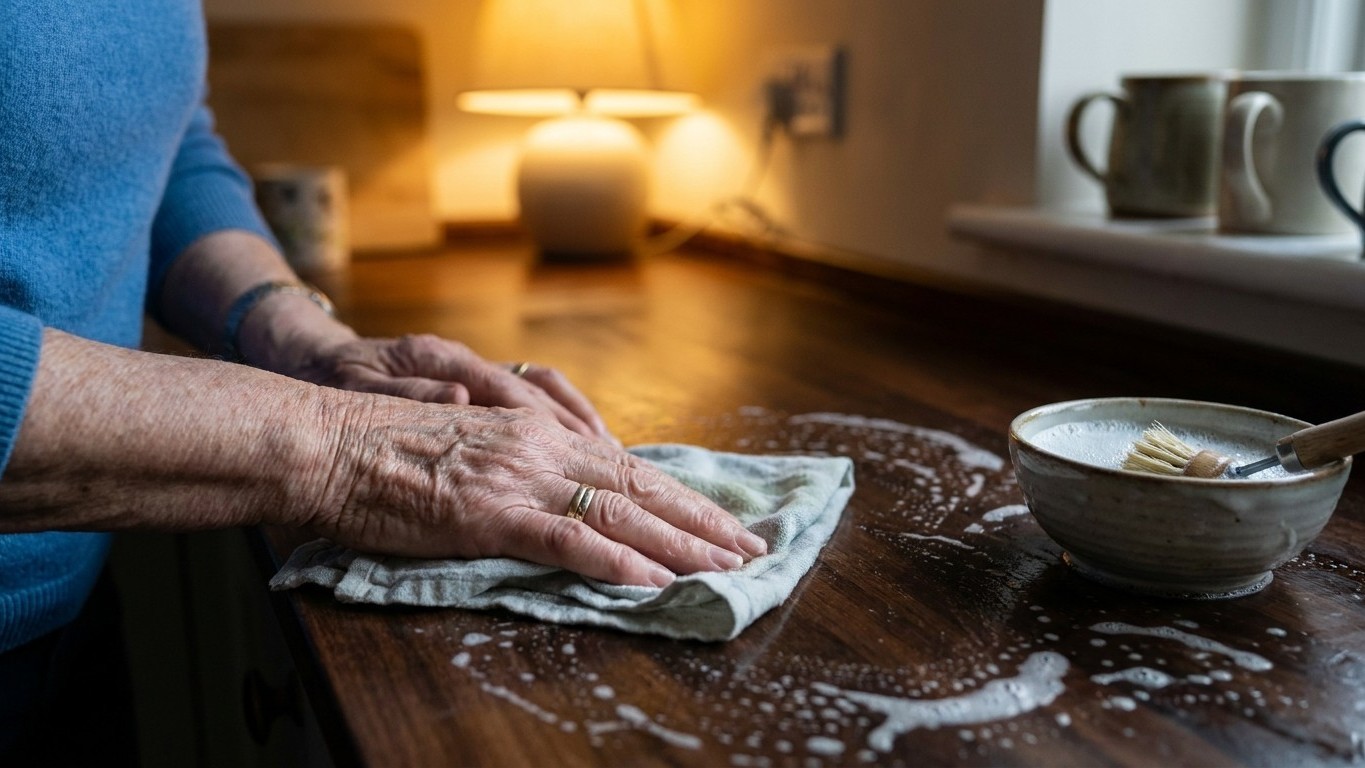
She wasn’t being fussy at all, bless her. That nightly ritual with the washing-up liquid bottle was pest control and food safety rolled into one, and grandmothers up and down Britain have been doing it for generations without ever needing a science degree to know it worked.
Here’s what’s really going on when a sink of hot water and a squirt of Fairy meets your worktop last thing at night. Washing-up liquid isn’t just soap, it’s a degreaser, and grease left sitting on a kitchen surface overnight becomes exactly the kind of feast that unwanted visitors go looking for once the lights go out and the house falls quiet.
Key takeaways
- A cockroach can survive a month on grease residue from a single plate—here’s what your grandmother knew
- Invisible grease and moisture create a buffet for nocturnal pests that most people never see coming
- Washing-up liquid was the perfect tool for this job—gentle enough for surfaces, effective enough to matter
The grease trail nobody notices until it’s too late
Cockroaches, in particular, have a genuinely alarming relationship with cooking fat. Pest control specialists note that grease buildup represents a major food source, as tiny oil splatters that coat a stovetop and backsplash become a sticky film that cockroaches love feeding on, setting up camp nearby to stay close to the buffet. One pest control firm puts it even more starkly: a cockroach can survive for about a month on the food residue from a single greasy plate. A month. From one plate. That’s the sort of fact that makes you reach for the washing-up liquid rather sharpish.
It isn’t just cockroaches either. Ants are drawn to exactly the same thing your grandmother was scrubbing away, since ants love sugars and fats, which are in many household foods, from jam or honey to greasy residues on pans. And the smell travels further than you’d think. Even a fly’s sense of smell is incredibly sensitive, so a drop of juice near the fridge, grease buildup around the stove, or crumbs tucked into corners all create scent trails that flies pick up almost immediately. A worktop that looks perfectly clean to your eye can still be broadcasting an invitation to every insect in the postcode.
The sink matters just as much as the worktop. One pest expert advises making it a habit to wipe your sink completely dry before you go to bed, removing the overnight watering hole for nocturnal bugs. Cockroaches and silverfish need moisture almost as badly as they need food, so a damp sink left overnight is doing them two favours at once.
Bacteria don’t clock off at bedtime
There’s a health angle here too, and it’s not just about creepy-crawlies. Government food safety guidance is quite clear that it is important to wash surfaces and utensils after each use, using paper towels or a clean cloth to help prevent the spreading of bacteria. Bacteria are opportunistic little things, and they thrive on the exact conditions a used worktop provides overnight: leftover moisture, a smear of grease, a few stray crumbs of cheese or chicken fat. One extension service warns that bacteria can hang around kitchen surfaces, the sink, and even the refrigerator, and bacteria likes moisture, so keeping your kitchen clean and dry can help protect you from foodborne illness.
Washing-up liquid is particularly good for this nightly job because it won’t damage most kitchen surfaces the way a harsher chemical cleaner might. As one home improvement guide notes, wood, marble, granite, quartz, engineered wood and stainless steel all require gentle cleaning to avoid damage, and with its neutral pH, dish soap is right for the job. It won’t strip a wooden worktop’s finish or dull granite the way vinegar or bleach sometimes can. That’s presumably why it became the go-to bottle by the kettle rather than something more industrial.
Now, I’ll be honest with you: washing-up liquid alone won’t sanitise a surface in the way a proper disinfectant would. It’s worth understanding the difference, because the two jobs aren’t quite the same. As one extension service explains, cleaning involves soap and water, removes visible dirt, and removes most of the germs, whereas sanitisers provide extra safety because they contain stronger solutions that destroy more disease-causing bacteria. What your grandmother was doing every night was the “cleaning” half of that pair, physically lifting grease, food particles and the moisture bacteria need to multiply, off a surface where it would otherwise sit undisturbed for eight hours.
How to do it properly, the old-fashioned way
If you want to bring the habit back into your own routine, it doesn’t need to be complicated or expensive. A dampened cloth, a small squeeze of washing-up liquid worked into a lather, and a good going-over of the whole worktop takes about ninety seconds. The trick is consistency rather than intensity. Pest specialists list the same handful of trouble spots every time:
- Crumbs and grease around the toaster, hob and chopping boards
- Standing water left in the sink or a wet sponge on the draining board
- Fruit bowls with anything overripe sitting out overnight
Rinse the cloth thoroughly, wring it properly (a soggy dishcloth left in the sink overnight is its own small ecosystem, unfortunately), and leave the worktop to air dry rather than towelling it. If you fancy an extra layer of protection once a week, a food-safe surface spray or a very dilute bleach solution after the soap-and-water stage will deal with anything the washing-up liquid missed, though for nightly use, soap and warm water genuinely does the heavy lifting.
What strikes me most, looking back at all this, is that our grandmothers arrived at good pest control and food hygiene practice through nothing more than trial, error and inherited common sense, decades before anyone wrote it into an official leaflet. There’s a lovely symmetry in that. She never called it “reducing your foodborne illness risk” or “eliminating conducive conditions for pest harbourage.” She just called it wiping down before bed, and got on with it, kettle already filled for the morning.
Sources : canr.msu.edu | cleverdude.com