
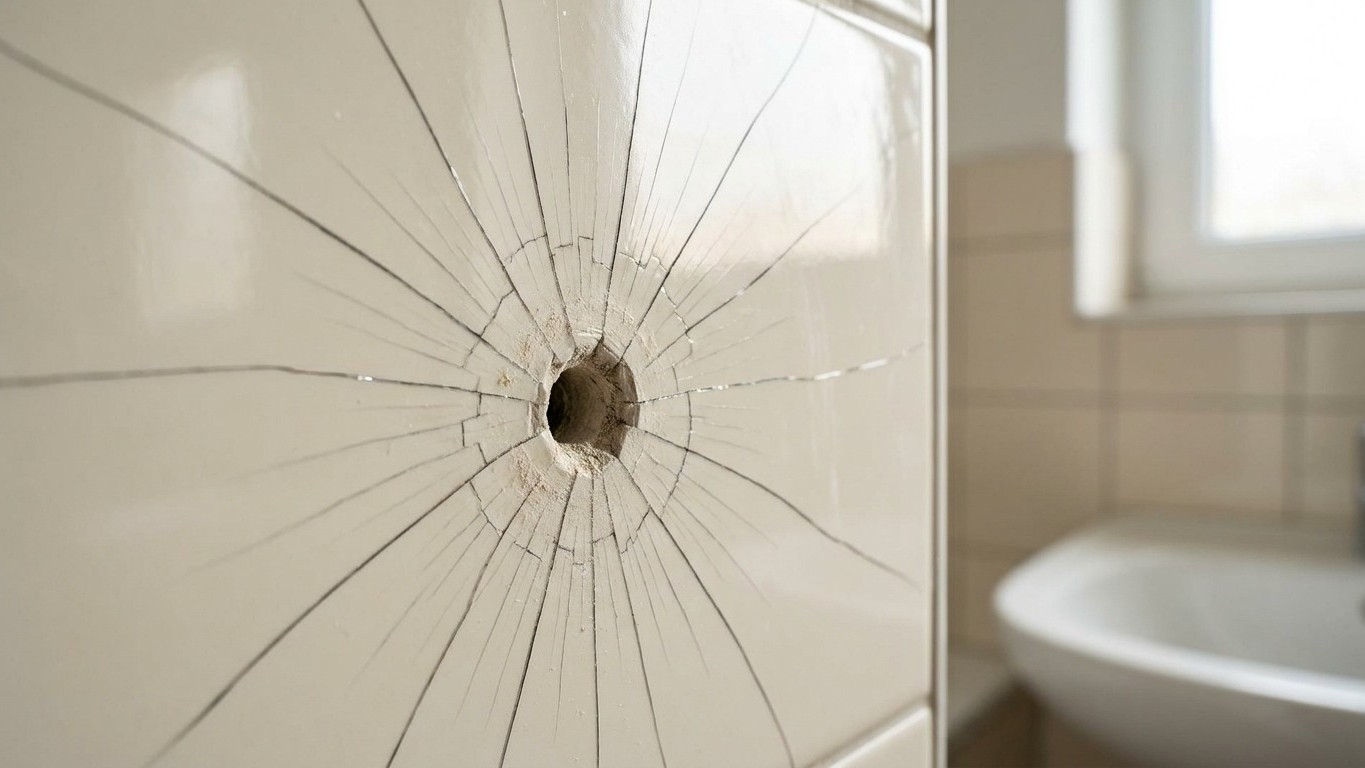
That spiderweb of hairline cracks racing out from under the drill bit is the glaze failing instantly under shock, not slowly under pressure. The moment you flick a standard drill onto its hammer setting for bathroom tiles, you’re sending rapid little jackhammer blows into a surface that’s essentially thin glass sitting on baked clay, and glass simply doesn’t forgive that kind of treatment. Avoiding the hammer function matters because the pounding action can instantly crack porcelain or ceramic tile. It’s not a gradual weakening, either. One pass, and the damage is done before you’ve even registered what happened.
Key takeaways
- A hammer drill’s percussive shocks shatter tile glaze instantly—it looks like a spiderweb spreading across the surface before you can stop it
- The glossy layer protecting your tiles is chemically identical to glass, and glass simply cannot forgive jackhammer-style impacts
- Switching to a gentler approach with the right bit, masking tape, and moisture cooling prevents damage entirely—and it’s easier than you’d think
Why the hammer setting is the wrong tool for the job
Most of us grew up thinking a hammer drill was simply the “strong” setting, the one you reach for when a job feels tough. Tile drilling has fooled a lot of sensible people this way. Ceramic tile typically consists of two layers that affect how drilling should be performed, with the outer layer being a smooth, glossy glaze that protects the tile from water and stains. This glaze is extremely hard and can cause drill bits to slip if the surface is not prepared properly, while below it is the clay-based ceramic material that provides the tile’s strength. That glaze layer is brittle by nature, and brittle materials fail through cracking rather than bending. Send percussive shockwaves through it, as a hammer drill does, and hammer action sends vibration directly into the surface and will crack even a well-supported tile.
Porcelain is worse still. Porcelain is fired at a higher temperature, which means it is more durable and resistant to chips and cracking, which is perfectly fine until you want to drill a hole through it. The density that makes porcelain such a good choice for a wet, steamy bathroom is exactly what makes it so unforgiving under the wrong drill setting. My late husband once tried to save time fitting a towel rail by “giving it a bit of welly” with the hammer function, and we spent the following Saturday morning at the tile shop trying to match a discontinued pattern. We never quite managed it, and that mismatched tile is still there behind the mirror, a permanent little reminder.
What actually works: patience over power
The fix isn’t a stronger drill, it’s a gentler one. Always switch the drill to regular mode before starting to work on the tile. Beyond that, three things make the real difference: the bit, the speed, and a bit of grip at the starting point.
For ordinary glazed ceramic, carbide-tipped drill bits work best, whereas anything denser, whether porcelain, natural stone, or those popular stone-effect floor tiles, calls for diamond-tipped drill bits, which are ideal for porcelain, stone, marble, or any dense tiling material. Whatever you do, leave the wood and metal bits in the toolbox. Bits made for wood or metal are too soft and will not cut through different tile types.
Before the drill even touches the tile, stick down a small cross of masking tape over your marked spot. The tape helps prevent the bit from skidding on glossy surfaces, giving you a fighting chance of starting exactly where you intended rather than three millimetres to the left. Then go slowly, properly slowly. The lowest tile drill bit speed possible, say 100 or 200 revolutions per minute, is perfect to drill standard ceramic tile. Once you feel the bit bite through that glassy top layer, you can ease the speed up a touch, but light, steady pressure throughout beats brute force every single time. Pressing hard will cause the bit to skate, crack the tile, or burn out the abrasive tip.
Heat is the quiet culprit nobody thinks about until their bit turns cherry red. Drilling generates friction, friction generates heat, and an overheated tile becomes brittle at exactly the wrong moment. A damp sponge dabbed against the bit every few seconds, or a light spray from an old plant mister, costs nothing and does more to prevent cracking than any expensive bit ever will. When you finally break through to the wall behind, switch to an ordinary masonry bit for that part, since forcing a tile bit through brick or plasterboard is a waste of a good bit and your patience.
If the crack has already happened
If you’re reading this with a spiderweb already staring back at you, take a breath before reaching for anything drastic. A small chip or hairline crack right around the hole is usually salvageable. Tile repair epoxy can fill the damaged area, and once it’s cured, paintable tile filler smooths the surface so the repair blends in rather than shouting for attention. It won’t be invisible under a magnifying glass, but at normal viewing distance, and with a towel rail or mirror covering the spot, nobody’s going to notice but you.
If the crack has spread properly across the tile face, though, honesty is the kinder route: that tile needs replacing, not patching. Keep a small stash of spare tiles from any bathroom refit tucked away in the airing cupboard for exactly this reason, because tile ranges get discontinued with alarming regularity and matching an older batch years later is a fool’s errand, as I learned the hard way.
Here’s a detail that surprises most people: the glaze on a typical ceramic tile is genuinely glass, chemically speaking, formed when a silica coating melts and fuses in the kiln. Many common ceramic tiles are made primarily with clay, but then coated with a thin glaze that is primarily silica, which in the kiln turns into a hard, thin glass coating. Knowing that changes how you think about the whole job. You wouldn’t take a hammer to a windowpane to make a neater hole in it, and a bathroom tile deserves exactly the same respect.
Sources : ceramices.com | defusco.com