
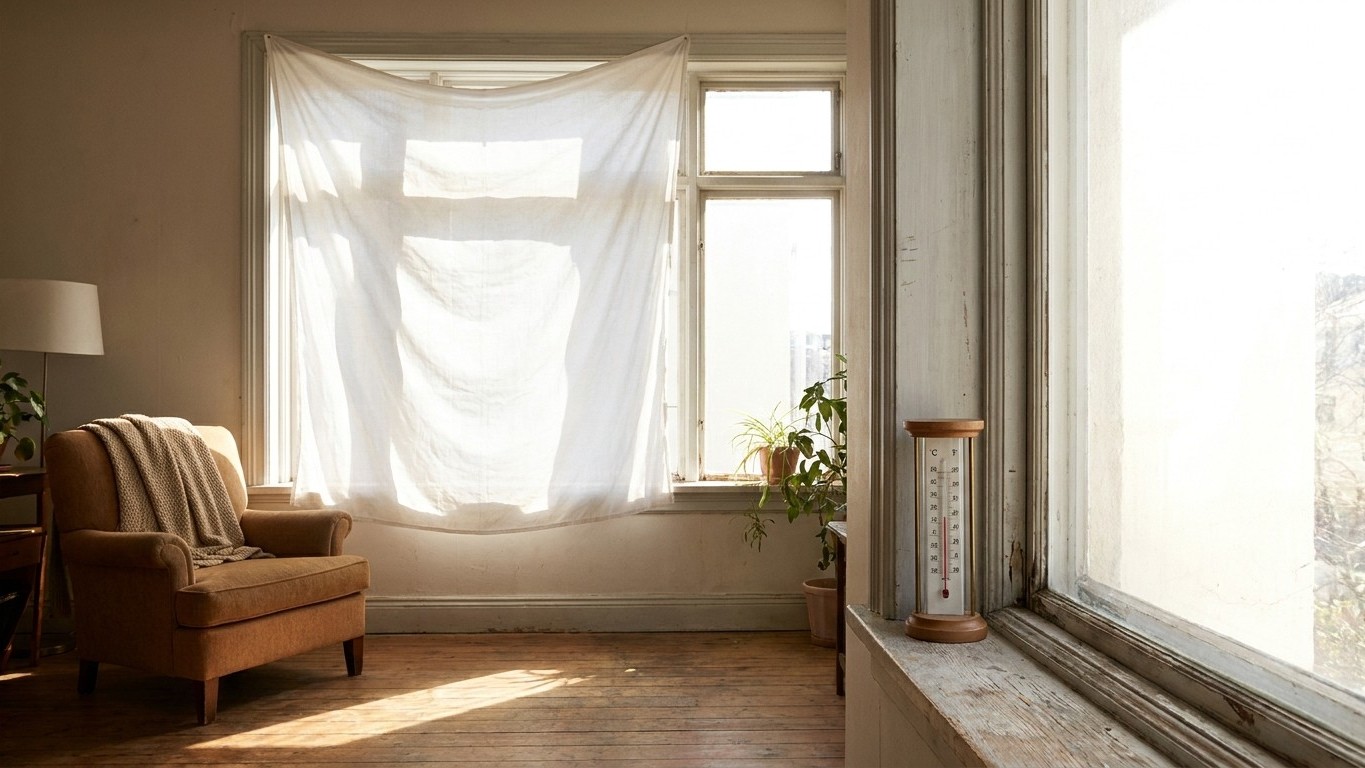
Ten o’clock in the morning, shutters latched tight on the south wall, and the room stayed a good five degrees cooler than the scorcher next door with her windows flung open. That was the moment I realised I’d been doing it backwards for the best part of thirty summers. Every hot afternoon, out came the fans, up went the sashes, and in poured what I thought was relief. It wasn’t. It was an oven fan pushing warm air straight into my sitting room.
Key takeaways
- Opening windows when it’s hotter outside than inside pushes warmth directly into your home
- Closing internal blinds only blocks 10% of solar heat—external shading from outside is what actually works
- A £0 bedsheet taped to south-facing windows outperforms expensive blackout curtains
Why flinging the windows open at 2pm makes things worse
The instinct feels right, doesn’t it? Stuffy room, blazing sun, so you throw the windows wide and hope for a breeze. But if the air outside is hotter than the air trapped inside your walls, you’re simply inviting the heat in to join you. Opening a window doesn’t always mean you’re cooling your home. In fact, if the air outside is warmer you could risk making it worse. The Red Cross puts it plainly: during the hottest parts of the day, it’s best to close windows to keep the warmer air out.
The trick, then, isn’t windows open or windows shut as a blanket rule. It’s timing, and it’s watching two temperatures rather than one. If the weather outside is hotter, then close your windows to trap the “cool” air in. On the other hand, if the inside of your house is hotter, usually in the early morning or late evening, then open them up to let a cool breeze in. I’ve since started keeping an old thermometer on the outside sill and another on the mantelpiece, nothing fancy, just enough to stop me guessing. When the two numbers cross over, that’s my cue.
What south-facing glass actually lets through
Here’s the bit that properly surprised me. I’d always assumed my curtains were doing the heavy lifting. They weren’t, not really. Even with the windows closed, sun shining through the glass can warm your home up quickly, so it’s worth covering windows during the day to protect from direct sunlight with blinds, curtains, or external shutters. But there’s a world of difference between shading from inside and shading from outside. Closing internal blinds or curtains still lets the heat get through the glass, and will only reduce solar gains by about 10%. To make a significant impact, shade the windows from the outside.
That single fact rearranged how I think about my own house. My grandmother’s cottage had proper wooden shutters on the outside of every south window, and as a girl I thought they were simply decorative, a nod to some Old-Fashioned charm. They were doing physics. Once sunlight has passed through glass it’s already converted to heat inside your walls; stopping it before it reaches the glass is the whole game. Europeans regularly employ products such as external roller shutter blinds and awnings, but these are currently much less common in the UK, though the same effect can be achieved with less intervention using old towels, curtains, bed sheets or bamboo screening to shade glazing. I’ve taped an old bedsheet across my worst-offending window and honestly, it works better than the blackout curtain that cost me considerably more.
Getting the shutting-up hour right
Ten o’clock wasn’t a number I plucked from nowhere. It lines up with official guidance almost exactly. NHS advice recommends keeping sun-facing rooms as shaded as possible by keeping curtains shut, particularly between the hours of 11 am to 4 pm. South-facing rooms catch the sun earliest and hardest through the late morning, so closing up shop by ten gives you a buffer before the real assault begins. Leave it until midday and you’re already fighting a room that’s started heating from the inside out.
Once the shutters or blinds are down, resist the urge to peek and let light back in “just for a bit.” Blackout curtains can be a useful addition to retain the shade and further reduce heat, providing an extra layer of protection in keeping the heat out of the room at night and keeping the room dark during the day to stop the sun from heating it. The other half of the routine, the bit I’d been getting wrong for years, is the release. Wait until the cooler times of the day to open windows, and when they are open, create a breeze in your home by opening different windows on opposite sides to help air circulate. If you’ve got a conservatory tacked onto the back of the house, treat it as its own weather system entirely: it’s recommended that you keep the conservatory windows open during the day and isolate it from the rest of the house, keeping the door between the conservatory and the house closed to prevent a “greenhouse effect” that traps extremely high heat levels inside.
None of this costs a penny beyond the price of an old bedsheet or two, which is rather the point. I’m not about to recommend anyone rush out and buy proper external shutters, satisfying as they’d be, when a length of mesh fabric or perforated packaging paper taped to the glass does much the same job for free. What changed for me wasn’t a purchase at all. It was simply learning that the sun does its worst damage before lunchtime, quietly, through glass I’d never thought to protect from the outside, and that closing up early isn’t giving in to the heat. It’s beating it to the door.
Sources : redcross.org.uk | greenmatch.co.uk