
Bleach was my weapon of choice for nearly a decade. Every spring, out came the rubber gloves and the bottle, and every spring my PVC window frames looked worse by autumn, not better. Turns out I had the whole thing backwards, and the fix a window fitter eventually showed me cost nothing but a bit of elbow grease and patience.
Here’s what nobody tells you when you buy PVC windows: that satisfying, oxidation is a chemical process. Unprotected PVC breaks down under sunlight through a process called photo-oxidation, causing yellowing or a chalky, dull surface. Sunlight isn’t just fading the colour on the surface, it’s actually altering the plastic at a molecular level. The carbon-chlorine bonds in PVC are susceptible to breaking in the photodegradation process, which in turn creates conjugated double bonds in the polymer chain, and introduction of these double bonds during UV exposure causes PVC to change color toward a yellowish or brownish hue. No amount of scrubbing undoes a chemical reaction that’s already happened inside the material itself.
Key takeaways
- A decade of bleach wasn’t fighting yellowing—it was causing permanent damage that can’t be undone
- The real culprit behind yellow PVC is a molecular breakdown called photo-oxidation, not surface dirt
- One simple ritual using items already in your kitchen can restore shine without harming the plastic
Why My Bleach Habit Was Making Things Worse
I genuinely believed harsher meant better. If soapy water wasn’t cutting it, surely bleach would finish the job? Wrong, and embarrassingly so. Cleaning experts are unanimous on this point: avoid using bleach to clean uPVC window frames or sills as it can damage the surface and cause permanent discolouration, because bleach can react with the chemicals in uPVC, leaving it looking dull or even tinted, and this damage cannot be reversed. One trade guide put it even more bluntly, warning that one of the main problems with cheap or older uPVC is it can develop a yellow tinge and it would be natural to think that a squirt of bleach will bring back the super white frames – DON’T! If you leave it sitting too long, the result isn’t whiter plastic. If you leave bleach on the uPVC frame it can turn it brown. I’d essentially been baking my own yellowing in, year after year, convinced I was fighting it.
It wasn’t only the bleach. Every “miracle” spray, every scouring pad I’d dragged across the sills to shift stubborn marks, was doing quiet damage too. Never use bleach, white spirits, or anything rough with too much pressure, as it can permanently scratch and damage the surface of the uPVC. Scratches trap grime, which then looks like yellowing, which then tempts you to reach for something stronger. It’s a horrible little cycle, and I’d been stuck in it since roughly 2016.
The Fitter’s No-Chemical Trick
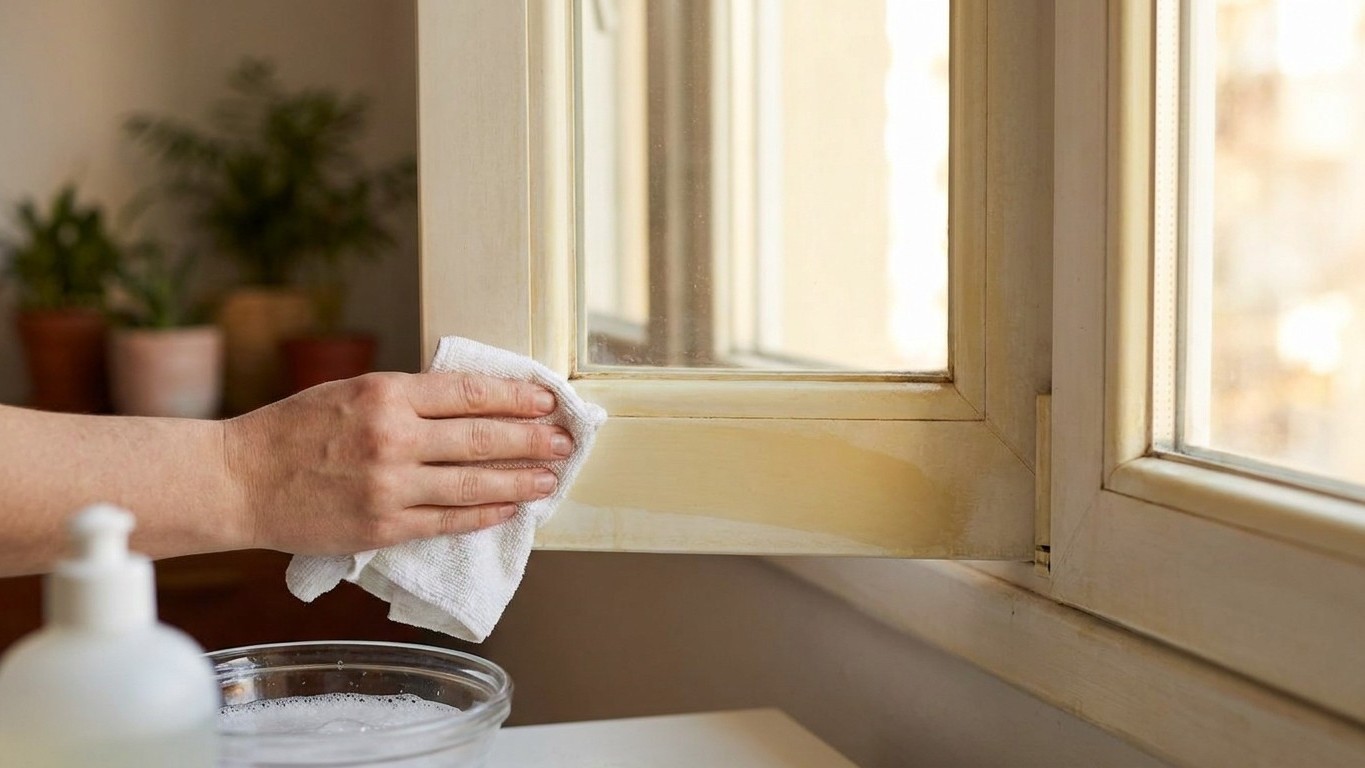
The man came round to quote for a replacement window on our south-facing bay, the worst offender in the house for that dingy tinge. He took one look at my cleaning cupboard and just shook his head, gently. His advice was almost insultingly simple: soft cloth, warm water, a squeeze of ordinary washing-up liquid, and time. Nothing more. Mix a solution of washing up liquid and water, and clean your windows with an old tea towel or dish cloth. In most cases, just perseverance and hard work is all that is needed to bring a shine back to your uPVC. The point he kept repeating was that the damage from chemicals is permanent, but the damage from grime usually isn’t, so the sensible move is always to work gently and repeatedly rather than aggressively once.
He also had me vacuum the frames and hinges first, which felt faintly absurd until I saw the difference. Removing loose grit before you wipe means you’re not grinding sand into a soft plastic surface with every pass of the cloth, which is exactly how those fine scratches build up. For proper grime rather than oxidation, he suggested a mild vinegar rinse, roughly one part vinegar with four parts water, left to work its magic for 10-15 minutes, giving you beautiful and bright windows without any chemicals or nasty smells. The acidity cuts through atmospheric dirt and light staining without attacking the plastic the way bleach does.
What Steam and Sunshine Actually Explain
Here’s the bit that finally made sense of my south-facing bay window. Aspect matters enormously, more than I’d ever appreciated. The primary cause of PVCu yellowing is the sun and its UV light, and if your windows have started to yellow, the areas where sunlight is more restricted are probably less discoloured, if at all, than parts in direct sunlight. A north-facing frame in the same house can look years younger than a south-facing one purely due to sun exposure, no amount of cleaning changes that underlying chemistry.
Quality plays its part too, which explains why my neighbour’s identical-age windows have stayed whiter than mine. Lower-grade uPVC frames often lack proper UV stabilizers in the material, so they oxidize more quickly and may turn yellow within a few years compared to high-quality, UV-resistant uPVC windows. Modern frames fare much better because manufacturers now build the protection into the outer layer itself. Premium profiles are made with a specially formulated outer skin that contains a high concentration of UV stabilisers and TiO2, while the inner core uses a different compound for structural strength, putting maximum UV protection exactly where it is needed at the surface. There’s a limit, mind. Once true photo-oxidation has set in deep, surface stains caused by dirt, smoke, or mold can usually be cleaned and restored, however, deep yellowing caused by UV oxidation may not be fully reversible.
So my frames aren’t back to showroom white, and I’ve made my peace with that. What’s changed is the maintenance rhythm, and honestly, the peace of mind. A gentle wipe-down every three months if you’re in town or near the coast, twice yearly out in the countryside, keeps grime from ever building up enough to tempt anyone back toward the bleach bottle. My fitter’s parting comment stuck with me most: he’d lost count of the callouts where the “damage” people wanted fixing was actually caused by whatever they’d used to try fixing the last lot of damage.
Sources : sunluxroofwindows.co.uk | tradeupvcwindows.co.uk