
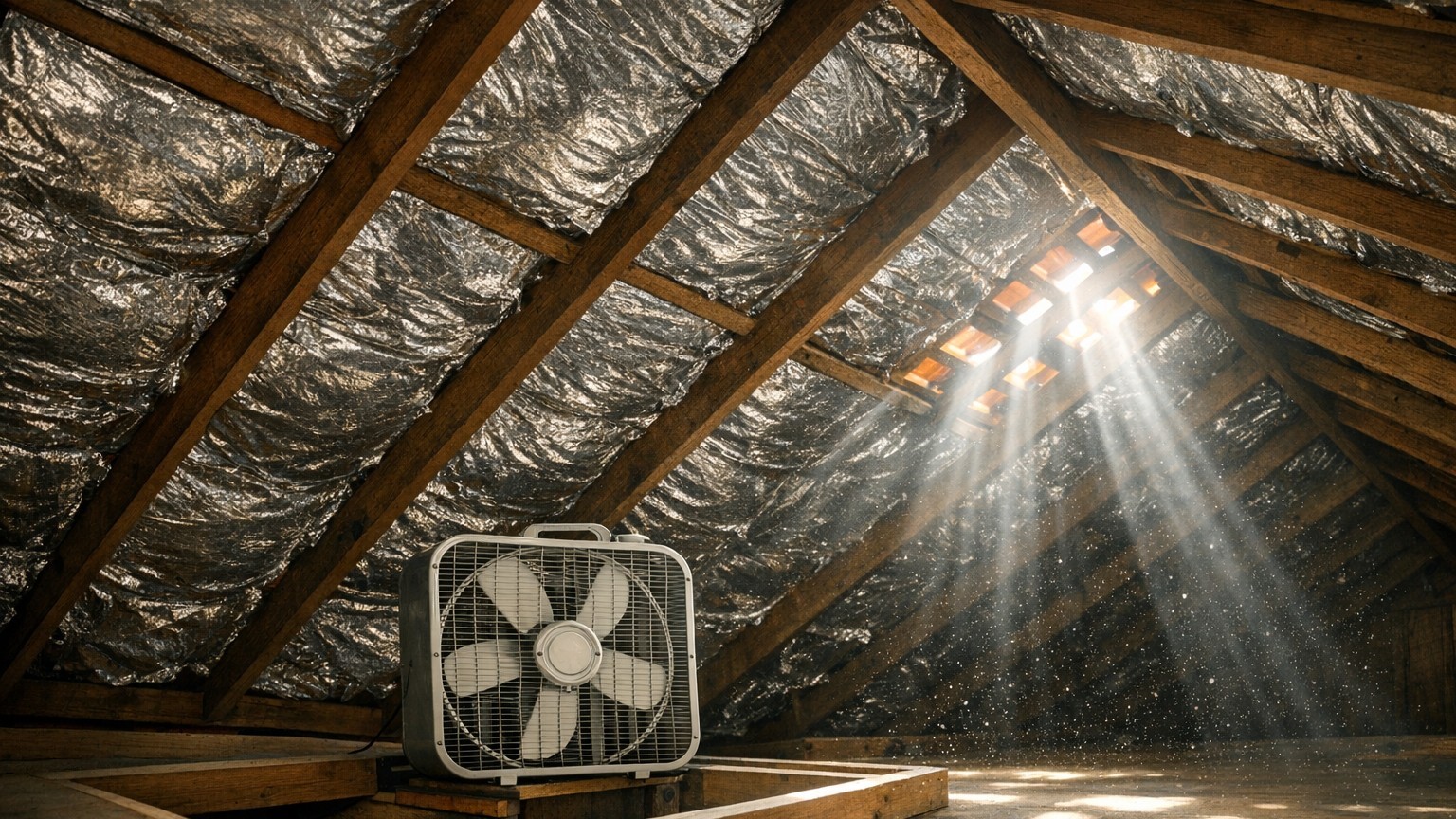
Three summers without touching the air conditioning unit. No repair bills, no monthly energy spike, no standing over a noisy portable fan at two in the morning. The fix that made it possible cost practically nothing and took one Saturday afternoon in the loft. What my father-in-law rigged up was almost embarrassingly low-tech: a simple combination of reflective foil stapled under the rafters and a repositioned box fan at the loft hatch. It works because it attacks the real problem, not the temperature in the rooms, but the temperature overhead.
Key takeaways
- An attic can reach 170°F on a 90°F day—and that heat silently infiltrates every room below through your ceiling
- A roll of reflective foil stapled to rafters bounces radiant heat back before it enters your home, costing just dollars
- A simple box fan at the loft hatch, combined with passive ventilation, creates circulation that sweeps heat out of the house
Your Loft Is Silently Cooking Every Room Below It
Most of us never think about what is happening above our ceilings on a hot July afternoon. Without proper ventilation, an attic becomes ferociously hot during summer, if it is 32°C (90°F) outside, the temperature inside a poorly vented loft can climb as high as 77°C (170°F). That is not a typo. It is closer to a fan oven than a room in a house. All that attic heat presses down into the home’s interior, making any cooling effort, fans, open windows, even a running AC, less efficient and driving energy bills higher.
The trouble is that attic insulation, rather than solving the problem, can actually make things worse: it holds the heat long after the sun has gone down, continuing to transfer it slowly through the ceiling into your living space. So insulation alone, without proper airflow, simply turns your loft into a slow cooker with the lid on. The physics are straightforward enough: cold air sinks and hot air rises, which means that every degree of trapped heat up in the roof space is quietly working its way down towards your bedrooms and sitting room. Attics are prone to overheating even in the UK, heat rises to the top of the house and gets trapped under the roof.
The £2 Fix: Reflective Foil and a Fan at the Hatch
What my father-in-law did first was staple a roll of reflective foil insulation to the underside of the rafters. This material, essentially a heavy-duty, tear-resistant aluminium foil, is the principle behind what professionals call a radiant barrier. Radiant barriers are installed in homes, usually in attics, primarily to reduce summer heat gain; the barriers consist of a highly reflective material that reflects radiant heat rather than absorbing it. The key word is reflects. Rather than trying to absorb and slow down the heat passing through the tiles (what standard insulation does), the foil bounces the radiant energy straight back before it ever enters the loft air.
In an existing home, an installer simply staples the rolled foil to the bottom of the rafters, foil-face down to minimise dust accumulation on the reflective surface. One important note from the experts: when installing a foil-type barrier, allow the material to droop slightly between attachment points to create at least a 2.5 cm (1 inch) air space between the foil and the underside of the roof. Without that small gap, the reflection effect is reduced. Also worth remembering: reflective foil will conduct electricity, so avoid making any contact with bare electrical wiring while you are up there. A pair of thick gloves and a head torch is all the kit you really need for the job.
The foil addresses radiant heat, the sun’s energy blazing through the tiles. But the second part of the fix deals with the hot air itself. Opening the loft hatch creates a low-resistance path for heat to rise out of the living space — and it works even better if the attic already has some form of passive ventilation like ridge, soffit, or gable vents. My father-in-law went one step further. A fan pointed upward at the loft hatch pushes warm air through the hatch and into the attic space, accelerating what is known as the stack effect. Meanwhile, box fans or window fans on the lowest floor pull cooler air in from outside, setting up a continuous circulation that sweeps heat upward and out through the roof vents. The box fan itself, a basic, plug-in model, costs very little and uses a fraction of the electricity of any air conditioning unit. An attic fan costs around a few pence per hour to run, compared to the much higher cost of running AC.
Making the System Work Properly
The fan-and-hatch trick has one condition: whole-house ventilation strategies are most effective when outdoor temperatures are lower than indoor temperatures, so the approach works best in the evenings, overnight, and in the early morning. During peak afternoon heat, keep the hatch closed and let the foil do its reflecting. Then, once the outside air cools off, which in Britain often happens by 9 or 10 in the evening, open the hatch, switch the fan on, and let the house breathe.
In summer, natural air flow in a well-vented attic moves super-heated air out of the space, protecting roof shingles and removing moisture, while the insulation below resists heat transfer into the house. Ceiling fan direction matters too: counter-clockwise circulation of fan blades in summer pushes cool air down to the floor, producing a wind-chill effect on the skin and making a room feel up to eight degrees colder to those underneath. That is worth checking on every fan in the house, there is usually a small switch on the motor housing to reverse the direction.
There is also something to be said for keeping interior doors open. HVAC experts recommend keeping interior doors open during summer, especially in two-storey homes, as this allows cool air to circulate properly between rooms and levels, maintaining an even temperature. Hot pockets forming in one room cannot escape if every door is shut.
What to Expect, and What to Watch
The honest answer is that the impact varies depending on your roof type, the existing insulation and how well your loft is already vented. Some studies show that radiant barriers can reduce cooling costs by 5 to 10 per cent when used in a warm, sunny climate. In a British context, where summer heat is intense but shorter-lived than in southern Europe, the gains may be modest in pure percentage terms, but the subjective difference in bedroom temperature at bedtime is striking. That one upstairs room that is always too warm in summer? That heat is almost certainly coming from the attic above. Deal with the attic, and the room changes.
One caveat worth flagging: if a radiant barrier is laid flat on the attic floor with the reflective side facing up, dust will settle on the foil surface over time, and once the dust layer covers it, the radiant barrier stops working entirely. Always staple the foil to the rafter undersides instead, angled so dust simply cannot accumulate on the reflective surface. Done correctly, it should last well over a decade with zero maintenance. Continuous airflow removes hot, moist attic air, protecting roofing, framing, and insulation while lowering energy costs — so the bonus is that your roof timbers are actually in better condition too. Three summers on, and the whole upstairs feels different from June to September. The air conditioning unit is still there, just in case. It has not been needed yet.
Sources : amazon.com | amazon.co.uk