
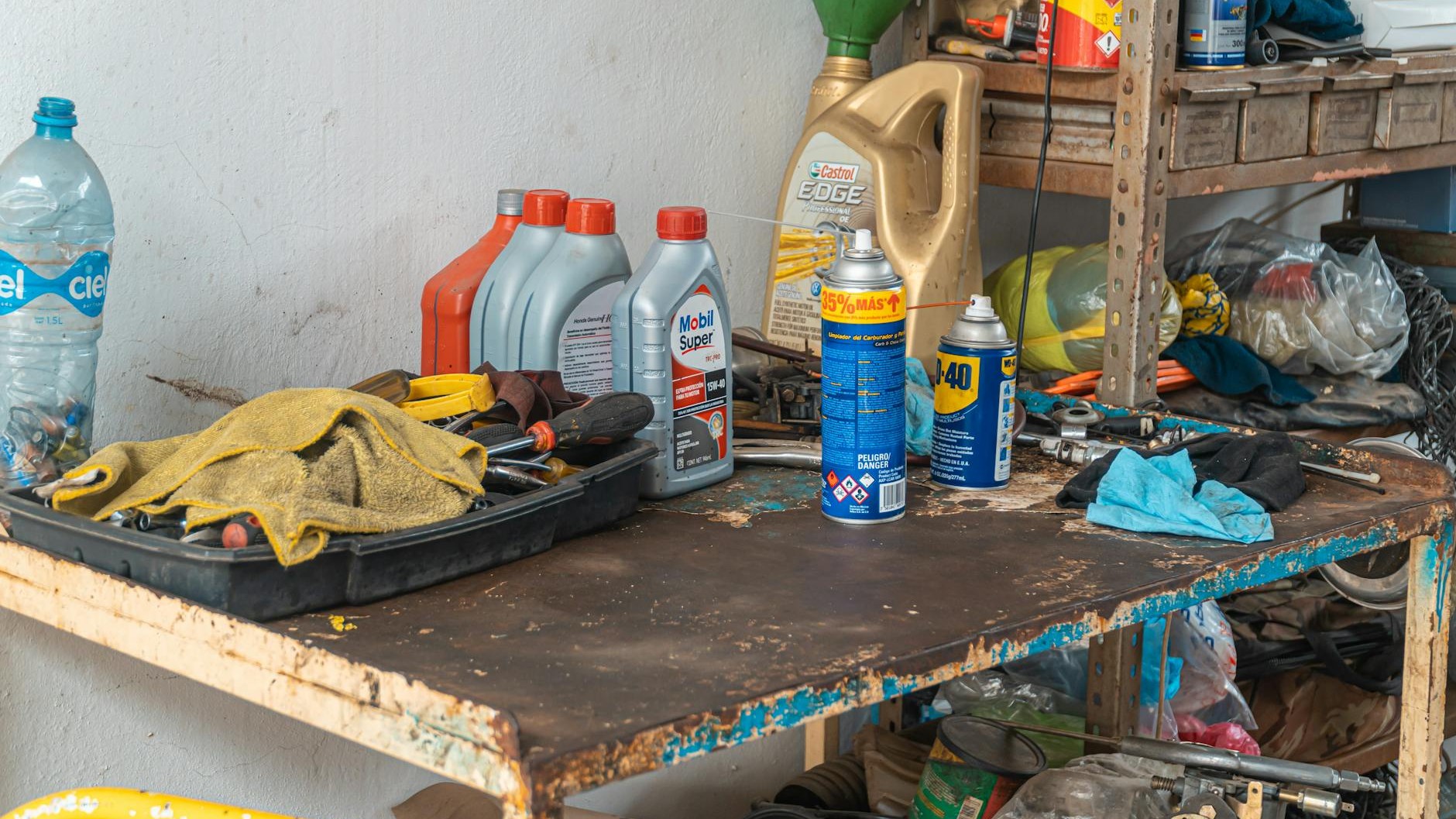
A squeaky hinge is one of those minor domestic irritations that somehow feels enormous at seven in the morning when the rest of the house is still asleep. Most of us reach for a can of WD-40 without a second thought, give the hinge a good spray, and enjoy perhaps three weeks of silence before the creaking returns. The spray is a temporary fix, not a cure, and the reason why becomes rather obvious the moment you actually pull the hinge pin out and look at it.
Key takeaways
- A worn flat spot on the hinge pin is why your door squeaks—WD-40 masks it temporarily but the problem always returns
- The pin takes 30 seconds to remove, and you can smooth shallow wear with sandpaper or replace it entirely if damage is severe
- Petroleum jelly or white lithium grease actually stay in place and protect the pin, unlike WD-40 which evaporates within days
What the pin is actually telling you
A hinge pin should be a smooth, uniform cylinder from top to bottom. Pull one from a repeatedly squeaky hinge, though, and you’ll almost certainly find a flat spot, a slight groove worn into the metal along one side. That worn patch is the source of your problem. As the door swings back and forth, the pin rotates fractionally inside its barrel, and over years of use the metal-on-metal contact grinds away at the surface. The result is a tiny ridge or depression that catches and drags with every swing of the door.
WD-40 does quieten this for a while, but here’s the mechanical reality: WD-40 is primarily a water displacer and light penetrating fluid, not a long-lasting lubricant. It evaporates relatively quickly, leaving very little protective film behind. Once it’s gone, that flat spot is right back at work, grinding and squeaking as enthusiastically as ever. You haven’t solved anything, you’ve just postponed the noise by a fortnight.
The proper approach, once you’ve pulled that pin
Removing a hinge pin takes about thirty seconds. Tap the bottom of the pin upward with a flat-head screwdriver and a hammer, and it lifts clean out. With the pin in your hand, you can see the damage clearly and decide what to do about it. If the flat spot is shallow, a few strokes with fine-grit sandpaper (around 220 grit) will smooth it back to something approaching round, and that alone can eliminate the squeak for good.
For lubrication, the material you want here is petroleum jelly, plain white lithium grease, or even a candle stub rubbed along the pin’s length. All three stay put, resist washing out, and actually coat the barrel rather than evaporating within days. Petroleum jelly in particular is something most households already have tucked in a bathroom cabinet, costs almost nothing, and does an excellent job on interior door hinges. Slide the freshly smoothed, freshly greased pin back in, tap it down, and that hinge may well stay silent for years.
A word on exterior hinges: they face rain, temperature swings, and road grime if you’re near a busy street, so a proper white lithium grease or a dedicated bicycle chain lubricant tends to outlast petroleum jelly in those conditions. The principle is the same, get something viscous and persistent onto that pin, not something thin and volatile.
When the pin can’t be saved
Sometimes the wear is too deep to sand out. If the flat spot has become a genuine groove, you can feel the edge clearly with your thumbnail, the pin needs replacing rather than polishing. Replacement hinge pins are sold individually or in packs at any decent ironmonger or DIY store, and a standard interior door pin typically costs very little. Take the old one with you when you shop, because pin diameters vary between hinge manufacturers and a slightly wrong size won’t sit properly in the barrel.
While the pin is out, peer into the hinge barrel itself with a torch. If the inner surface has corresponding wear marks, the entire hinge may be worth replacing. A single hinge on an interior door is a straightforward job requiring only a screwdriver, and a new hinge bought from a hardware shop costs a matter of pounds. The satisfaction of a completely silent door, properly fixed rather than repeatedly sprayed, is out of all proportion to the effort involved.
Why we reach for the spray without thinking
There’s a comfortable logic to the spray-can solution: it works immediately, requires no disassembly, and the can lives handily under the kitchen sink. WD-40 has earned genuine trust in British households over decades, and for certain jobs, freeing a rusted bolt, protecting a garden tool blade over winter, shifting a stuck zip — it is genuinely the right tool. The problem is that we apply it to squeaky hinges almost by reflex, without asking what’s actually causing the noise.
A 2019 survey of home maintenance habits in the UK found that squeaky doors and hinges ranked among the top five most commonly reported household irritants, yet fewer than one in five respondents had ever removed a hinge pin to inspect it. The spray habit is simply passed down: most of us were shown the WD-40 trick by a parent or partner, and we’ve never had cause to question it until the squeak comes back again and again.
There’s one more small detail worth knowing. Some modern hinges, particularly the pressed-steel type found on interior doors fitted in new-build properties since the early 2000s, have pins that aren’t fully removable, they’re crimped at the top to prevent removal during installation. If your screwdriver and hammer meet real resistance at the top of the pin rather than gentle friction, don’t force it. In that case, a drop of thick oil worked into the joint from above and below is your best option, and white lithium grease applied with a cotton bud can reach surprisingly far into a tight barrel. Still better than WD-40, and still a great deal longer-lasting.