
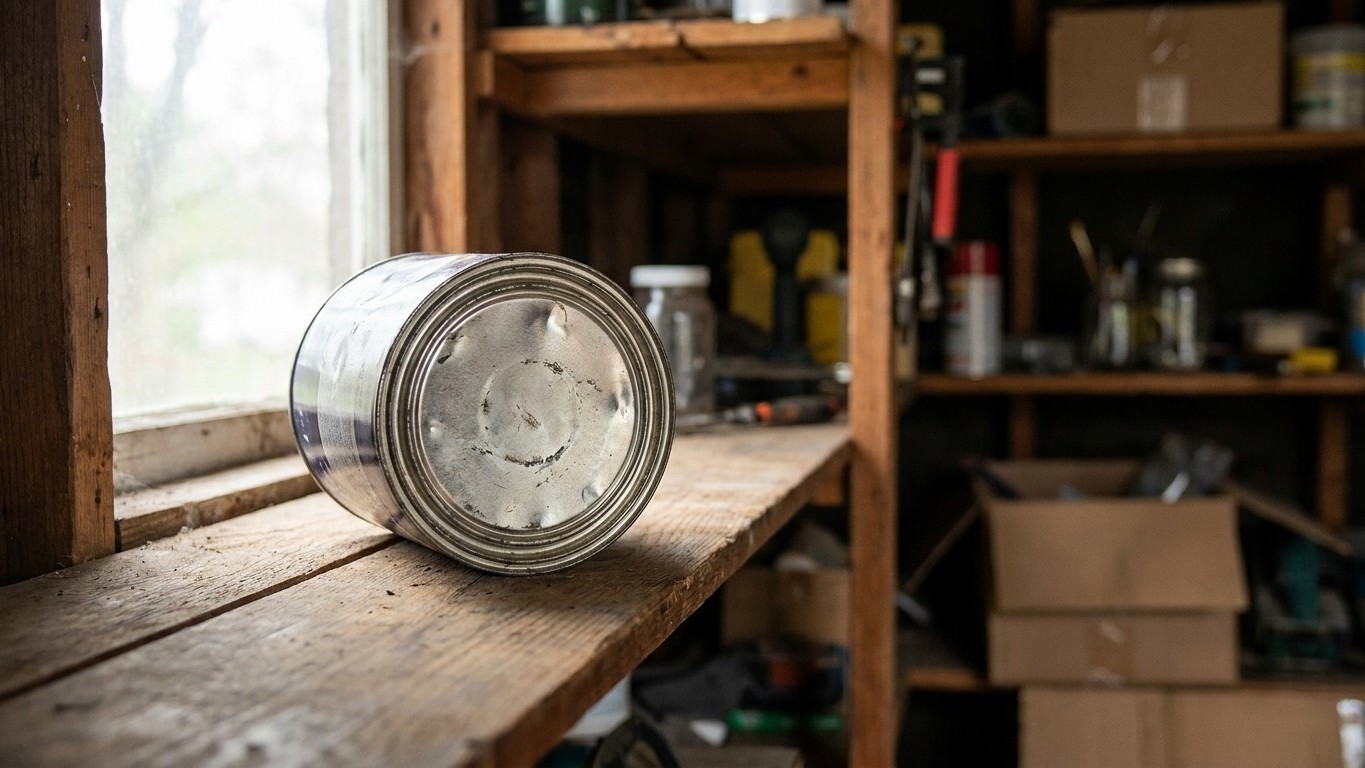
Paint tins should be stored upside down. There, I’ve said it. If you’ve been keeping yours the conventional way up on a shelf in the garage for years, you’re not alone, but you’ve likely been losing paint in the process, and not always understanding why the results were disappointing when you came back to finish a job.
The logic behind flipping a tin is beautifully simple. When paint sits upright for months, the solvents and lighter components gradually migrate toward the top, leaving the pigment and heavier binders slowly settling at the bottom. You open the tin a year later, see a pale watery layer on the surface, and assume the paint has gone off. Sometimes it has. But often, a thorough stir would have saved it, if you’d known what you were dealing with. Storing the tin upside down means that separation still happens, but now the skin that forms does so on the metal base, which becomes the bottom when you flip it right side up to use it. Open the lid and the paint surface is already well mixed, without that deflating crust to peel away.
Key takeaways
- A decades-old professional trick that most DIYers have never heard of
- How gravity and oxidation conspire against paint stored the conventional way
- The one critical step everyone gets wrong before attempting to flip a tin
The skin problem nobody talks about enough
That rubbery film that forms on the surface of stored paint is caused by oxidation. As soon as paint is exposed to even the smallest amount of air, the outer layer begins to cure. A tight lid helps, but it never creates a perfect seal, and over time, tiny amounts of oxygen do their quiet work. The skin itself isn’t necessarily a disaster, but when you try to stir it back in, it often breaks into fragments that create texture problems in your final finish. Many a ceiling has ended up with mysterious little bobbles because of stirred-in skin fragments that nobody spotted.
Storing tins upside down doesn’t eliminate skinning entirely, but it changes where the skin forms. When you turn the tin right side up to open it, you’ve effectively buried the skin at the bottom of the tin, where it’s far less likely to contaminate your brush or roller. A quick stir around the edges and you’re generally in good shape. This is why professional decorators have been doing it this way for generations, quietly, without making much fuss about it.
Getting the seal right before you flip
Before you store any tin upside down, the lid has to be properly seated. This sounds obvious, but it’s where most people go wrong. A lid that’s only half-pressed down will leak, and coming back to find a ring of dried emulsion on your garage shelf is not a pleasant experience. Use a block of wood and a mallet rather than hammering directly on the lid, which can distort the rim and make the seal worse, not better. A rubber mallet is gentler still.
Some people place a layer of cling film over the opening before pressing the lid back on, which creates an extra barrier against air. For oil-based paints and gloss, this is especially worth doing, as these are more prone to skinning than water-based emulsions. Once the lid is truly secure, place the tin on a shelf upside down and leave it. Store it somewhere that avoids extremes of temperature: a garage that drops well below freezing in winter can cause water-based paint to deteriorate regardless of how it’s stored, as the water in the emulsion freezes and the paint’s structure breaks down permanently.
What else has been quietly ruining your leftover paint
Temperature is actually the bigger culprit in most paint failures, and flipping the tin won’t save paint that’s been repeatedly frozen and thawed. The standard advice is to keep paint somewhere that stays above about 10°C through winter. A kitchen cupboard or an indoor utility room is far better than an unheated outbuilding. You can test whether emulsion has survived a cold winter by stirring it thoroughly and spreading a small amount on a piece of card. If it dries smooth and consistent, it’s still usable. If it goes lumpy or stringy, even after a long stir, it’s gone.
Rust is another quiet enemy. Once a tin’s interior starts to rust, the corrosion can discolour light-coloured paints and introduce particles that ruin a fine finish. Pouring leftover paint into a clean, lidded plastic container eliminates this risk entirely and takes up less shelf space. Labelling the container with the colour name, the room it was used in, and the date is the sort of small habit that saves an enormous amount of frustration two years later when you’re trying to touch up a scuff on the landing wall and can’t remember whether it was Pale Ivory or Antique White.
Decanting also makes it easy to check at a glance how much paint you have left. A half-full tin sounds full when you shake it, which has fooled more people than you might expect into starting a second coat with less paint than they actually needed.
One last thing worth knowing: water-based paints, which now account for the vast majority of what’s sold in British DIY shops, have a shorter shelf life than old-fashioned oil-based paints once opened, typically two to five years rather than the decade or more an alkyd gloss can sometimes last. The upside-down method buys you time with both types, but it’s not a substitute for using paint up reasonably promptly. A tin that’s been in the garage since before your youngest started secondary school probably owes you nothing.