
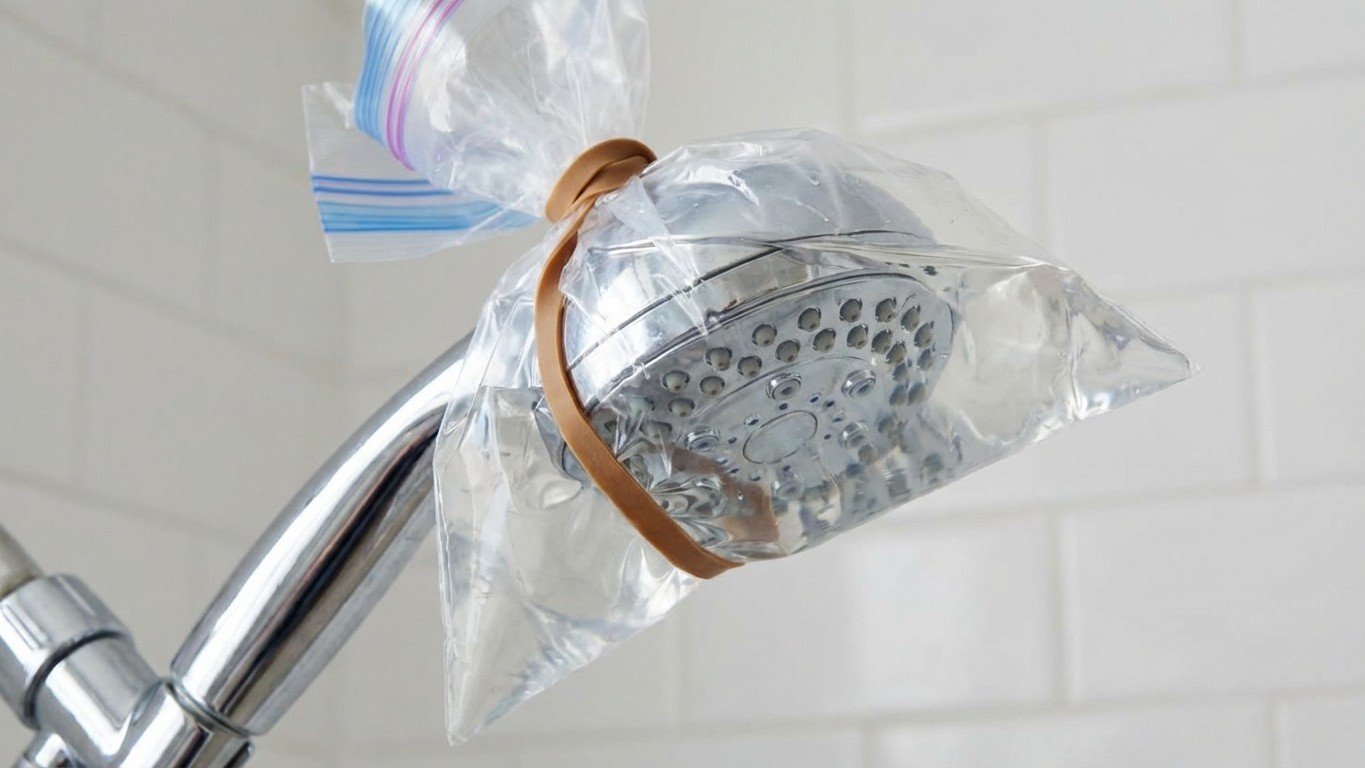
Tying a bag of white vinegar around your shower head is one of the most quietly effective household tricks ever devised, and yet most people stumble across it only when a plumber finally lets them in on the secret. The method requires no tools, costs a few pence, and can restore a sluggish shower head to its former vigour, all while you sleep. Here is exactly why it works, and how to do it properly.
Key takeaways
- Plumbers have been using this one-bag trick for years, but the reason why remains a mystery to most homeowners
- Hard water minerals don’t just block jets — they create the perfect breeding ground for dangerous bacteria invisible to the naked eye
- One night, one bag, one household ingredient — yet the results are dramatic enough that plumbers use it before recommending expensive replacements
Why your shower head silently suffers
Approximately 13 million households in the UK live in a hard water area, amounting to roughly 60% of the population. That is a striking number of homes quietly waging war against limescale every single day. Hard water contains high levels of dissolved minerals, mainly calcium and magnesium. As rainwater trickles over soft rocks like chalk and limestone, some of the minerals become dissolved in the water, making it “hard.” Those minerals have to go somewhere, and the tiny nozzles of your shower head are a perfect trap.
The minerals are left behind, layer upon layer. Over time, this mineral buildup hardens into limescale, narrowing or completely blocking the tiny shower head jets. You may not notice it for months, until one morning you are trying to rinse shampoo from your hair and the water barely trickles out. That chalky crust steals pressure, sprays water sideways, and turns morning rinses into a dribble.
There is a hygiene dimension to this that goes beyond mere inconvenience. The inside of a shower head is a specific niche that is moist, warm, dark, and frequently replenished with low-level nutrients and seed organisms. Biofilms form on interior shower head surfaces and potentially expose the user to aerosolised microorganisms. Hard water causes limescale buildup in pipes, taps, and shower heads, and limescale provides Legionella bacteria with nutrients, which help them grow. Unpleasant to contemplate, certainly, but the good news is that the bag method addresses both problems at once.
The chemistry behind the bag trick
Limescale is mostly calcium carbonate; white vinegar is acetic acid. Contact time is everything. A wipe will not reach inside the tiny spray channels, but a bag keeps vinegar hugging every surface, dissolving the crust where your cloth cannot. That is the whole genius of the method. The bag brings the acid to the problem instead of removing the shower head or using harsh chemicals.
Vinegar has antimicrobial properties that help eliminate common pathogens. Vinegar is acidic enough to dissolve limescale and disrupt the sticky film that bacteria cling to. So a single overnight soak is quietly fighting the chalky blockage and the hidden biology at the same time. Two problems, one crinkly bag.
One nuance worth knowing: use plain white vinegar, not malt or balsamic. Malt vinegar is not particularly effective, and brown vinegar may stain, the last thing you want is a vinegar-coloured shower head. Standard distilled white vinegar from any supermarket will do the job perfectly.
How to do it properly, step by step
The method itself takes about two minutes to set up. Grab white vinegar, a sturdy freezer bag, an elastic band or cable tie, a soft cloth, and an old toothbrush. Fill the bag with enough vinegar to submerge the shower head’s nozzles. Loop it over the head so the jets sit in the liquid, then secure the bag to the arm with the elastic. A zip tie is even more reliable if the bag is heavy with liquid, as it will not slip during the night.
A quick five-minute dunk will not touch the hidden bacteria because that protective biofilm acts like clingfilm. Plumbers insist on a good few hours, ideally overnight, to let the vinegar break down the scale and the slime together. For lighter build-up, 30 to 60 minutes may be sufficient; stubborn limescale warrants a few hours. Once the time is up, remove the bag, give the nozzles a gentle scrub with the toothbrush, and run hot water for a minute to flush out loosened deposits. Running hot water for a minute or two allows any mineral deposits still inside the head to be rinsed out.
A word on finishes. If your shower head is gold, brass, or nickel-coated, do not leave the bag on for more than 30 minutes, as it could damage or remove the finish. Chrome and plastic are far more forgiving of a long soak. Do not mix vinegar with bleach or any chlorine-based product, as dangerous gases can form. Plain vinegar, plain bag, plain elastic. No improvisation needed.
Making it a routine, not a rescue mission
This is a way to stop limescale before it ruins seals or narrows flow restrictors beyond saving. Plumbers love it because it prevents callbacks that nobody enjoys, not them, not you, not your water bill. In hard water areas, a monthly soak is wise; every two to three months if you are lucky enough to have softer water.
After the last shower of the day, give the head a quick shake and wipe to deny scale its drying time. A rapid 10-minute vinegar bag soak once a month works as maintenance instead of waiting for clogs to develop. If your postcode sits in an extremely hard water area, consider a water softener or an inline polyphosphate filter, as both reduce mineral deposition in pipes and on fixtures.
If the spray sharpens and the head stops spitting sideways after a soak, you have just dodged a pointless replacement. That is the pragmatic reason plumbers reach for this method on callouts before even considering new parts. Call a plumber if low pressure persists after descaling, if the diverter struggles, or if temperature swings suggest a failing thermostatic cartridge, those are signs of something the vinegar bag cannot fix.
One final thing that rarely gets mentioned: irregularly used shower heads are a particular risk area for bacterial build-up. Regular cleaning, descaling, and disinfecting of shower heads is important, as this minimises the risk of bacteria multiplying inside. If you have a guest bathroom that sits unused for weeks at a time, run it for a few minutes before anyone uses it, and give it a vinegar soak every couple of months regardless of how it looks. The problem with a neglected shower head is that the visible chalky ring is only the beginning of what is actually going on inside.
Sources : menuthai-fleet.co.uk | proplumb365.co.uk