
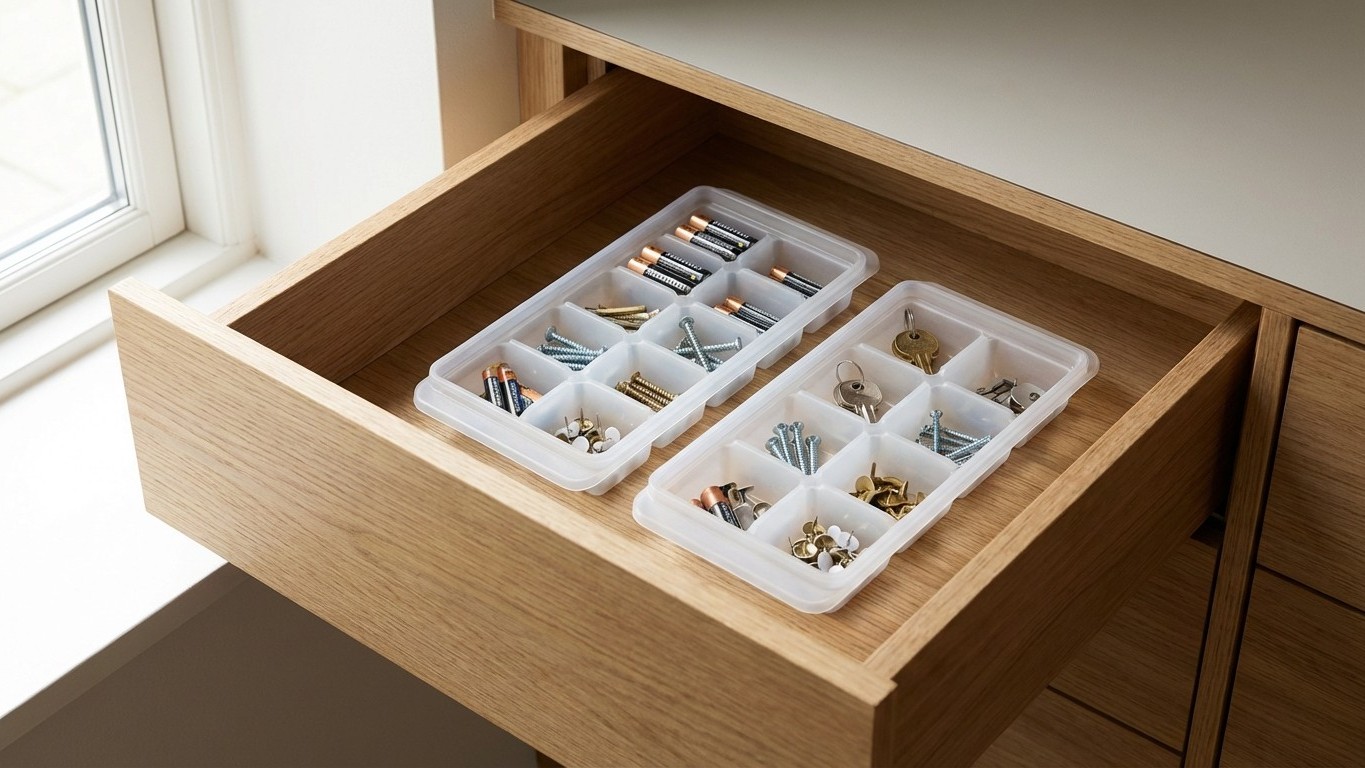
The humble ice cube tray has been sitting quietly in your freezer, making itself useful once a week when someone actually wants ice. But pull it out, give it a rinse, and drop it into that chaotic Kitchen-cupboard-has-the-solution/”>Kitchen drawer instead, and you’ll wonder why you ever spent a penny on a plastic organiser in the first place.
This isn’t a tip that requires a trip to any shop. No measuring tape, no assembly required, no disappearing down a rabbit hole of matching bamboo sets online. The ice cube tray you already own is, quietly and without fanfare, one of the most practical small-item organisers ever designed. It just happens to make ice as well.
Key takeaways
- A common kitchen item you already own works better than expensive organisers
- Why most drawer organisers fail within weeks—and how this alternative sidesteps that problem
- One surprising trick that lets silicone trays fit drawers that rigid organisers can’t solve
The real cost of bought drawer organisers
Most of us have been there: standing in a home goods aisle, genuinely convinced that a set of interlocking Plastic trays will finally bring order to the chaos lurking beneath the cutlery. There are plenty of products out there that claim to make organising easy, but they’re expensive and aren’t easily customisable to your needs and your cabinet dimensions. You bring them home, discover they’re 2cm too wide, and end up wedging them in at an angle anyway. The drawer still rattles. The rubber band you were looking for is still missing.
What nobody mentions is that kitchen drawers are deeply personal things. The measurement of your drawer is unique to your kitchen, and your collection of odds and ends, the spare batteries, the mystery keys, the little hook whose screw you lost in 2019 — doesn’t come in a standard size either. DIY kitchen organisation ideas cost 60–80% less than commercial organisers while providing similar functionality. That’s a significant saving, especially when the alternative has been sitting in your freezer all along.
Why the ice cube tray is surprisingly perfect
Think about what an ice cube tray actually is: a rigid grid of small, open compartments, designed to hold individual items without letting them migrate into one another. That is precisely the brief for a drawer organiser. Placing a couple of ice cube trays in a drawer as organisers works beautifully, the mini compartments are perfect for storing all those tiny things that get lost in the shuffle.
Batteries, Command hooks, screws, and more can get lost amid larger tools. Luckily, your ice cube tray can make the process of organising these small kitchen items easier. You can fit small bits and bolts into a standard plastic ice cube tray and ensure you can always find the item you need. Ice cube trays are usually small enough that they can fit in the drawer without clunking on the top of the sides. That last point matters more than it sounds, there’s nothing more infuriating than a drawer that jams because an organiser has ridden up against the frame.
Silicone trays offer a particular advantage here. Because they’re slightly flexible, they can be gently squeezed to fit into drawers that aren’t quite a standard width. A rigid plastic tray either fits or it doesn’t; a silicone one gives you a bit of forgiveness. Besides the odds-and-ends drawer, you can also use an ice cube tray to store jewellery, small tools, drill bits, and more. One in the kitchen junk drawer, one on the dressing table, one in the craft box, the same item solves completely different problems in completely different rooms.
How to put it to work (properly)
The key is to empty the drawer completely before you begin. This isn’t optional, it’s the step most people skip, and it’s the reason so many organisation attempts fail within a fortnight. Pull everything out. Wipe the drawer down. Then, before putting a single thing back, decide what genuinely belongs in there.
The only real way to reclaim any space, junk drawer included, is to empty it out, clean it thoroughly, and then return items, placing each one in a proper home. Once you’ve done that, lay your ice cube tray flat in the drawer and start sorting. Batteries in one row. Drawing pins in another. Spare keys together. Those tiny screws that came with flat-pack furniture get their own dedicated cell, and for the first time in years, you’ll actually be able to find them.
If one tray doesn’t fill the full width of your drawer, place two side by side, or pair an ice cube tray with a shallow box or tin alongside it. Cutting sections to nestle around a larger tray, creating a patchwork of compartments, actually works well. The goal isn’t perfection, it’s function. Mismatched containers doing a good job beat a pristine matching set that doesn’t quite fit.
For spice drawers, the same logic applies in a different way. If you need somewhere to store spices and don’t have room for a spice rack, designating a kitchen drawer for your ingredients can free up storage space in your pantry or kitchen cabinets, giving you an easy-to-reach spot to quickly grab what you need. An ice cube tray used horizontally can cradle individual small jars so they don’t roll around every time you open the drawer.
The egg carton: the ice tray’s equally thrifty cousin
While we’re on the subject of items most people throw away without a second thought, the cardboard egg carton deserves its moment too. Egg cartons are ideal for categorising and storing smaller items in drawers, as are silicone muffin trays and ice trays. The twelve-cup format is actually larger than most ice cube cells, making egg cartons better suited to bulkier small items, like a collection of corks, spare batteries of different sizes, or the kind of craft supplies that end up scattered across three drawers at once.
Egg boxes work well for storing jewellery too, each section can be used to separate bracelets, earrings, rings and so on, while the lid acts as a barrier against dust, keeping pieces in good condition. That’s a free jewellery box, right there. The ice cube tray and the egg carton together can organise an entire room’s worth of small-item chaos without spending a thing.
There’s something quietly satisfying about all of this, beyond the tidiness itself. Every time you reach into a perfectly sorted drawer and find exactly what you need in three seconds flat, you’ve saved yourself the low-level frustration that accumulates over years of rummaging. A kitchen that works with you rather than against you Changes the mood of cooking entirely. And if you happen to need the tray back for ice one summer evening, well, that’s easily sorted.