
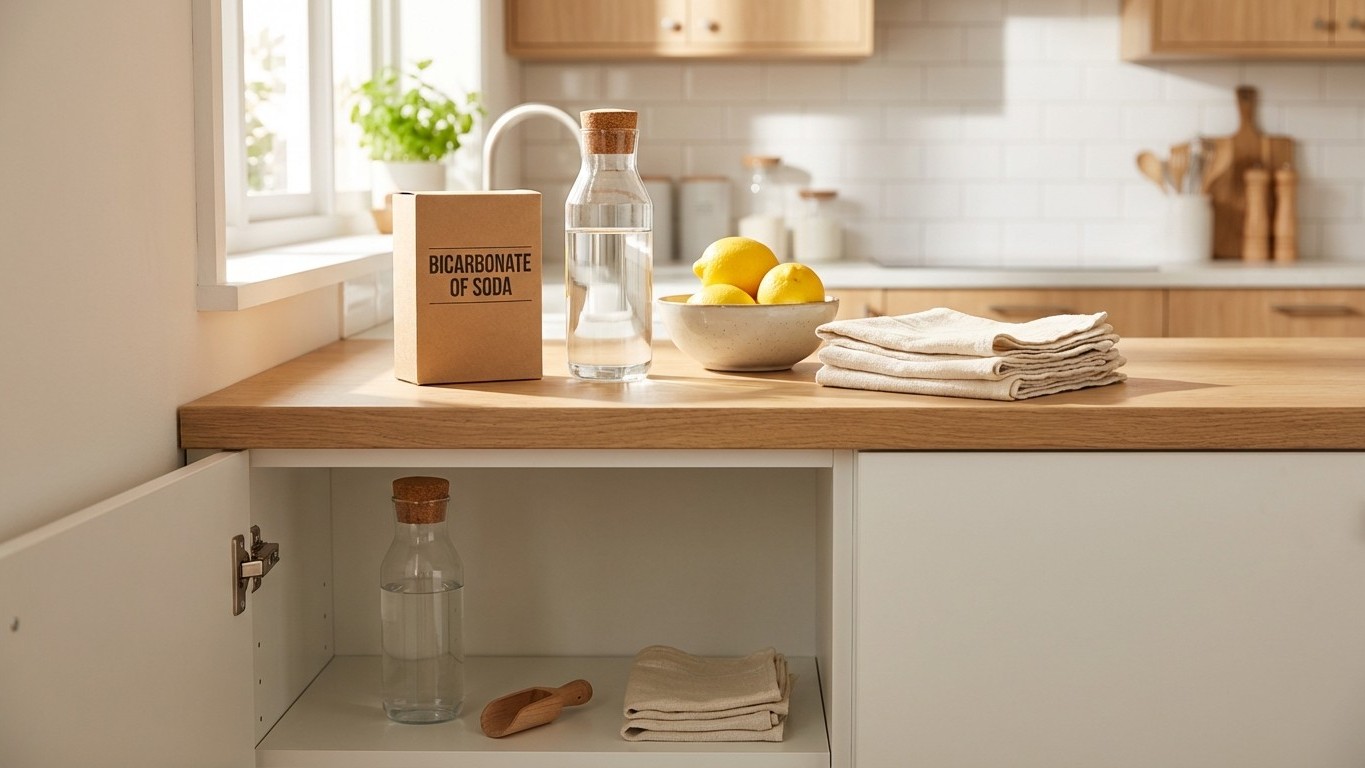
Swapping out the rows of plastic bottles under your kitchen sink for a handful of simple, natural ingredients is one of those changes that sounds almost too good to be true. And yet, millions of households across Britain have done exactly that, discovering that clean doesn’t have to mean chemical. A box of bicarbonate of soda, a bottle of white vinegar, and a lemon can tackle an astonishing range of cleaning tasks, often better, nearly always cheaper, and without filling the recycling bin with yet another single-use plastic container.
This guide is designed as your starting point. Whether you’ve stumbled across natural cleaning hacks online and want to understand the science behind them, or you’ve already tried a recipe or two and want to build a proper, reliable routine, everything you need is here. We’ll cover the ingredients, the recipes, the kit, the precautions, and the honest truth about what these natural cleaners can and cannot do. For those particularly interested in baking soda solutions, you might find these natural cleaning hacks with baking soda especially useful, while those looking for a simple all-purpose solution can start with this homemade natural cleaning spray vinegar and water recipe or try this comprehensive DIY all purpose natural cleaner recipe.
Why make the switch to natural cleaning?
What homemade cleaners actually offer over shop-bought products
The first thing most people notice is the price. A standard bottle of multi-surface spray from a supermarket might seem inexpensive at a pound or two, but consider how many you buy across a year: one for the kitchen, another for the bathroom, a separate one for glass, a foam for the oven. It adds up. A kilogram bag of bicarbonate of soda costs a fraction of that and lasts for months. White wine vinegar in a large bottle from the cooking aisle is cheaper still. Once you’ve invested in the basic ingredients, you’re making your cleaning products for pennies per bottle.
There’s also something quietly satisfying about knowing exactly what you’re spraying onto the surface where your family eats breakfast. Conventional cleaning products are often required by law to list their ingredients only in general terms, using categories like “preservatives” or “perfuming agents” rather than specific chemical names. Homemade recipes have no such opacity. You made them. You know what’s in them.
The environmental and health case
The environmental argument runs deeper than packaging alone. Many synthetic cleaning agents contain compounds that don’t fully break down in waterways, contributing to the chemical load that aquatic ecosystems have to cope with. Natural ingredients like bicarbonate, vinegar, and citrus juice are biodegradable in the truest sense; they break down into harmless components quickly and completely. If you’re looking for practical ways to implement these sustainable alternatives, these eco friendly cleaning hacks for home provide excellent starting points for reducing your household’s environmental impact.
For people with asthma, eczema, or chemical sensitivities, the health dimension can be the deciding factor. Some commercial cleaners release volatile organic compounds (VOCs) that linger in indoor air long after you’ve finished scrubbing. A room cleaned with a vinegar-and-water spray simply doesn’t have that problem. The smell of vinegar dissipates within minutes; the residue is harmless. If you want to explore this territory more broadly, the eco friendly cleaning hacks for home guide covers the environmental picture in genuine depth.
The essential ingredients and what they actually do
Bicarbonate of soda: the gentle abrasive with a chemistry degree
Bicarbonate of soda (sodium bicarbonate, if we’re being precise) is mildly alkaline, which makes it effective at breaking down greasy, acidic residues, the kind that build up on hob surrounds, inside ovens, and on bathroom tiles. Its fine, crystalline texture gives it a gentle abrasive action: enough to shift grime without scratching most surfaces. Sprinkle it on a damp cloth and it becomes a soft scrub that costs almost nothing.
It also neutralises odours rather than masking them, which is why a small open pot of bicarbonate in the fridge genuinely works to absorb smells, rather than just covering them with a synthetic fragrance. For a comprehensive look at everything this ingredient can do, the natural cleaning hacks with baking soda guide is well worth bookmarking.
One precaution worth knowing: bicarbonate of soda should not be used on natural stone surfaces like marble or limestone. Being alkaline, it can very gradually etch and dull the surface over time. Stick to sealed tiles, ceramic, stainless steel, and enamel, and you’ll be fine.
White vinegar: the workhorse you probably already own
White vinegar is acetic acid diluted in water, typically to around 5% strength in the distilled white variety sold for cleaning. That mild acidity cuts through limescale (which is alkaline calcium carbonate) with genuine efficiency, something that matters enormously in hard-water areas like London, the South East, and much of the Midlands, where kettles and shower heads fur up within weeks.
It’s also a decent disinfectant at full strength, though it’s honest to say it doesn’t reach the antimicrobial performance of bleach-based products. For everyday surface hygiene, it’s entirely adequate. For sanitising surfaces that have been in contact with raw meat or poultry, you’d want something Stronger, or to reserve those surfaces for a separate deep-clean protocol.
Never use neat white vinegar on natural stone, cast iron, or unsealed grout. The acid will damage all three. And the vinegar-plus-bicarbonate combination that looks so impressively fizzy? That reaction actually neutralises both ingredients, leaving you with mostly water and a bit of sodium acetate. The fizz is satisfying but chemically counterproductive. Use them separately, at different stages, for best results. The homemade natural cleaning spray vinegar and water guide goes into exactly how to use this ingredient well.
Citrus, Castile soap, and essential oils
Fresh lemon juice shares vinegar’s acidity and adds natural antibacterial properties from its limonene content. It’s also a gentle bleaching agent in sunlight, which makes it useful for treating fabric stains you can leave outside on a sunny day. The drawback is shelf life: lemon juice turns within days at room temperature, so recipes using it should be made in small batches and used promptly.
Castile soap is a vegetable-based liquid soap, traditionally made with olive oil, that produces a gentle lather and cuts grease effectively. It mixes well with water and essential oils, making it the ideal base for a proper floor cleaner or a foaming hand soap for the utility room. A small amount goes a long way, and it’s safe for most surfaces.
Essential oils, most often tea tree, lavender, or eucalyptus in cleaning recipes — contribute antimicrobial and antifungal properties alongside a pleasant scent. Tea tree oil in particular has well-documented antibacterial action. The quantities used in homemade recipes (typically 10 to 20 drops per 500ml) are small enough to be safe around adults, but essential oils should be kept well away from cats, who lack the liver enzymes to metabolise many of them safely.
Equipment, storage, and safety basics
What you actually need in your kit
A small collection of glass or dark plastic spray bottles (500ml capacity works well for most recipes) is the foundation of a homemade cleaning kit. Glass is ideal for recipes containing essential oils, as some oils can leach into soft plastics over time and degrade the container. Dark glass or opaque plastic extends the shelf life of recipes that contain lemon juice or certain essential oils by reducing light exposure.
Good reusable cloths matter more than people expect. Microfibre cloths clean effectively with less product because of their fine structure, which physically traps dust and bacteria rather than just moving them around. Keep separate cloths for kitchen surfaces, bathroom surfaces, and floors, and wash them at 60°C regularly. A few wooden-handled scrubbing brushes, a squeegee for windows, and a glass measuring jug to mix your recipes accurately, and you’re genuinely set up.
Dosages, labelling, and how long these recipes keep
Accurate measuring makes a real difference to how well homemade cleaners perform. A recipe that calls for one tablespoon of Castile soap per 500ml of water will streak if you accidentally pour in three. Use measuring spoons rather than eyeballing, at least until you know your recipes by feel.
Label every bottle clearly with the recipe name, date of preparation, and key ingredients. This matters for safety (especially if you have children) and for knowing when to make a fresh batch. General guidelines: vinegar-and-water sprays keep for several months at room temperature. Recipes with fresh lemon juice should be used within a week and stored in the fridge. Anything containing Castile soap is best used within a month. Bicarbonate-based pastes can be made fresh in small quantities as needed, which sidesteps the storage question entirely.
Three core recipes to start with
The all-purpose spray
This is the recipe most people make first, and the one they end up using most. Mix 250ml of white wine vinegar with 250ml of cold water in a spray bottle. Add 15 drops of tea tree essential oil and 10 drops of lavender. Shake well before each use. This works beautifully on kitchen counters, bathroom sinks, the exterior of appliances, and tiled walls. For a deeper dive into variations, including versions without vinegar for sensitive surfaces, the DIY all purpose natural cleaner recipe page has everything you need.
Floor cleaner for everyday use
For sealed wooden floors and tiles, a simple solution of one teaspoon of Castile soap dissolved in two litres of warm water cleans effectively without leaving a residue. Add a few drops of eucalyptus oil if you like, both for fragrance and for its mild disinfectant properties. Apply with a well-wrung mop, the key word being well-wrung. Excess water is the enemy of wooden floors. For linoleum or vinyl, you can increase the Castile soap very slightly, to about two teaspoons per two litres.
Powder scrub for sinks, baths, and stubborn spots
Combine 250g of bicarbonate of soda with 5 drops of tea tree oil and 5 drops of lemon essential oil in a glass jar with a shaker lid (a recycled spice jar works perfectly). To use, sprinkle a little onto the damp surface, scrub with a cloth or soft brush, then rinse. This shifts soap scum from baths and sinks with minimal effort and leaves surfaces smelling clean and fresh. For tougher stains, make a paste by adding just enough liquid Castile soap to the powder to form a thick consistency, apply to the stain, leave for 10 minutes, then scrub and rinse.
Making natural cleaning part of your routine
Building a practical weekly rhythm
The shift to natural cleaning works best when it’s built into a routine rather than attempted as a one-off project. Many people find that keeping a bottle of all-purpose spray visibly accessible on the kitchen counter, rather than hidden away under the sink, means surfaces get wiped down far more often, simply because it’s there. That habit alone, the quick daily wipe with a spray you mixed yourself in two minutes, does more for kitchen hygiene than a weekly deep-clean with expensive products.
A Sunday evening batch-making session, taking perhaps 15 minutes, can set you up for the whole week: refill the spray bottles, top up the scrubbing powder jar, make a fresh batch of floor cleaner if you’re due a mop round. It sounds more organised than it feels in practice.
Tips for getting the best from your ingredients
Hot or warm water activates Castile soap’s cleaning power better than cold. Leave bicarbonate paste on greasy surfaces for at least 10 minutes before scrubbing; rushing that stage halves its effectiveness. White vinegar at full strength removes heavy limescale from shower heads brilliantly, simply fill a small bag with undiluted vinegar, tie it around the shower head so the nozzle is submerged, leave for an hour, and rinse. That single trick impresses people every time.
What to avoid: safety and limitations
A few combinations are genuinely unsafe and worth knowing firmly. Vinegar and bleach together release chlorine gas; even tiny residual amounts of bleach on a surface, combined with vinegar spray, can produce irritating fumes. If you’re transitioning from conventional to natural products, rinse surfaces thoroughly before switching. Bicarbonate of soda and vinegar together, as noted earlier, cancel each other out chemically. Hydrogen peroxide and vinegar mixed in the same bottle create peracetic acid, which is irritating to skin, eyes, and lungs.
Natural cleaners are also not the right tool for every job. Hospital-grade disinfection, mould remediation in structurally affected areas, or heavily contaminated surfaces (after raw poultry preparation, for example) call for appropriate clinical products or professional intervention. Knowing the limits of your homemade kit makes you a smarter cleaner, not a less committed one.
FAQ: Common questions about natural cleaning hacks
What ingredients are truly indispensable for homemade cleaners? At minimum: bicarbonate of soda, white wine vinegar, and liquid Castile soap. Add tea tree essential oil and lemon if budget allows. Those five ingredients cover roughly 90% of household cleaning tasks.
How do you store homemade recipes safely? In labelled glass or dark plastic bottles, away from direct sunlight and heat. Fresh-ingredient recipes (those with lemon juice) go in the fridge and are used within a week. Vinegar-based sprays are shelf-stable for months. Always label with the date and contents.
Do natural cleaners actually disinfect? White vinegar and tea tree oil both have documented antibacterial properties, though they don’t achieve the same kill rate as commercial disinfectants. For everyday hygiene on low-risk surfaces, they are more than adequate. For surfaces that have been in contact with raw meat, a purpose-made disinfectant or a dilute bleach solution remains the safer choice.
Are these cleaners safe around children and pets? Generally yes, with one key caveat: essential oils, especially tea tree and eucalyptus, are toxic to cats. If you have cats, either omit essential oils from your recipes or ensure surfaces are fully dry before allowing them access. The base ingredients (vinegar, bicarbonate, Castile soap) are all non-toxic.
Explore further: related guides in this series
Once you’ve got the basics in hand, the rest of the natural cleaning world opens up quite quickly. Each ingredient has its own depth, and each room in your home has its own particular challenges.
- natural cleaning hacks — 40 tried-and-tested recipes and techniques covering every room in the house
- DIY all purpose natural cleaner recipe — the definitive guide to the spray you’ll use every single day
- homemade natural cleaning spray vinegar and water — dosages, surfaces, and everything you need to know about the vinegar-and-water combination
- natural cleaning hacks with baking soda — 15 specific techniques that make the most of this extraordinary ingredient
- eco friendly cleaning hacks for home — 25 practical strategies for a genuinely greener home routine
The real pleasure of natural cleaning, I’ve found, isn’t just the money saved or the reduced chemical load, it’s the quiet competence of knowing how things work. Once you understand why vinegar dissolves limescale and bicarbonate lifts grease, you stop following recipes blindly and start adapting them. That shift, from follower to maker, is where the real independence begins. What will you mix first?