
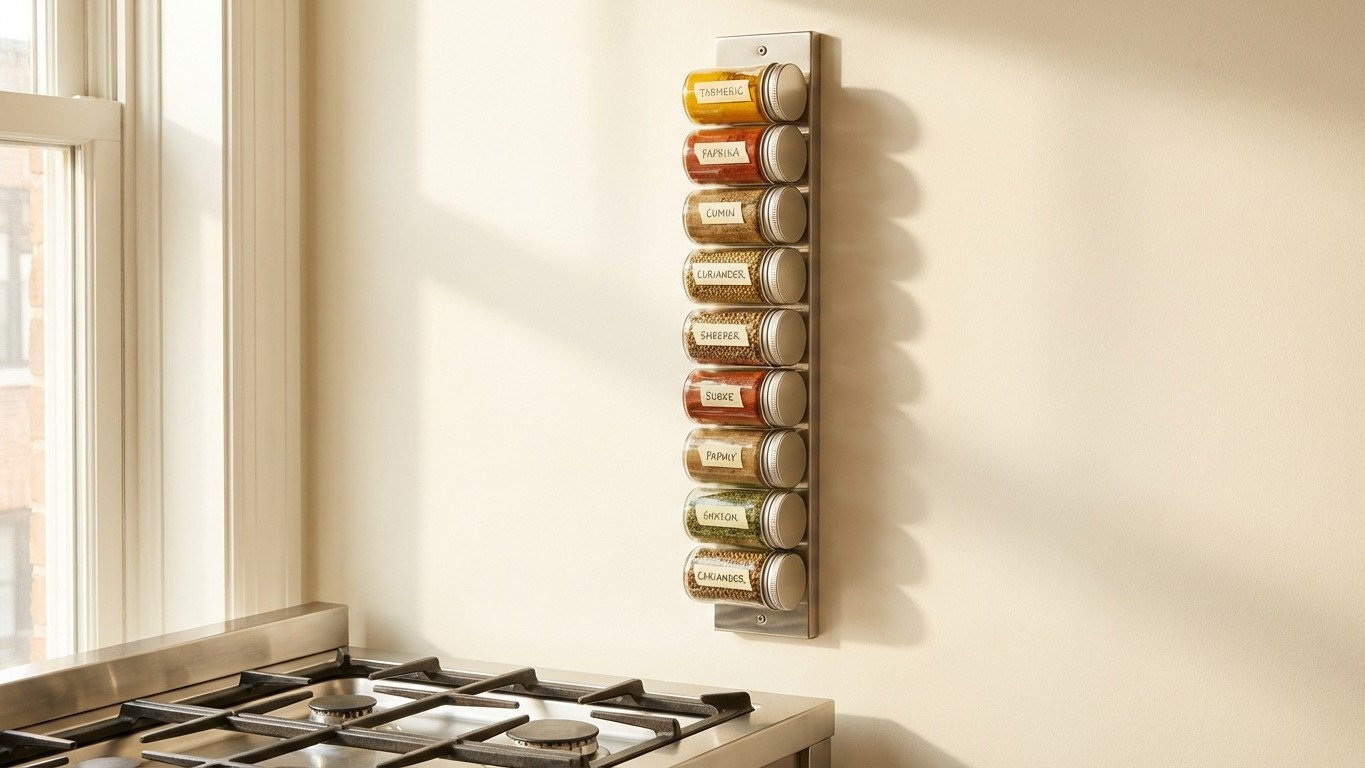
Two pounds. That’s genuinely all this costs, and once you’ve done it, you’ll wonder why you ever spent good money on those wobbly chrome spice racks that never quite fit the cupboard anyway. The trick is simple: old glass jars, a handful of small magnets, and a bare patch of wall or fridge you’ve been ignoring for years. Your spices go from buried at the back of a drawer to right there in front of you, every single one visible, every single one within arm’s reach.
Key takeaways
- A storage solution that costs less than a coffee but outperforms racks costing ten times more
- The unexpected reason why this method changes your cooking habits without you realising it
- One simple ingredient determines whether your jars stay safely mounted or become a kitchen hazard
Why the drawer and the rack both fail you
Most of us cycle through the same frustrating routine. We buy a spice rack with great intentions, fill it beautifully, and then discover that either the jars don’t fit (those supermarket own-brand tubes are never a standard size, are they), or the rack lives on a shelf behind something else, which means we’re forever shuffling things around just to find the smoked paprika. The drawer is worse. Studies on kitchen behaviour Suggest the average person owns roughly 40 spices but regularly uses only about six of them. The rest get lost, expire quietly, and eventually go in the bin having barely been touched. It’s a quiet little domestic tragedy, that.
The magnetic jar system solves both problems at once. Because Everything is mounted at eye level on a vertical surface, you can see what you have in under a second. No rummaging. And because you’re reusing jars you already own, there’s nothing to buy except a small pack of strong circular magnets, which you can find in most pound shops or hardware shops for around two pounds per bag.
What you’ll need and how to put it together
Gather your old glass jars first. Small jam jars work beautifully, as do baby food jars, mustard jars, anything with a metal lid. The lid is the key part here, because that’s where your magnet attaches. Give everything a thorough wash, make sure the lids are completely dry, and then rough up the inside surface of each lid slightly with a piece of sandpaper. This gives the glue something to grip.
Apply a small amount of strong adhesive (any decent superglue or epoxy resin from a pound shop will do) to the back of a magnet and press it firmly to the inside centre of the lid. Leave it to cure for at least two hours, ideally overnight. Once dry, screw the lid onto your jar. Then simply hold the jar up to your fridge door or a magnetic knife strip fixed to the wall, and that’s your rack done.
The wall-mounted version is worth a small extra investment. Magnetic knife strips, the long metal bars typically sold for holding kitchen knives, work perfectly for this. A basic one costs somewhere in the region of six to ten pounds in most kitchen or homeware shops, though I’ve seen them cheaper in discount stores. Fix it to an empty bit of wall at a comfortable height, and you can line up a dozen jars across it with room to spare. My own kitchen has two strips running side by side above the hob, and there’s something quietly satisfying about it every single morning.
A word on magnet strength
Not all magnets are equal, and this is where a little patience pays off. The small decorative fridge magnets you might have lying around are rarely strong enough to hold a full jar safely. Look for neodymium magnets if you can find them, sometimes sold as “rare earth” magnets in hobby or hardware shops. They’re small, surprisingly powerful, and will hold a filled jar without any anxiety whatsoever. If you’re using a standard fridge surface rather than a dedicated magnetic strip, test the hold before you fill the jar fully, just to be sensible about it.
Making it look proper lovely
This is where the practical becomes genuinely pleasing. Once your jars are up, take ten minutes to label them. A strip of masking tape and a marker pen is the no-fuss approach, and actually looks rather charming in that rustic, farmhouse sort of way. If you want something neater, small chalkboard labels are inexpensive and can be wiped clean when you refill with something different. Matching jar sizes helps the overall look, though it’s not strictly necessary.
Decanting your spices into the jars rather than keeping them in their original packaging does two useful things. It standardises the size so everything fits neatly, and it forces you to do a proper audit of what you actually have. You may discover, as I did the first time I did this, that you own three separate tins of ground cumin at various stages of emptiness. Consolidate them, check the dates, and suddenly your spice collection is organised in a way no purchased rack ever managed.
There’s a lovely bonus to this system that nobody really talks about: it encourages you to cook more adventurously. When your spices are hidden in a drawer, you forget they exist. When they’re mounted on the wall in front of you, you notice things. You think, oh, I’ve got sumac, I should use that. The visibility changes your cooking habits gradually, without you even trying.
And on a purely budget note, once you’ve made this switch, you’re done spending money on storage solutions forever. Jars get replaced for free as you finish jam or mustard. Magnets last indefinitely. The only question left is why this simple idea isn’t already in every kitchen in Britain.