
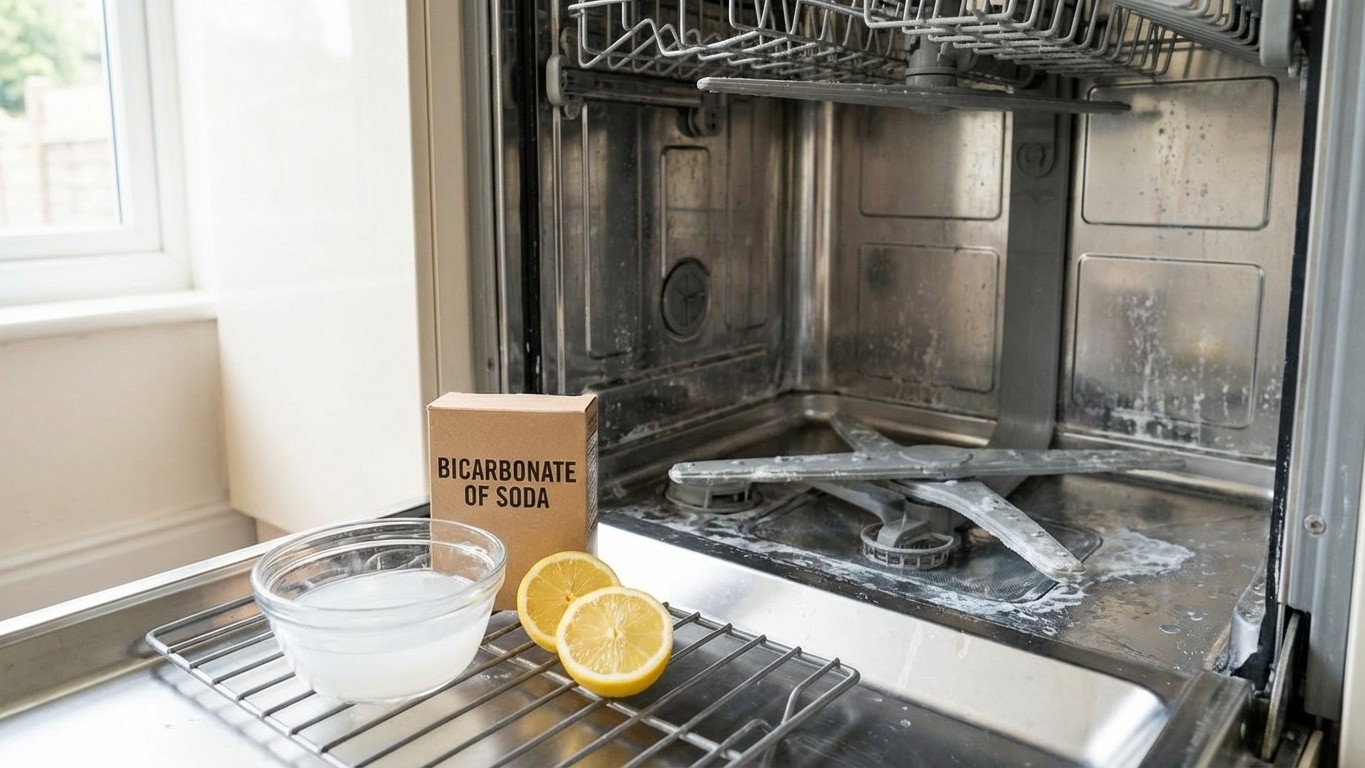
Your dishwasher works hard every single day, yet it rarely gets the attention it deserves. Grease films coat the interior walls, limescale builds quietly on the spray arms, and somewhere in the depths of the filter, last Tuesday’s fish supper is making its presence felt. The good news is that three humble ingredients, white vinegar, bicarbonate of soda, and lemon, are genuinely all you need to clean dishwasher naturally, deodorise it completely, and tackle those stubborn white deposits without reaching for a single harsh chemical.
Why a Dirty Dishwasher Deserves Your Attention
There’s a certain irony to a machine that cleans your dishes while slowly becoming filthy itself. Over weeks and months, food particles accumulate in the filter and around the door seal. Cooking fats, rinsed off your plates in warm water, don’t simply disappear, they cling to the interior surfaces and gradually turn rancid. That musty, slightly sour smell you notice when you open the door first thing in the morning? That’s exactly what’s happening.
White deposits are a separate problem entirely. They form when hard water (and most of the UK has it, with the South East and Midlands being especially prone) leaves calcium and magnesium minerals behind as the water evaporates. Over time, these minerals build up on the spray arms, blocking the tiny jets that distribute water evenly. A partially blocked spray arm means dishes come out streaky, glassy, and, frankly, not very clean. The machine also has to work harder, which shortens its lifespan and nudges up your energy bills.
Switching to natural cleaning methods makes sense on several levels. Proprietary dishwasher cleaning tablets often contain surfactants, bleaching agents, and synthetic fragrances that are hard on aquatic ecosystems once they go down the drain. Natural alternatives are gentler on the environment, cheaper by a considerable margin, and, this is the part that surprises most people, genuinely effective when used correctly.
The Natural Cleaning Arsenal: What Each Ingredient Actually Does
Understanding why each ingredient works stops you guessing and helps you use them with confidence.
Bicarbonate of Soda
Bicarbonate of soda (baking soda) is mildly alkaline, which makes it a natural deodouriser. Rather than masking smells, it neutralises the acidic volatile compounds that cause them. Sprinkled across the base of the dishwasher or dissolved in warm water to clean the interior, it lifts greasy residue without scratching stainless steel or plastic components. A standard 500g box costs very little from any supermarket and will last you months.
White Vinegar
White vinegar is acidic (typically around 5% acetic acid), which gives it two important jobs in your dishwasher. First, it dissolves limescale and calcium deposits, acid reacts with the alkaline minerals and breaks them down. Second, it cuts through grease films and kills a broad range of bacteria and mould. Run a hot cycle with a cup of white vinegar in a bowl on the bottom rack, and you’ll notice the interior looking noticeably cleaner and brighter afterwards. One small caution: don’t use it every single wash, as repeated acid exposure over a long period can degrade rubber seals. Once or twice a month is perfectly safe.
Lemon
Citric acid, found naturally in lemons, is a powerful chelating agent, meaning it binds to mineral ions and lifts them away from surfaces. A halved lemon placed on the top rack during a hot wash will release citric acid throughout the cycle, helping to dissolve light limescale and leaving a genuinely fresh scent rather than the synthetic “citrus fragrance” you get from commercial products. For a stronger treatment, you can use two or three tablespoons of citric acid powder (sold cheaply in home-brew shops and online) dissolved in the detergent compartment.
A Note on Castile Soap and Essential Oils
Some natural cleaning guides suggest adding a few drops of tea tree or lavender essential oil to boost antibacterial action and fragrance. This can work well when cleaning removable parts by hand. However, avoid adding Castile soap or essential oils directly to a running dishwasher cycle, most produce excess foam, which can interfere with the wash mechanism and leave residue.
Step-by-Step: A Complete Natural Dishwasher Clean
Start With the Removable Parts
Empty the machine completely. Remove the lower basket, the cutlery tray, and, most importantly, the filter assembly at the base. The filter is usually a twist-and-lift affair; your machine’s manual will show you how if you’re uncertain. Rinse the filter under a running tap, then soak it for 20 minutes in a bowl of warm water with two tablespoons of white vinegar and a teaspoon of bicarbonate. Use an old toothbrush to scrub away any trapped grease or debris. This step alone makes a dramatic difference to both smell and performance.
While you’re at it, unclip the spray arms (the rotating plastic components that distribute water). Hold each one up to the light and check the small holes aren’t blocked. A cocktail stick or a wooden skewer will clear any clogged jets. Give the arms a quick soak in the same vinegar solution, rinse well, and click them back into place.
The Main Cycle: Bicarbonate, Then Vinegar
This two-stage approach is the heart of any good natural dishwasher clean. Do not mix bicarbonate and vinegar together before using them, they neutralise each other on contact, producing carbon dioxide and water but precious little cleaning action.
Stage one: scatter four to five tablespoons of bicarbonate of soda across the base of the empty machine. Run a short hot cycle (around 60°C if your machine has a temperature setting). The bicarbonate will work through the interior, absorbing odours and lifting greasy deposits from walls and seals.
Stage two: once that cycle has finished and the machine has cooled slightly, place a dishwasher-safe bowl containing 250ml of white vinegar on the bottom rack. Run another full hot cycle. The vinegar vapour circulates through the entire interior, dissolving limescale from the spray arms, heating element, and walls. The door seal gets a good dose too, run your finger along it after the cycle and you’ll find it cleaner than it’s been in a long time.
Tackling Stubborn White Deposits
For heavier limescale build-up, particularly on the heating element or around the base of the interior — a citric acid treatment works better than vinegar alone. Dissolve three tablespoons of citric acid powder in the detergent compartment, then run an empty cycle at the hottest setting your machine offers. Leave the door closed for an hour afterwards to allow the acid to continue working as the water cools. Repeat monthly if you live in a hard-water area.
Eliminating Persistent Odours
If the smell remains after the bicarbonate and vinegar treatment, the culprit is almost certainly the door seal or the drain hose. Peel back the rubber seal around the door, you’ll often find a black, slimy build-up hiding in the fold. Dip an old cloth in a solution of warm water, a splash of white vinegar, and a few drops of tea tree oil, and wipe firmly around the entire seal. For the drain hose, run the machine empty on the hottest cycle with a bowl of vinegar as described above — this effectively flushes the hose without any disassembly needed.
Keeping It Fresh: Routine Maintenance and Common Mistakes
A Simple Monthly Routine
The secret to a consistently clean dishwasher is short, regular attention rather than occasional deep cleans. Once a month, remove and rinse the filter, check the spray arm jets, and run the bicarbonate-then-vinegar cycle. Between those monthly sessions, a few small daily habits make a real difference: scrape plates before loading (you don’t need to rinse them, but large food debris should go in the bin), leave the door ajar after a cycle to allow moisture to escape, and never leave the machine sitting for days with dirty dishes inside before running it.
Mistakes Worth Avoiding
Over-using vinegar is probably the most common error. Some enthusiasts add it to every single wash in place of rinse aid, while this works in the short term, the cumulative acid exposure can soften rubber door seals over months. Use it as a treatment, not a daily routine. Similarly, don’t use more bicarbonate than necessary; an excess left sitting in the machine can occasionally leave a faint powdery residue on darker plastic items.
One combination to avoid completely: bleach and vinegar. If you’ve been using bleach-based cleaning products in your kitchen and are switching to a vinegar-based routine, flush the machine with a plain hot water cycle first. Mixing the two produces chlorine gas, not something you want wafting out when you open the door.
Frequently Asked Questions
Does Vinegar Damage Dishwasher Seals?
Used occasionally (once or twice a month) at the dilutions described above, white vinegar will not harm rubber seals in a healthy machine. The concern relates to prolonged, repeated exposure at high concentrations, which is not what this cleaning method involves. If your seals are already cracked or brittle, they likely need replacing regardless of what cleaning products you use.
Can Bicarbonate of Soda Be Used at Every Wash?
It won’t harm your machine, but it’s unnecessary. The bicarbonate treatment works as a periodic reset to neutralise accumulated odours and lift grease. Daily use offers no extra benefit and, at scale, adds a small but unnecessary cost.
What If the Smell Persists Despite Regular Cleaning?
A persistent smell that survives thorough cleaning often traces back to one of two places: the drain pump filter (a separate, deeper component from the standard mesh filter, check your manual) or a partially blocked waste pipe where it connects to the kitchen drain. If cleaning the standard filter and running vinegar cycles doesn’t resolve it, it’s worth checking that the drain hose isn’t kinked or sitting too low, which can cause waste water to siphon back into the machine.
Taking the Natural Approach Further
The same principles that work so well in the dishwasher translate beautifully to other areas of the kitchen and home. The combination of acid (vinegar or citric acid) to dissolve mineral deposits, alkali (bicarbonate) to neutralise odours and lift grease, and mechanical action to shift residue is a surprisingly versatile toolkit. If you find yourself enjoying the simplicity of this approach, there’s a whole world of equivalent natural cleaning hacks covering everything from ovens to bathroom tiles.
Bins are another area where odours accumulate in much the same way as a neglected dishwasher, and the same natural ingredients offer a reliable solution, you can find a detailed guide on how to clean bin naturally and remove smell that follows a very similar logic. For broader kitchen and household surfaces, the guide to natural ways to disinfect surfaces at home is worth a look, particularly if you’re trying to build a coherent, chemical-free cleaning routine throughout the house. And if you want a single resource covering drains, bins, surfaces, and more in one place, the comprehensive guide to natural disinfecting cleaning hacks pulls it all together.
A machine that smells clean, drains properly, and leaves your glasses sparkling costs nothing extra to maintain beyond a bottle of white vinegar and a box of bicarbonate. The question isn’t really whether natural cleaning works, it’s whether you’ll try it this weekend or wait until that smell becomes impossible to ignore.