
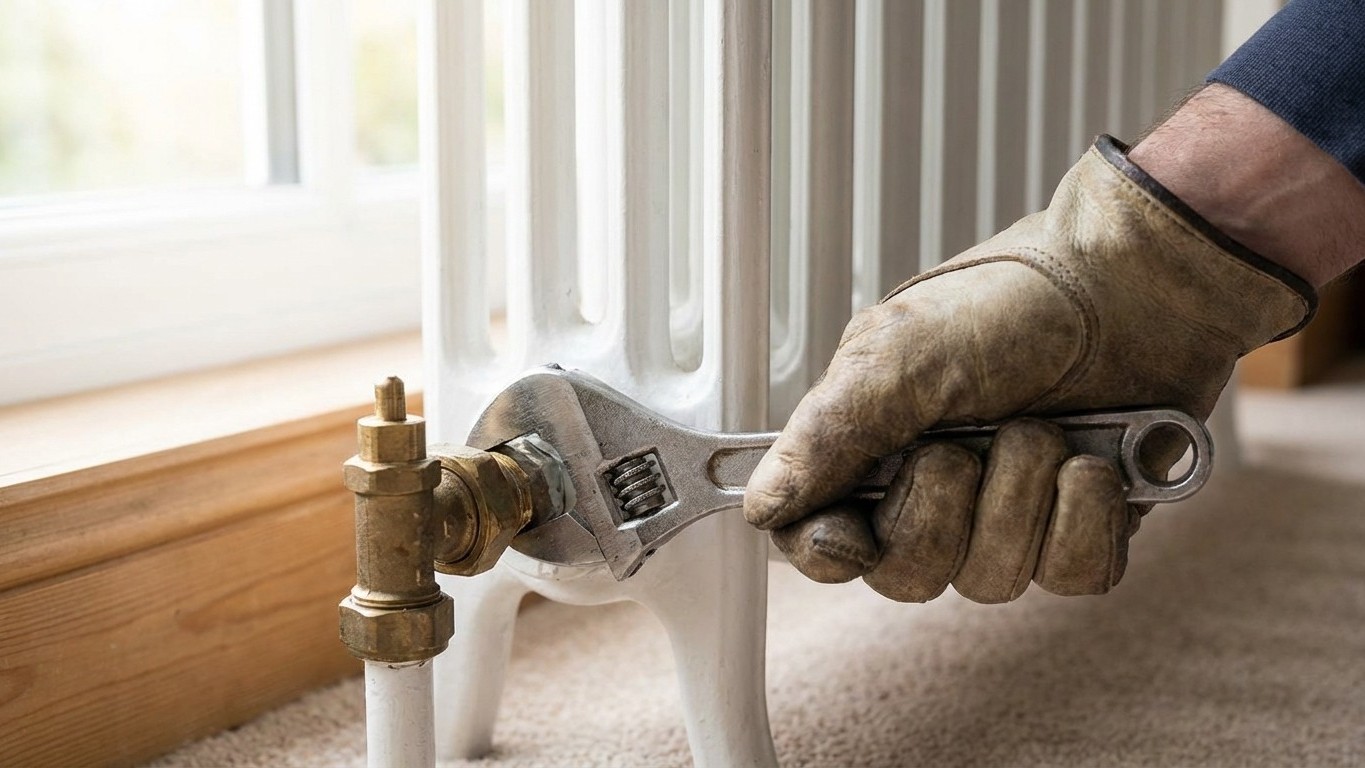
There is one small valve at the bottom of your radiator that most households completely ignore, and plumbers have known for decades that adjusting it correctly can make a very real difference to how much you spend on heating. We are talking about the lockshield valve, the little capped fitting on the opposite end of the radiator from your thermostatic valve. Getting this right is called balancing your radiators, and it costs nothing but an hour or two of your time.
Key takeaways
- A forgotten valve on every radiator is silently draining your heating budget
- Your boiler is probably working twice as hard as it needs to right now
- The fix takes an afternoon and costs virtually nothing—but the savings are real
Why Your Heating System Is Probably Working Against Itself
Think of your central heating as water flowing through a network of pipes, all connected to the same boiler. The radiators closest to the boiler receive hot water first and tend to get far too hot, while those at the far end of the circuit, the bedroom at the top of the stairs, the back bedroom, the bathroom, struggle to warm up at all. Your boiler keeps firing away trying to heat those distant radiators, burning gas the whole time, while the downstairs sitting room radiator is practically glowing.
This imbalance means the boiler runs longer than it needs to. Some rooms overheat so you crack a window open (which defeats everything entirely), while others stay stubbornly chilly. The lockshield valve is the tool that corrects this, by restricting the flow slightly to the greedy near radiators so that hot water is distributed more evenly around the whole system. When every radiator reaches the right temperature at roughly the same time, the boiler can cycle off sooner. That is where the saving lies.
How to Actually Balance Your Radiators
You will need a radiator bleed key, an adjustable spanner, a simple clip-on pipe thermometer (available from most hardware shops for just a few pounds), and a notepad. Before you begin, bleed all your radiators to remove any trapped air. Then turn your heating on and let the system run until every radiator is fully hot. Go around the house and write down the rough order in which each radiator heats up, from fastest to slowest. That list becomes your guide.
Now turn the heating off and let everything cool completely. This step matters. Once cool, go to every radiator and close the lockshield valve fully by turning it clockwise, using your spanner on the small plastic cap underneath. Open your thermostatic valves fully on every radiator too. Turn the heating back on and watch your list.
As each radiator heats up in order, open its lockshield valve very slightly, just a quarter turn, starting with the radiator nearest the boiler. What you are aiming for is a temperature difference of roughly 12 degrees Celsius between the flow pipe (water going in) and the return pipe (water coming back out). Your clip-on thermometer lets you measure both. If the difference is much smaller than 12 degrees, close the lockshield a fraction more. If it is much larger, open it a touch. Work your way through each radiator in order, adjusting as you go.
The radiator furthest from the boiler will likely end up with its lockshield valve opened fully or nearly so. That is perfectly correct. You are essentially slowing down the eager ones so the quiet ones get a fair share.
What a Difference It Actually Makes
Many householders who try this report that previously cold rooms become properly warm for the first time, sometimes within a single heating cycle. The boiler stops short-cycling (firing up, barely running, switching off, firing up again) because the system load is balanced and the return water temperature is more consistent. Short-cycling is one of the most wasteful habits a boiler can have, wearing the heat exchanger out faster into the bargain.
There is a figure that circulates among heating engineers that an unbalanced system can waste between 10 and 25 per cent of your gas compared to a properly set-up one. I would not want to put a precise number on your individual saving because homes vary enormously, but the logic is sound and the process is completely free. A plumber visiting to balance your radiators professionally would typically charge for an hour or two of labour, which is why so few people have ever had it done. Doing it yourself removes that barrier entirely.
One small thing worth mentioning: if you have a relatively new home or have recently had a new boiler installed, the installer should have balanced the radiators as part of the commissioning. In practice, this does not always happen as thoroughly as it ought to. Checking the work yourself is never a bad idea.
The Other Adjustment People Often Miss
While you have your spanner out, it is worth checking the thermostatic radiator valves (TRVs) themselves. These are the numbered dials most people turn to maximum and leave there, which rather misses the point of having them. A TRV set to 3 or 4 in a bedroom is usually plenty, keeping the room at a comfortable sleeping temperature without demanding full boiler output. Running every TRV on maximum is a bit like pressing every button in a lift and wondering why the journey takes so long.
The boiler thermostat itself is another often-overlooked control. Many older installations have the flow temperature set much higher than modern condensing boilers need. Turning the flow temperature down to around 60 degrees, or even lower if your home is well insulated, allows the boiler to condense more efficiently and extract more heat from each unit of gas. Your boiler manual will explain how to adjust this, or a quick search for your model number online will show you the relevant control.
A balanced, properly set system with sensible TRV settings and an appropriate flow temperature is genuinely one of the most cost-effective things you can do before considering any expensive upgrades. The question worth sitting with is: how many other small adjustments are quietly costing money, simply because nobody thought to mention them?