
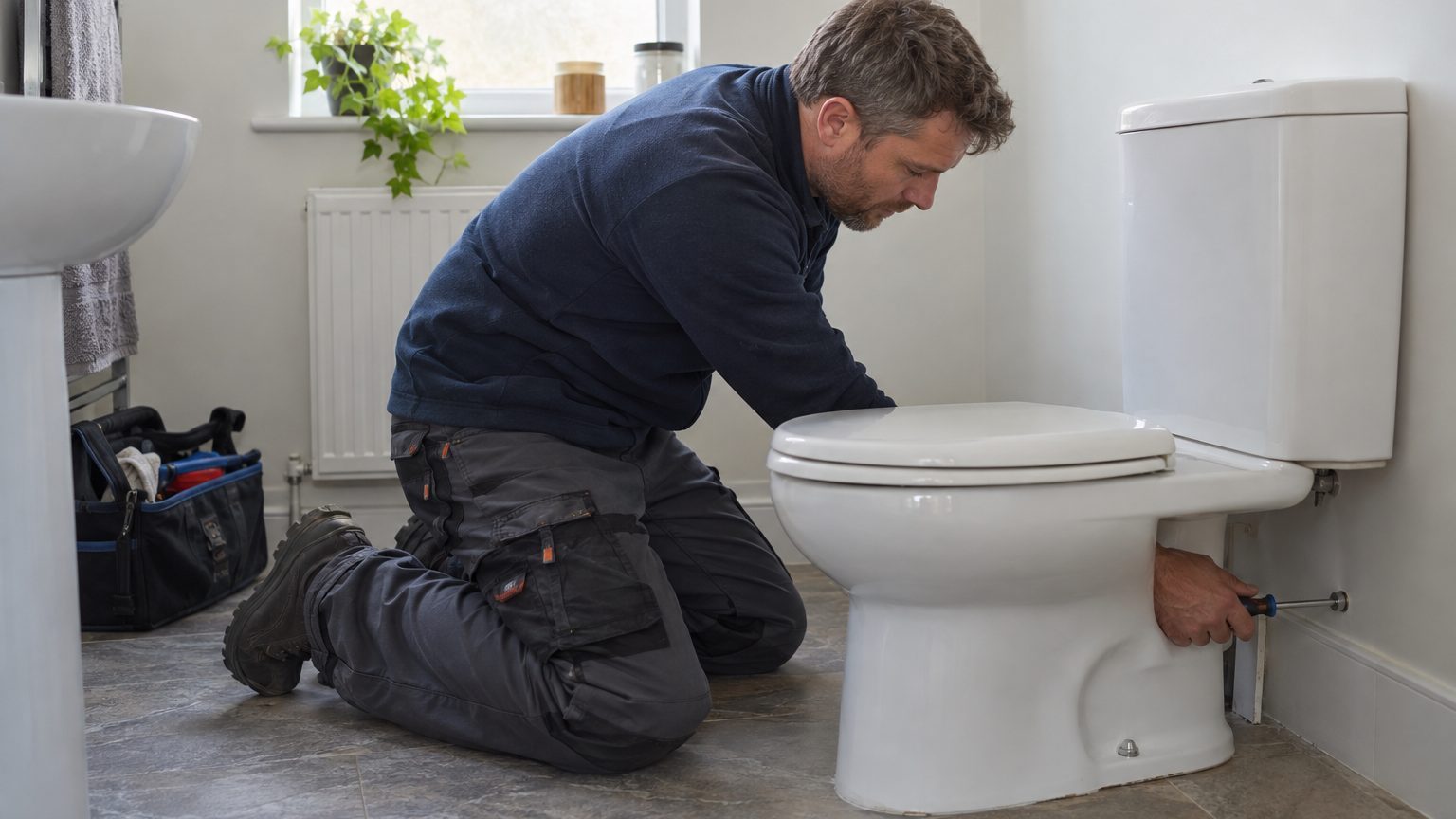
A toilet seat that slides sideways every time you sit down is almost never broken. The bolts have worked loose, or the fixings were never quite right for your pan, and a ten-minute job with a screwdriver and a spanner will usually sort it for good.
Mine did this for months before I did anything about it.
- Loose toilet seats are usually caused by bolts that have worked loose, not broken parts.
- Holding the bolt head still while tightening the nut from underneath stops the bolt spinning.
- Worn fixings, missing rubber bumpers and mismatched seat sizes are the most common reasons a seat won’t stay put.
Why the seat wobbles in the first place
Most seats are held on by two bolts that pass through holes in the back of the pan, with a nut underneath (or a plastic wing nut, depending on the design). Every time someone sits, stands, or shifts their weight, those bolts take a small sideways knock. Over a few months, that repeated movement loosens the nuts, and once there is a little play, the seat starts to slide and the whole thing speeds up.
The fixings themselves are often the real culprit. Plastic bolts and nuts are common on cheaper seats, and they can stretch, strip their threads or go brittle with age. Cleaning products don’t help, since strong bleach-based cleaners left sitting around the hinges can weaken plastic and corrode metal parts over time.
There is also the matter of fit. Pans vary in the spacing of their bolt holes and in their overall shape, so a seat that is slightly too narrow or too wide will never sit square. If it keeps shifting even when the bolts are tight, the seat may simply be the wrong size for the pan.
Check the hinge caps too.
Tightening it properly, step by step
You need very little: a flat-bladed screwdriver, an adjustable spanner or pliers, and an old towel to kneel on. Start by flipping up the plastic caps at the back of the seat, which cover the bolt heads. A fingernail or the tip of the screwdriver will lever them open, and they usually hinge rather than pop off.
Underneath, you will see the top of each bolt. Hold the bolt head still with the screwdriver while you reach behind the pan to tighten the nut from below. This is the step people skip, and it is why the bolt just spins round and round. If you cannot get your hand behind comfortably, a torch and a pair of long-nosed pliers make light work of it.
Before you tighten fully, line the seat up with the rim of the bowl. Sit it centrally, with an even gap around the edges, then snug each side a little at a time, alternating left and right as you would with a car wheel. Tighten until firm, but stop there. Cranking plastic fittings as hard as you can is a reliable way to crack them, and a cracked pan is a far costlier problem than a wobbly seat.
Give the seat a good shove sideways when you have finished. A small amount of movement, perhaps a few millimetres, is normal with some designs. Anything more than that means you need to look further.
When tightening doesn’t hold
If the nut keeps working loose, the fixing is probably worn. Replacement bolt sets are inexpensive at any DIY shop and are often sold in universal packs. Stainless steel or brass are better choices than plastic if your seat allows it, though check the fitting is compatible with your hinge before you buy. Take the old bolt along if you can, as comparing the thread and length side by side saves a second trip.
Slotted holes are a different matter. Some pans have an oval slot rather than a round hole, which lets the bolt slide forward and back and so allows the seat to drift. A pair of rubber or plastic washers placed above and below the pan hole can add grip, and a little extra friction is often all it takes.
Some seats have an adjustable hinge with a slot for fine positioning. Loosen it, centre the seat, then tighten with the seat held in place. A lopsided seat sat on a tightened bolt will always creep back to where the pan pulls it.
Rubber bumpers matter more than you would think. The small round pads on the underside of the seat, which rest on the rim, wear down or fall off, and without them the seat rocks on the porcelain. They stick on with adhesive, and replacements are cheap. A missing pad on one side is a common reason for a seat that tilts even when the bolts are tight.
Replacing the whole seat
Sometimes a new seat is the honest answer. If the hinges are cracked, the seat has warped, or the shape never matched your pan, no amount of tightening will cure it. Measure before you buy: the distance between the bolt holes, the width of the pan at its widest point, and the length from the hinge to the front of the rim. Most pans fall into a handful of standard shapes (round, square, D-shaped), and a measured match beats a guess.
Soft-close seats tend to use a bottom-fix design, where the bolts are reached from underneath and the seat lifts off with a button or clip. That makes cleaning easier, and it makes loosening less likely, since the fixing is clamped from beneath.
Keeping it tight for good
A drop of thread-locking fluid on the bolt threads, sold in small tubes for a few pounds, is a tidy fix for a nut that keeps backing off. Use the removable, low-strength type, so you can still undo it next year. Failing that, a thin wrap of plumber’s PTFE tape round the thread adds enough grip to hold most nuts in place.
Rinse hinge areas with plain warm water and a little washing-up liquid rather than harsh cleaners, and recheck the bolts every few months as part of your regular clean. It takes a minute, and it catches the wobble before it begins.
One last thing about the bolts: many seats come with a spare set of nuts in the box, and the instruction leaflet usually lives in the same bag. Keep it in the bathroom cabinet and the next replacement is already half done.