
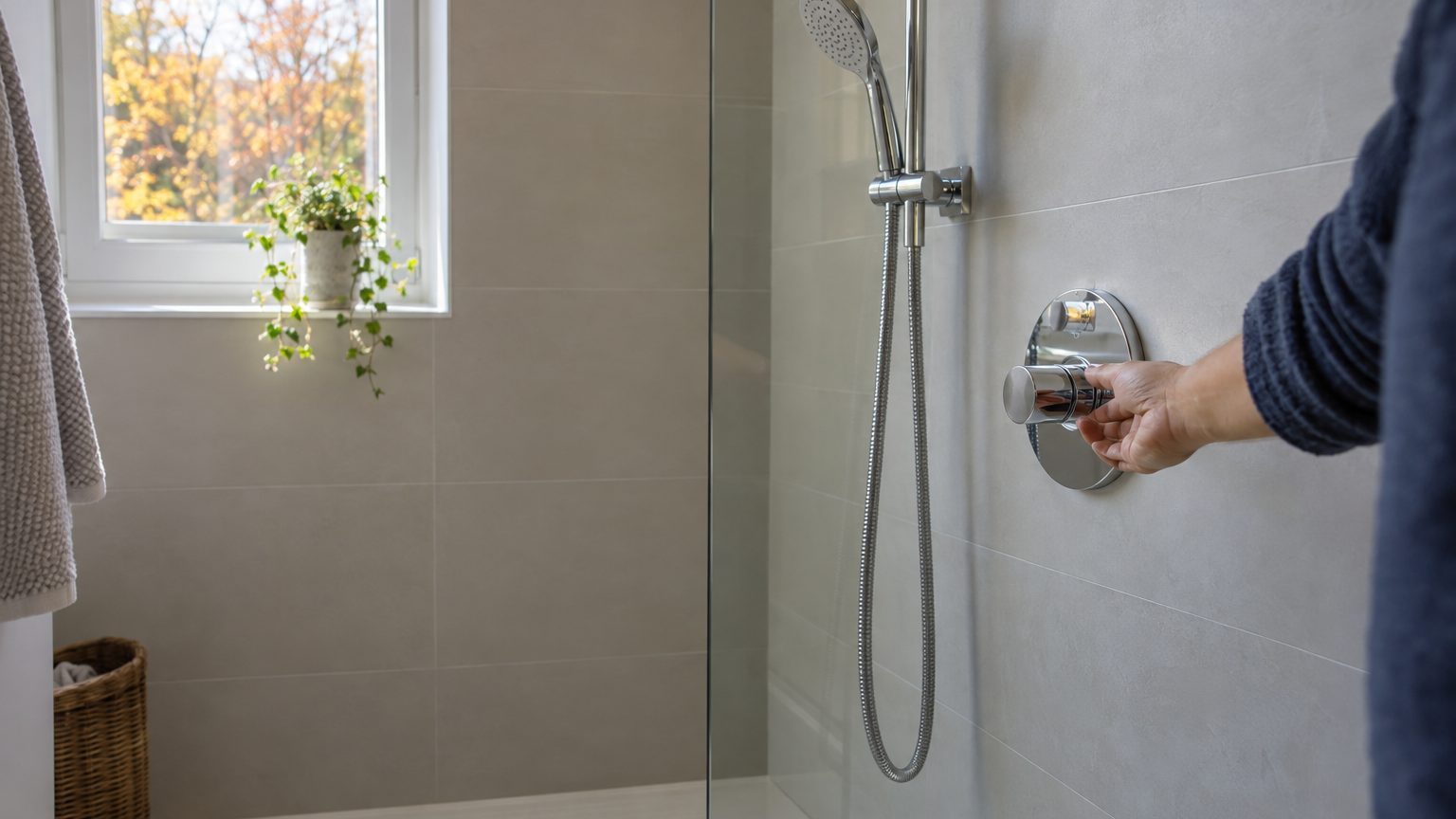
A shower that swings between scalding and icy is almost always down to one of four faults: a worn thermostatic cartridge, a mixer valve clogged with limescale, a boiler or hot water cylinder struggling to keep up, or pressure drops caused by someone else using water elsewhere in the house. Each has its own tell-tale sign, and two of the four can be sorted at home for the price of a bottle of white vinegar.
Start by noticing the pattern.
- A worn or limescale-clogged thermostatic cartridge is the most common cause of a shower swinging between hot and cold.
- A partially closed isolation valve or blocked inlet filter can create uneven pressure between the hot and cold supplies.
- A combi boiler or hot water cylinder that cannot keep pace makes hot water run out after several minutes.
Reading the clues before you pick up a spanner
When the temperature lurches only when the washing machine starts or someone flushes the loo, you are looking at a pressure problem. When it wanders on its own, with nobody else using water, the fault lies in the shower valve or the heating system itself. And if the water runs hot for a minute, then turns cold and stays cold, your hot water supply is probably running out.
Make a quick note over a few mornings. Does it happen at the start, in the middle, or at random? Is it worse in winter? A few scribbled observations on the back of an envelope will save you a good deal of guessing, and they are exactly what a plumber will ask for if you end up calling one.
Cause one and two: the valve itself
Most mixer and thermostatic showers contain a small cartridge that blends hot and cold water. Over the years, limescale builds up inside it, particularly in hard water areas, which covers much of the south and east of England. A gummed-up cartridge cannot react quickly, so the temperature overshoots one way, then the other.
Descaling comes first, and it is cheap. Switch off the water supply to the shower (isolation valves are usually near the unit, or you can turn off at the stopcock), remove the cartridge following the manufacturer’s instructions, and soak it in a half-and-half mix of white vinegar and warm water for an hour or two. Rinse, refit, and test. Do not use anything harsher than vinegar on rubber seals, as strong descalers can perish them.
Cartridges wear out.
If descaling does not help, the cartridge itself may be tired, with seals that no longer sit properly or a wax element that has lost its spring. Replacement cartridges are sold for most mainstream shower brands, so take the old one with you or note the model number from the valve, and match it exactly. Fitting one is usually a twenty-minute job with an Allen key or adjustable spanner, though if you are unsure, a plumber can do it quickly.
The showerhead and hose deserve a glance too, because partially blocked nozzles can alter the flow and make the blend feel erratic. Unscrew the head, leave it in a bowl of vinegar and water overnight, and rinse it well. It costs almost nothing, and it often improves the spray as well.
Cause three: hot water that cannot keep pace
If the water turns cold after several minutes, the trouble may be upstream. With a hot water cylinder, a small tank or a faulty thermostat on the cylinder can leave you with less hot water than you think. Cylinders are generally set to around 60°C to keep bacteria such as legionella at bay, so a cylinder running well below that is worth investigating.
Combi boilers behave differently. They heat water on demand, so a fluctuating temperature can point to a scaled-up heat exchanger, a failing diverter valve, or a flow rate that is simply too low for the boiler to fire steadily. Many combis cut in and out if the water flow drops below a minimum threshold, and the result is the classic hot-cold-hot sandwich. If you suspect any of this, leave it to a Gas Safe registered engineer, who can check the registration on the official Gas Safe Register at gassaferegister.co.uk. Gas appliances are not a place for experiments, however handy you are.
Electric showers have their own quirk, of course. Their heating element warms water as it passes through, so if the flow is too strong the water runs cooler, and if it is too weak the shower may cut out. Turning the flow down a notch often steadies the temperature at once.
Cause four: pressure that dips and dives
Older homes often have a mixer shower fed by uneven pressure on the hot and cold sides. Flush a toilet or run the kitchen tap and the cold supply dips, so the shower suddenly gets hotter, sometimes uncomfortably so. A thermostatic valve is designed to compensate, which is why the fix for many households is replacing a basic manual mixer with a thermostatic one.
Check the simple things first. Make sure the isolation valves on the shower’s supply pipes are fully open, because a half-closed valve creates exactly this kind of imbalance, and it happens more often than you would expect after a bit of DIY or a plumber’s visit. A partially blocked filter in the shower inlet can do the same. Many showers have a small mesh strainer behind the connection, which can be lifted out, rinsed under the tap, and put back.
When the pressure on one side is persistently low, a shower pump may be the answer, but those need to be chosen to suit your system type, and fitting one is a job for a qualified plumber. Pumps cannot be used with every kind of supply, and getting it wrong can cause more trouble than it solves.
A sensible order of attack
Work from cheapest to dearest. Clean the showerhead, check the isolation valves, clear the inlet filters, descale the cartridge, and only then buy a replacement. If the fault is still there, bring in a professional for the boiler or cylinder. A plumber will thank you for arriving at the call-out with notes rather than guesses.
One last safety point: if anyone in your household is elderly or very young, set the cylinder or boiler thermostat sensibly and consider a thermostatic valve with a maximum temperature stop, usually set near 38°C to 41°C, since a sudden hot surge burns far faster than most people expect.