
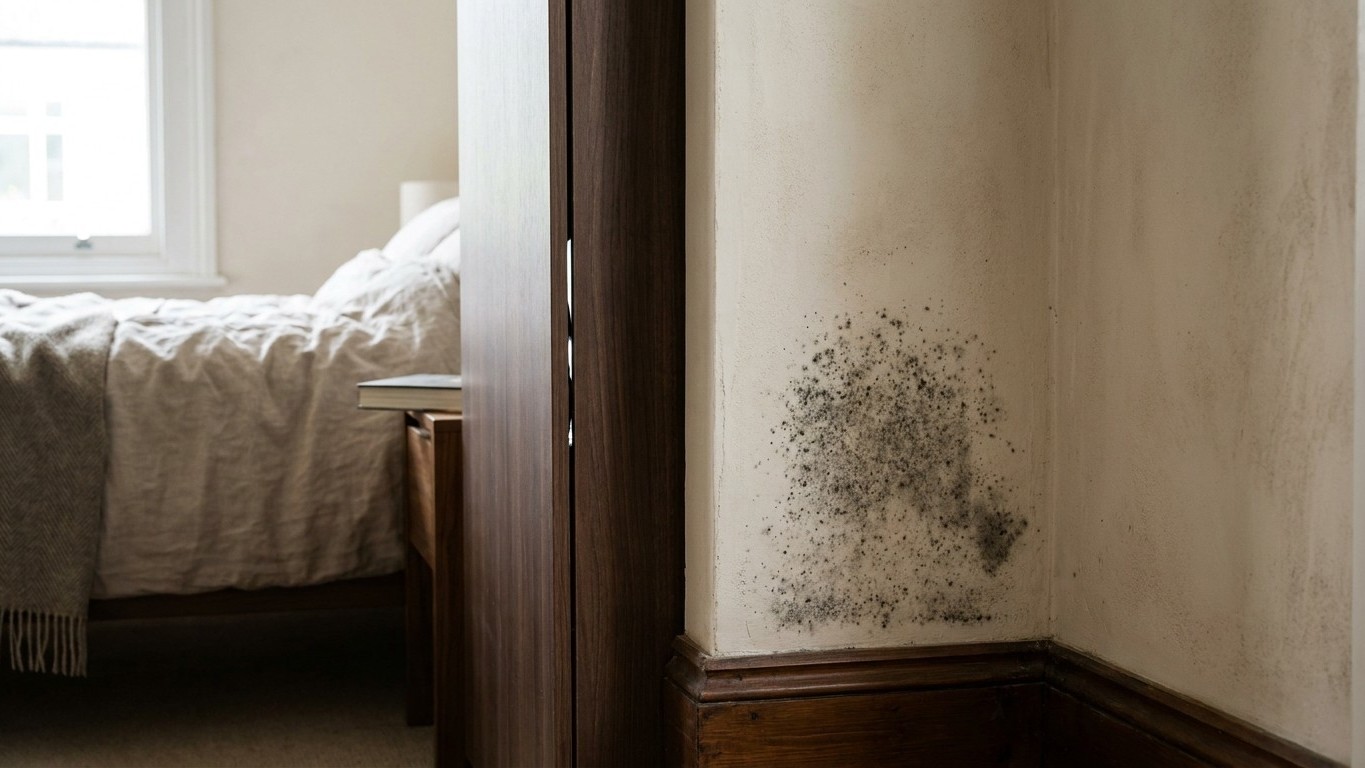
Four radiators’ worth of washing, most evenings, all winter. That was the routine until the first proper cold snap of the year forced me to shift the wardrobe six inches so I could get at the skirting board behind it, and there it was: a patch of greyish-black speckling the size of a dinner plate, right where the wardrobe had been sitting flush against an outside wall. No smell had warned me. No damp patch on the visible plaster. Just months of quiet, hidden growth on the one bit of wall nobody ever looks at.
What I’d been doing, without realising it, was pumping litres of water vapour into a small room every single week and giving it nowhere sensible to go. Drying clothes indoors can add 10 to 15 litres a week to the air in an average home, and condensation is caused when warm, moist air hits a cold surface such as an external wall or a wardrobe pushed up against one. Four loads a week on the radiators had turned my bedroom into exactly that sort of moisture factory, and the coldest, stillest corner of it, tucked behind a wardrobe nobody moved from one year to the next, paid the price.
Key takeaways
- A common household habit created the perfect conditions for mold growth in an invisible location
- The physics behind why radiator drying backfires—and it’s not what most people think
- Why furniture against external walls becomes a dangerous ‘blind spot’ that nobody checks
Why the radiator habit backfires so badly
It feels efficient, doesn’t it? The heating’s already on, so why not sling a few jumpers over the rail and let them dry for free. Except that’s not quite how it works. Drying clothes on radiators makes your boiler work harder to heat your house and cost almost as much as using a tumble dryer, whilst creating a lot of condensation. You’re not saving money so much as swapping one bill for another, invisible one, paid out in dampness rather than pounds.
Chartered surveyors have been flagging this for years. Drying clothes on radiators, keeping windows shut during cooking, and not heating the home enough can all make condensation more likely, alongside incorrectly vented tumble dryers, overcrowding, and not opening windows when showering. The mechanism is simple physics rather than anything mysterious: when indoor temperatures drop or humidity is already high, water vapour can condense into droplets on windows, walls and other cold surfaces, creating the conditions mould needs to grow. A radiator loaded with wet washing releases its moisture straight into the room’s air, and that air then drifts to the coldest spot it can find, which is very often an external wall shielded from any airflow by a large piece of furniture.
The wardrobe wall: a mould blind spot
Furniture pushed against outside walls creates what surveyors sometimes call a cold bridge trap, though I’d never heard the term until I started reading up on what I’d found. Condensation forms when warm, moisture-laden indoor air meets a cold surface, typically an external wall, a window reveal, the corner of a room, or behind furniture pushed against an outside wall, and the moisture in the air turns to water on that cold surface. Behind a wardrobe, there’s barely any air movement at all, so that moisture just sits there, day after day, with nothing to dry it out.
Surveyors and damp specialists point to the same blind spots again and again. Check behind large furniture, inside built-in wardrobes on external walls, and around cold corners, since black mould around these hidden areas is common because air circulation is poor. Wardrobes, chests of drawers, and headboards flush against an outside wall are the usual culprits, and unheated spare rooms are nearly as bad, because a room that’s rarely warmed stays that little bit colder than the rest of the house, which is exactly what damp air is looking for.
The species growing on my skirting board was probably one of the common household types rather than anything exotic. Common indoor mould species include Aspergillus and Cladosporium, which thrive in areas with poor ventilation such as behind furniture, in high-moisture rooms such as bathrooms or kitchens and on the walls of rooms that have cold spots, such as external facing walls. It’s not pleasant to discover, and it’s not something to shrug off either. Damp and mouldy environments can cause or worsen respiratory problems, trigger asthma attacks, and provoke allergic reactions such as a runny nose, sneezing, red eyes and skin rashes, according to NHS and government guidance, and those most at risk include people with existing chest conditions, small children and anyone with a weakened immune system.
What actually works, and what to try instead
None of this means banishing indoor drying entirely, which isn’t realistic for most of us in a British winter with no garden to hang washing in. The fix is about where and how, not whether. A proper clothes airer earns its keep here far more than a radiator ever will, because using a drying rack instead of hanging clothes on radiators allows air to circulate more effectively around the laundry rather than trapping steam against a warm metal surface. Set the airer up somewhere with a bit of ventilation, ideally with a window cracked open and the door shut, so the moisture has an exit route rather than drifting straight into your bedroom air and onto that wardrobe wall.
A few habits make a genuine difference, and none of them cost much:
- Keep main rooms at a steady 18 to 21°C rather than letting them go cold and cranking the heat up sporadically, since a gently warm house holds less condensation risk than a cold one that’s suddenly heated
- Open trickle vents or crack a window for ten minutes daily, even in winter, to let trapped moisture escape
- Pull furniture a few inches away from external walls to let air move behind it, particularly wardrobes and beds on cold gables
- Wipe down any wet windows or sills each morning rather than letting the water sit and evaporate back into the room
As for my patch of mould, it came off with a fungicidal wash carrying a Health and Safety Executive approval number, wiped on with the window open and the door shut so the spores didn’t travel further into the house. The bigger job was fixing the habit that caused it. The wardrobe now sits a good three inches proud of the wall, and the washing goes on an airer by a cracked window instead. My heating bill hasn’t budged either way, which rather proves the point that the radiator was never really saving me anything in the first place.
Sources : sussexdampexperts.com | gcha.org.uk