
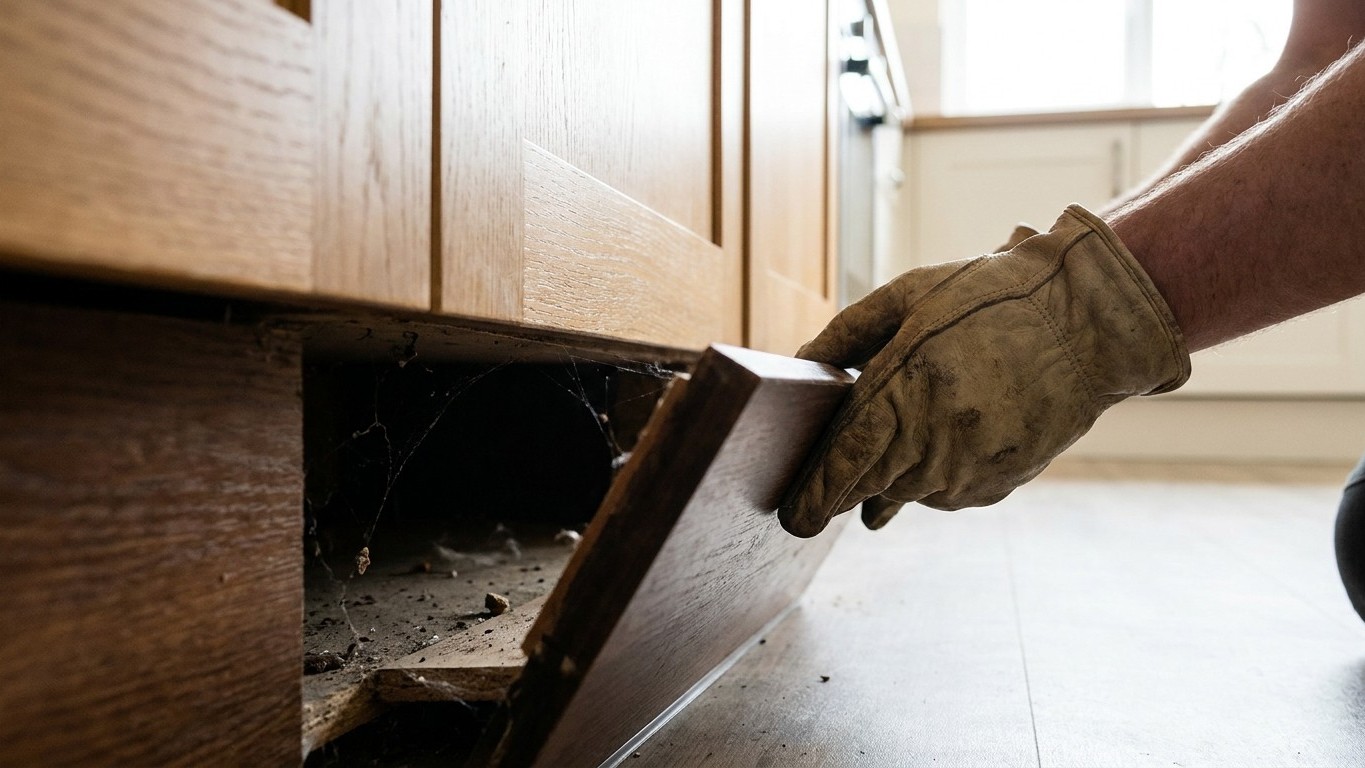
What greeted me when I finally prised that plinth away wasn’t a plague of insects or a family of spiders, as I’d half expected. It was worse, in a domestic sort of way: a run of greasy black smudges along the timber, a scattering of dark, rice-shaped droppings, and a faint whiff that no amount of kitchen spray had ever quite masked. Mice. Not one, judging by the mess, but a small colony that had clearly been treating the void beneath my units as a motorway service station for months, possibly years, before I ever thought to seal that draughty gap.
The foam hadn’t caused the problem, to be clear. It had simply forced me to look at what was already there. And once I started reading up on it, I realised my kitchen was far from unusual.
Key takeaways
- A routine draught-sealing project revealed something alarming hiding just three feet away
- Kitchen plinths are the preferred motorway for mice—and the signs were there all along
- Standard expanding foam stops draughts but won’t stop determined rodents from chewing through
Why the plinth void is prime real estate for wildlife you didn’t invite
Kitchen kickboards hide a space that’s dark, warm and almost never disturbed, which happens to be exactly what a mouse is looking for on a cold night. Kitchen kickboards can hide mouse activity because the void beneath units is dark, warm and rarely disturbed. Pest control professionals know this so well that it’s one of the first places they look. During a professional inspection, a pest controller will usually check beneath the kitchen sink and behind the plinths first. The reason is depressingly simple: these spaces commonly contain pipe gaps, and occupants rarely clean them, so the accumulated evidence can reveal both the history of the problem and the likely entry route.
It isn’t just an isolated hidey-hole either. Kitchen kickboards can hide long mouse routes, as mice may travel behind units for some time before entering a cupboard or crossing the room, and droppings under or behind kickboards often suggest activity along the full run of fitted units. That greasy tramline I found wasn’t decoration; it was a superhighway, built up from countless nightly trips, each mouse depositing a little more oil and dirt from its coat as it brushed the same route. And they don’t need much of an opening to get started: these holes don’t need to be very big at all for mice to squeeze through, and it’s said that if you can fit a biro pen in the hole, a mouse would fit through too.
This isn’t some rare misfortune reserved for tumbledown cottages, either. UK pest controllers deal with this constantly, year in, year out. UK pest controllers receive roughly 80,000 callouts for mice in homes each year, and when you widen the lens to local authorities, the numbers get properly startling: local authority pest control services responded to 291,132 pest-infested homes in a recent year, with a massive 91% of these callouts related to rodents like mice and rats. Kitchens, with their food debris, warmth from appliances and forest of pipework, are ground zero for nearly all of it.
Why my well-meaning foam job wasn’t the fix I thought it was
Here’s the bit that stung a little. I’d genuinely believed that squirting foam into a gap was a tidy, permanent solution, the kind of thing my own grandmother would have approved of for its thrift and simplicity. Ordinary DIY expanding foam, though, isn’t designed with rodents in mind at all. It’s built to insulate and to stop air movement, and while it can plug a hole beautifully for a draught, it offers precious little resistance to a mouse’s teeth. While it might seem like a quick fix, expanding foam is not a foolproof solution for preventing mice from entering your home; while it can temporarily block entry points, expanding foam alone often fails to effectively deter mice in the long run.
What’s more, sealing one visible gap does nothing for the network of routes running behind it. The same mice will use wall cavities, pipe runs and under floor voids to reach other rooms, the loft and the utility area, so once the kitchen activity is under control, you need to look for the gaps that let them in: holes around pipework under the sink, gaps behind the kick boards, damaged airbricks, and spaces where cables enter. My foam had blocked a draught. It had done nothing whatsoever about the mice already living three feet away, behind a panel screwed on with four little clips.
There are proper rodent-barrier foams on the market now, formulated with denser cell structures and sometimes additives specifically meant to resist gnawing, and they’re a sensible upgrade if you’re tackling a genuine entry point rather than just a chilly ankle. But no foam, however good, replaces the basic detective work of finding out what’s already inside before you seal it in.
What to actually do if you’re pulling your own plinth off this weekend
Before you touch anything, take a proper look rather than a squeamish glance. If you can remove a plinth without damaging the kitchen, check the floor, pipe penetrations, cabinet corners and appliance cables for droppings, smear marks, damaged material or visible gaps. Clean the area thoroughly with hot soapy water rather than a dry brush, since dried droppings can carry pathogens best left undisturbed and unswept into the air.
If you do find evidence, resist the urge to reach straight for poison. It feels decisive, but it carries real risks. Poison baits should really be your absolute last resort, since they pose a serious risk to pets and local wildlife that might eat the poisoned mouse. Traps or locked bait stations placed along the actual routes work far better, and far more safely, than scattering bait where a curious dog or hedgehog might find it. Locked bait stations belong on the routes mice use to reach the cupboard, with good spots in a kitchen being under the units in the kick board void, behind and under appliances like the fridge, oven and dishwasher.
Once you’ve dealt with the immediate residents, the sealing job needs to be more thorough than a squirt of foam behind one plinth. Mice can squeeze through a gap about the width of a pen, so seal what you find with wire wool and a suitable filler. Wire wool matters here because mice can’t gnaw through it the way they can chew through soft foam or even hardened sealant given enough patience. Pack it into the gap first, then finish over the top with your filler or foam for a neat appearance. It’s a fiddly half hour with a torch and a pair of marigolds, but it’s considerably cheaper, and considerably less alarming, than discovering the same thing again in another three weeks.
Sources : sprayman.co | forums.moneysavingexpert.com