
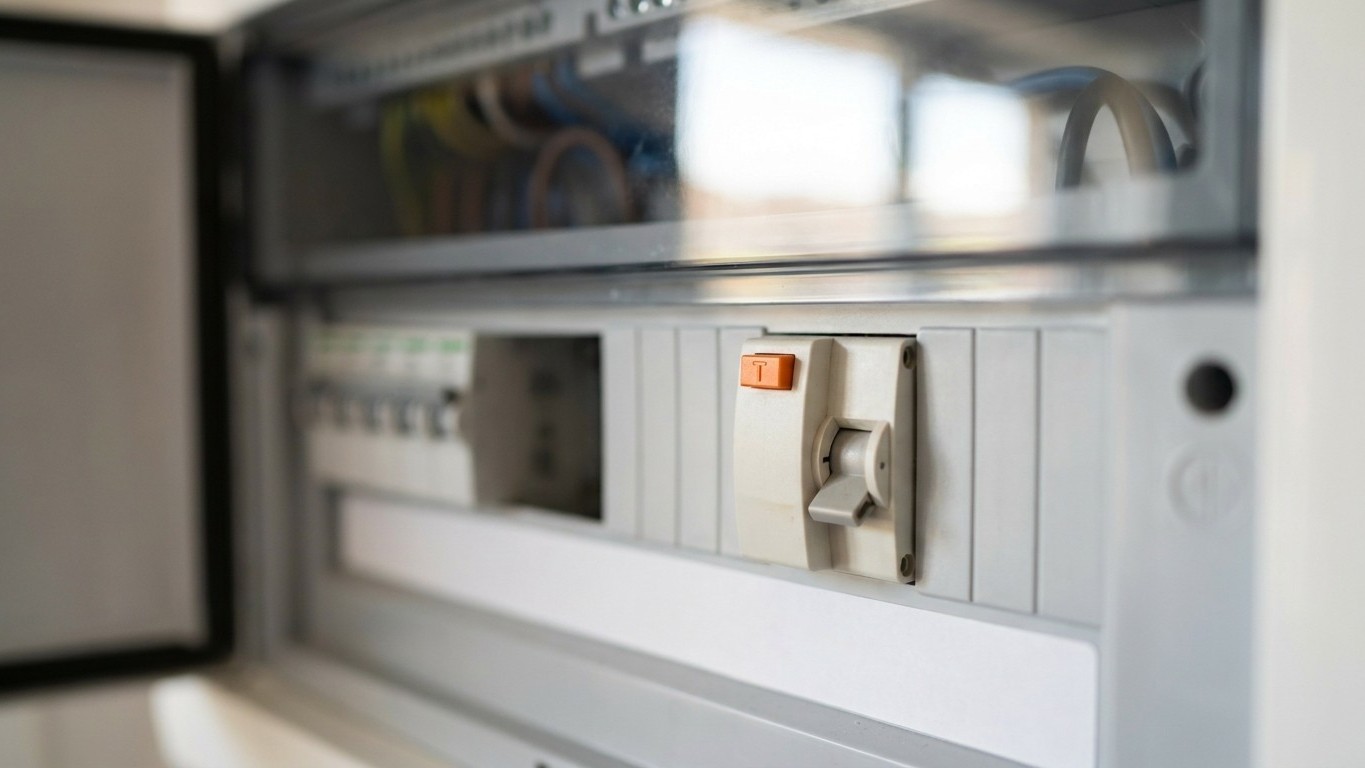
That little button marked “T” or “Test” sitting on your consumer unit isn’t there to reset a tripped circuit at all. It’s an RCD test button, and your neighbour is doing something far more sensible than it might first appear: he’s checking that his residual current device, the mechanism that could genuinely save his life during a fault, still works properly. Manufacturers recommend testing every three months by pressing the test button, and once you understand why, you’ll probably want to start doing the same.
Key takeaways
- A hidden mechanism in your consumer unit could silently fail—and most homeowners never test it
- Your neighbour knows something about electrical safety that could protect your family from 70+ preventable deaths annually
- One button press every three months takes 30 seconds and reveals whether your home’s most critical safety device actually works
What that button is actually testing
An RCD (Residual Current Device) sits inside most modern consumer units, and it monitors the electricity flowing out on the live and returning on the neutral. If there is an imbalance, it assumes some current is leaking somewhere it should not be, often to earth, which can happen through damaged cable insulation, moisture getting into outdoor equipment, or a fault in an appliance. When it senses that leak, typically the kind that would otherwise pass through a person, it cuts the power in milliseconds. It’s genuinely one of the cleverest bits of kit hiding behind that plastic door in your hallway cupboard.
The trouble is, an RCD that sits quietly for months or years without ever being asked to trip can seize up mechanically, rather like a garden gate hinge that’s gone stiff from disuse. These devices are not tested during everyday use. In many cases, the internal mechanism only moves during a fault or during a manual test. If it seizes or sticks, the unit may not trip when you need it most. That’s precisely why the test button exists: this is normal and correct behaviour. The test button intentionally creates an imbalance to confirm the device works properly. Your neighbour presses it, the switch clicks down, the power drops on that circuit for a second, and he flips it back up. Job done for another three months.
It’s worth knowing that this pressing routine and a full electrical inspection are not the same thing. The test button on an RCD simulates a small earth fault inside the device and lets you confirm the mechanical trip still releases. It does not measure trip current or trip time, that is what an electrician does with an RCD tester at an EICR. The button check is the quick, free, do-it-yourself version. The professional version, using calibrated equipment, checks something rather precise: it should trip within 40 ms of a 30 mA leak to earth, and that timing genuinely matters for preventing a fatal shock.
Why three months, and how to do it properly
The quarterly interval isn’t arbitrary. The Electrical Safety Council recommends testing your RCD every three months to ensure it’s working correctly, and the process really couldn’t be simpler. Testing your RCD is simple and safe, it only takes 30 seconds and requires no tools or electrical knowledge. Find the button, marked T or Test, on the RCD or RCBO switch in your consumer unit, give it a firm push, and listen for the click as the switch drops.
A couple of practical points make the ritual less disruptive. Before you press anything, avoid testing when it would cause inconvenience, during cooking, when working on computers, or when medical equipment is in use, since the whole point is that the circuit genuinely loses power for a moment. If you’re testing multiple RCDs on a larger board, doing them all in one sitting saves you fiddling with the consumer unit repeatedly, and picking a memorable date helps the habit stick. One electrician I came across suggests tying it to something you already do every few months, the same weekend as a seasonal garden tidy, for instance, so it never slips your mind. Some households jot the date on the inside of the consumer unit door, which is a tidy bit of housekeeping that also gives an electrician a quick history if they ever need to look at the board.
What should actually happen is refreshingly binary. Push the button, and the switch should drop immediately, no delay, no second press required. Push it back up, and the power returns straight away. If that’s what happens, you’ve confirmed the mechanical trip still releases properly. If nothing happens at all, that’s the result that matters most: a test button that does not trip is a broken RCD. Do not use that part of the installation until it is replaced. Call an electrician the same day. The same urgency applies if the switch trips but refuses to reset, or if it starts tripping randomly during ordinary use rather than only when you press the button.
Why this matters more than people realise
The scale of the risk RCDs are guarding against is sobering. Around 70 deaths and 350,000 injuries occur in UK homes annually from faulty electrics and electrical equipment, highlighting the importance of protective devices. Against that backdrop, a device that can cut power in a fraction of a second is doing serious work, but only if it’s actually functioning. One Bristol-based electrical firm has noted something rather telling: official research has found that RCD’s are about 97% reliable, but this figure would likely be higher if they were tested more often by homeowners. Put another way, roughly three in every hundred RCDs might fail when called upon, and regular testing is one of the few ways an ordinary homeowner can catch that before it becomes a genuine emergency.
The button test doesn’t replace a proper professional inspection, though. For that, you’re looking at an EICR carried out by a qualified electrician using calibrated equipment that measures the exact trip time rather than simply confirming the mechanism moves at all. A proper EICR with instrument-measured trip times every 5 years (private rented) or 10 years (owner-occupied) is the electrician’s job. Landlords, in particular, have a clear obligation here, since inspections for rented properties are required on a stricter schedule, at change of tenancy or every five years, whichever comes first.
If your consumer unit doesn’t have a test button at all, that’s worth flagging too. If you can’t find a test button, your consumer unit may not have RCD protection, and older boards, particularly anything installed more than fifteen years ago, may be lacking modern shock protection entirely. Your neighbour’s quarterly ritual, odd as it might look from over the garden fence, is genuinely one of the cheapest and most effective safety habits going. It costs nothing, takes half a minute, and gives real peace of mind that if a fault ever does occur in his wiring, the switch that’s meant to save him actually will.
Sources : electricalfaultsfixed.com | wyelectrical.co.uk