
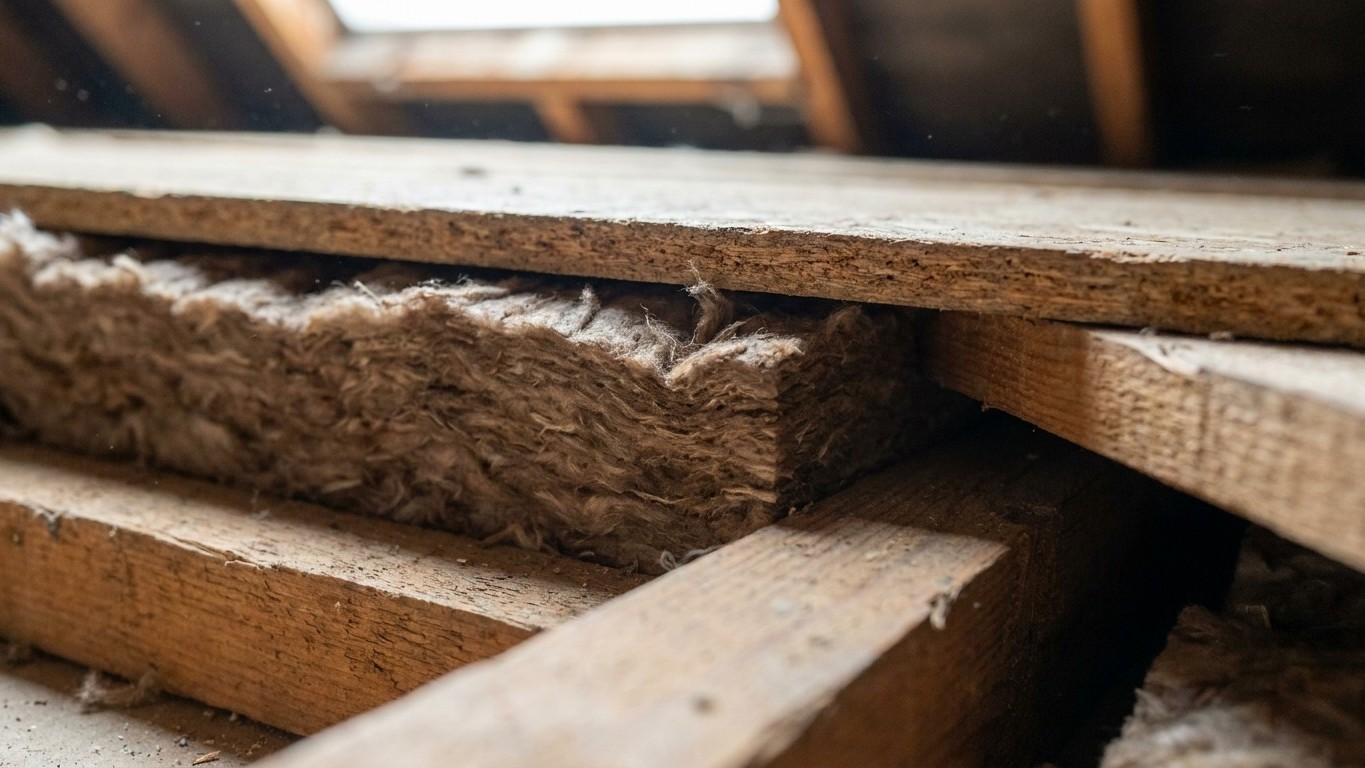
Those 270 millimetres of fluffy mineral wool I’d been so proud of, bought with a grant voucher and laid out over a whole Saturday, had been squashed down to the depth of my joists: barely 100mm. I hadn’t removed a single roll. I’d just screwed chipboard straight on top, box by box, congratulating myself on finally having somewhere to put the Christmas decorations. It took the first proper cold snap, standing in the bedroom below with my coat still on, staring at the ceiling, to understand what I’d actually done to that insulation.
Mineral wool doesn’t insulate because of the wool itself. It insulates because of the air trapped between the fibres, millions of tiny pockets that slow heat from escaping through your roof. Compressed insulation loses much of its effectiveness because trapped air pockets are reduced, which can increase heat loss and reduce the home’s energy efficiency. Flatten that fluffy layer under a sheet of chipboard and you’ve essentially built yourself a very expensive, very ineffective floor.
Key takeaways
- One Saturday of loft boarding destroyed 270mm of insulation in seconds—but the damage took a cold snap to reveal
- 65% of UK loft users have unknowingly crushed their insulation, losing as much heat as an entire power station
- Moisture is quietly building inside the compressed layer, threatening the timbers holding up your ceiling
The numbers are worse than you’d think
I assumed a bit of squashing wouldn’t matter much. I was wrong, and not by a small margin. Research from the National Physical Laboratory found that compressing loft insulation reduces its effectiveness by 50%, and when 270mm-thick insulation is compressed to 100mm, its thermal resistance drops from 6.11 m²·K/W to just 3.09 m²·K/W. Other analyses put the damage even higher: compression from 270mm to 75mm results in a reduction of thermal resistance of 61%, which across the whole UK amounts to a reduction equivalent to switching on one whole power station. That’s not a trivial loss you can shrug off with an extra jumper. It’s the difference between a loft that’s doing its job and one that’s basically decorative.
What stunned me most, sitting with my tea going cold, was learning I wasn’t remotely alone in this. A survey found that while 82% of households use their lofts for storage, only 26% knew that compressing insulation makes it less effective. A separate large-scale study came to nearly the same grim conclusion: Carbon Trust sponsored the biggest ever survey of loft users, with 6,000 responses, finding that 65% have fully or partially boarded their loft at joist height, typically squashing or removing the insulation down to 75 or 100mm, and only 26% knew that squashing loft insulation was bad for it. My mistake was, apparently, the national pastime.
Why the cold snap told the real story
What I felt that night wasn’t just draughtiness. It was something more specific, and rather worrying once I understood it properly. Beyond simply reducing thermal performance, boarding directly onto joists can create interstitial condensation: warm, moist air rises from the living spaces below, travels through the now-inefficient compressed insulation layer, and when it reaches the cold underside of the loft boards, its temperature drops rapidly, releasing moisture as condensation on the cold surface. That process, left unchecked, doesn’t just waste heat. It builds a condensation trap within the insulation layer, leading to dampness that further degrades the material’s performance and can promote mould growth and rot in the timber joists. I’d been so focused on tidy storage boxes that I’d overlooked the fact I was slowly inviting damp into the very timbers holding my ceiling up.
The building regulations, for what it’s worth, never intended for boards to sit flush on joists at all. Part L of the UK Building Regulations sets loft insulation thickness at a minimum of 270mm of mineral wool to achieve a U-value of 0.16 W/m²K. Ordinary ceiling joists, though, are nowhere near deep enough to hold that much wool without help. Ceiling joists are typically only 100mm deep, or less, while modern insulation recommendations are nearly three times that. Put a board straight across the top and you’ve guaranteed the squashing before you’ve even opened your first storage box.
The fix costs less than you’d think
The remedy, thankfully, isn’t ripping everything out and starting again. The solution isn’t thinner insulation, it’s raising the storage floor above it. Small plastic or composite supports, often called loft legs, screw into the joists and lift your boards clear of the insulation entirely. This gap prevents compression of insulation while preserving its thermal efficiency, and these supports simply screw into the joists, with the loft boards secured on top. Some systems raise the boards a modest amount for lighter storage; others go further. A raised boarding system can lift the deck 170 to 225mm above the joist top, achieving both thermal performance and safe limited storage.
If you’ve already made my mistake, don’t panic and don’t ignore it either. It’s a weekend job, not a rebuild. Lift the boards, check the wool underneath hasn’t gone damp or matted, top it up if it’s thin, then fit raised supports before putting the boards back down. It costs far less than a boiler service and pays for itself in a single hard winter. My own loft is sorted now, boards a good six inches clear of the wool, and that bedroom below hasn’t needed the extra jumper since. The bit nobody tells you, though: even a raised system needs a small gap left at the eaves for ventilation, otherwise you’re just trading a cold problem for a damp one somewhere else entirely.
Sources : squote.app | energysavingtrust.org.uk